Has India become the next big test of the German tunneling giant?
Shrikant Rao
The most revealing development around Herrenknecht today may not be happening beneath a mountain or beneath one of Europe’s great cities, but in the industrial belt north of Chennai.
Herrenknecht has been in India since 2007 and its established Indian operation at Alinjivakkam, on GNT Road in the Ponneri area of Tiruvallur district, has gradually evolved from a manufacturing and service base into something much more substantial. The operation covers project planning, manufacture, assembly, refurbishment, sales and service of tunnelling machines and related equipment.
That operation has already demonstrated what localisation can mean in practice. Herrenknecht manufactured all ten EPB shield TBMs for Chennai Metro Phase 2 within a single year, between July 2022 and July 2023. The achievement says quite a lot about how far its Indian operation has travelled from the days when sophisticated tunnelling equipment was largely something that had to arrive from overseas.
Now comes the next step. Herrenknecht has established a separate Unit-II at Kannigaipair on Periyapalayam Road, also in Tiruvallur district. The new facility, associated with an investment of about Rs 250 crore and expected to create around 400 jobs, takes the Indian manufacturing story into another phase, with large-diameter tunnelling capability becoming increasingly important as Indian infrastructure projects grow in scale.
There is a strategic story behind those developments that is more interesting than the numbers themselves. India has relied heavily on imported TBMs from Germany, China, the United States and other manufacturing centres, while long supply chains can become a vulnerability when major infrastructure projects are working to tight schedules. A larger manufacturing base in India therefore makes commercial sense for Herrenknecht, but it also allows the company to develop a deeper local chain of engineering, components, service, refurbishment and skills.
That could eventually matter more than the additional factory capacity.
The character of the Indian operation is changing. Herrenknecht is no longer simply bringing German tunnelling technology into India; it is increasingly deciding how much of that technology can be manufactured, supported and, perhaps eventually, adapted here.
Deep Roots
For fifty years, Herrenknecht has built its reputation on an unusually difficult form of industrial knowledge. The machine itself is only the visible part of the proposition; behind it sits accumulated experience of geology, cutter technology, pressure management, machine behaviour, logistics, maintenance and the thousands of small decisions that determine whether a tunnel drive becomes an engineering achievement or an extremely expensive problem.
There is an interesting distinction in the company’s history. Martin Herrenknecht established his own engineering business in 1975 and founded Herrenknecht GmbH two years later, in 1977. That engineering enterprise eventually became the company that grew into one of the world’s most influential manufacturers of mechanised tunnelling systems.
Its machines have been associated with projects that have become reference points in the history of underground construction, including the Gotthard Base Tunnel, major European transport projects and some of the world’s most ambitious urban and infrastructure tunnels.
The achievement is not simply that Herrenknecht has built very large machines. It has repeatedly had to make those machines work in conditions where the geology, water pressure, urban density and consequences of failure leave very little room for improvisation.
That is what makes the company such a striking example of the German Mittelstand. Its market has never depended particularly heavily on corporate glamour. The people who buy and operate its machines are engineers, contractors, geologists and public authorities who want to know what will happen when the machine is deep underground, surrounded by rock and groundwater, with an enormous amount of infrastructure and human activity above it.
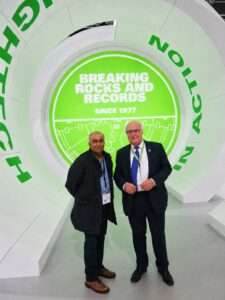
I was reminded of that when I met Martin Herrenknecht at bauma in Munich a few years ago. The conversation had the directness of someone who had spent a lifetime dealing with physical realities that do not respond to PowerPoint presentations — geological uncertainty, machine wear, pressure, risk and the consequences of getting something wrong underground.
My later visit to the Grand Paris Express brought another perspective. Beneath Paris, one of Europe’s great historic cities was acquiring an entirely new layer of mobility, and Herrenknecht technology was part of that transformation. It was difficult not to think about how much of the next generation of urban infrastructure will have to be built below the city rather than above it.
Different Ground
India brings a very different set of conditions to that equation.
Its tunnelling environment combines dense urban development, poorly documented underground utilities in many locations, monsoon conditions, difficult geology, environmental sensitivities and relentless pressure to deliver infrastructure at competitive cost. At the same time, the country is building metro systems, road tunnels, high-speed rail, water infrastructure and new transport links through terrain that has tested tunnelling technology for decades.
Herrenknecht machines are already part of that transformation.
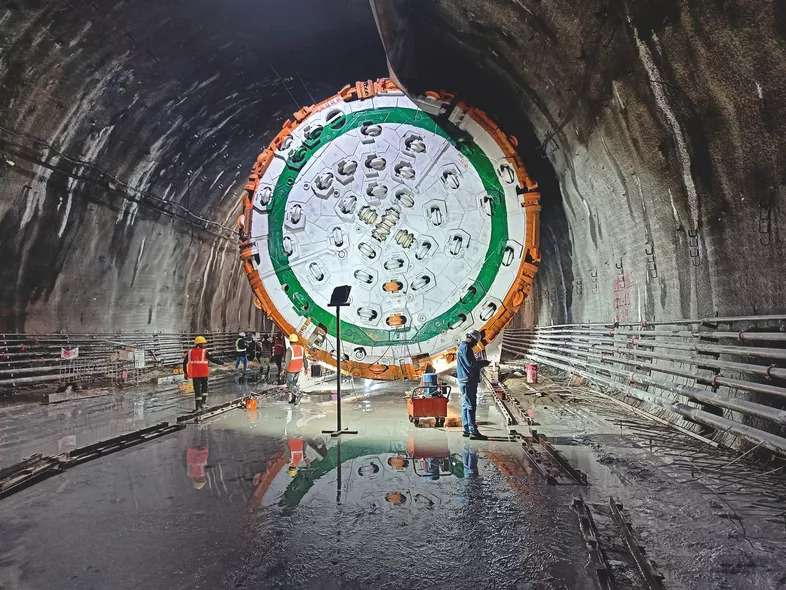
In Mumbai, four Herrenknecht TBMs are being deployed for the Thane–Borivali twin road tunnel project being executed by Megha Engineering & Infrastructures Limited. The machines have cutterheads of about 13.2 metres in diameter, with MEIL describing its 13.34-metre Single Shield machine as the largest diameter TBM deployed for an urban project in India.
The scale is significant, but so is the setting. The tunnels will pass beneath the Sanjay Gandhi National Park, linking Thane and Borivali while reducing the pressure on one of Mumbai’s most congested surface corridors. The first Herrenknecht machine, named Nayak, was launched from the Thane side in April 2026, while the second machine, Arjuna, is being assembled.
The Mumbai–Ahmedabad High-Speed Rail project presents another kind of challenge. Afcons Infrastructure is executing the underground package for the National High Speed Rail Corporation, including the approximately 21-kilometre tunnel between Mumbai and Shilphata and India’s first undersea rail tunnel beneath Thane Creek. Herrenknecht Mixshield technology is part of this effort, bringing German machine expertise together with an Indian contractor that has itself accumulated considerable underground experience.
Then there is the Himalayas, where the engineering story is different again. Two Herrenknecht Single Shield TBMs completed their drives on the Rishikesh–Karnaprayag railway project in 2025, with the first reaching its destination in mid-April and the second completing its drive-in late June. Together, they completed the two parallel tubes of a more-than-20-kilometre tunnel system through some of the most difficult geology encountered in Indian railway construction.
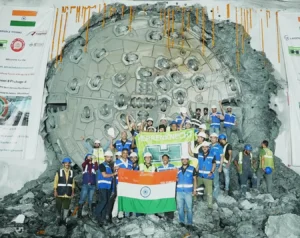
Taken together, these projects show why India is becoming more than a large customer for Herrenknecht. The country is creating situations in which machine technology, Indian contracting capability, local manufacturing and difficult operating conditions are being tested simultaneously.
China Lesson
There is another reason why the Indian manufacturing story has acquired a sharper edge.
In 2024 and 2025, India’s infrastructure industry discovered just how exposed a major project can become when the machine needed to build it is manufactured elsewhere and its movement depends on a foreign supply chain. The most visible example was the Mumbai–Ahmedabad High-Speed Rail project.
Three Herrenknecht TBMs intended for the underground section, including the undersea tunnel beneath Thane Creek, were manufactured at the company’s Guangzhou facility in China. They subsequently became caught up in customs-clearance problems at a Chinese port. Reports in June 2025 warned that the delay could affect the tunnelling schedule of India’s first high-speed rail project.
The machines were German in technology and ownership, the project was Indian, the contractor was Indian, yet a critical part of the infrastructure programme became dependent on a manufacturing and export chain located in China.
The machines eventually began arriving in India in 2026, but the episode had already made the larger point.
It was not necessarily a question of China deliberately withholding TBMs from India. The more important lesson was less political and more practical: India’s infrastructure schedule could be affected by a customs or export decision taken outside the country.
That is a vulnerability no serious infrastructure economy can afford to ignore.
And the timing is striking. India is now preparing a proposed Rs 1.2-billion-dollar-equivalent incentive programme to encourage domestic production of high-value construction and infrastructure equipment, including TBMs, with the explicit objective of reducing dependence on Chinese imports. The proposal reportedly envisages attracting substantial new investment and increasing local value addition in machinery that India currently imports.
The Herrenknecht story therefore sits neatly inside a much larger Indian industrial question.
Changing Partnerships
The changing relationship between Herrenknecht and Indian contractors may prove almost as important as the machines themselves.
Afcons, Larsen & Toubro, Megha Engineering & Infrastructures and other major Indian infrastructure companies are no longer simply buyers of imported technology. Years of metro, hydropower, road, railway and utility tunnelling have created specialist teams and a much deeper understanding of mechanised excavation, which in turn makes the customer increasingly sophisticated.
That matters to Herrenknecht.
A contractor with its own tunnelling experience is likely to expect more than a reliable machine. It will want faster technical support, better data, greater machine availability, local refurbishment capability, easier access to components and a greater degree of involvement in solving problems as they emerge on the project.
The relationship can therefore move gradually from supplier and customer towards engineering partnership, particularly on the kind of complex projects where the machine, geology and construction methodology cannot really be separated.
India Calling
Which brings me to the question I find most intriguing as Herrenknecht enters its sixth decade: should it allow India to change the company?
Not the engineering principles that made it successful, and certainly not the German DNA that has been central to its identity, but the way it designs, manufactures, supports and eventually thinks about tunnelling.
India’s requirements are different. Projects can be highly price-sensitive, schedules can move, geological information is not always complete, service response can become critical and contractors increasingly expect localisation rather than dependence on components travelling thousands of kilometres.
The new Kannigaipair investment could therefore become much more than additional factory capacity. Together with the established Alinjivakkam operation, it could support a wider Indian base for engineering, components, refurbishment, service, training and supplier development.
It could also reduce one of the dependencies that the bullet-train episode exposed. Manufacturing more of the TBM closer to the project does not make India completely independent of global supply chains; a modern TBM is far too complex for that. But it can reduce the number of critical links outside India’s control, shorten response times and make it easier to maintain, modify and refurbish machines once they are working underground.
The distinction is important. This is not simply a “Make in India” argument. It is an infrastructure-resilience argument.
And there is a tension here that I find particularly interesting. Herrenknecht’s greatest strength is the accumulated engineering discipline of its German heritage; India’s value to Herrenknecht may lie precisely in forcing that discipline to adapt to a market where scale, cost, localisation and speed carry an importance that is difficult to replicate in Europe.
The companies that eventually succeed in India tend to be those that stop treating the country merely as a market and allow its scale, cost pressures and operating realities to influence the way they themselves evolve.
Herrenknecht now has an opportunity to do exactly that.
Unfinished Business
For all its engineering dominance, there is one area where Herrenknecht may have an opportunity to think differently about its next fifty years.
The company has become synonymous with the TBM, but the underground infrastructure market is gradually becoming much larger than the machine itself. Geological intelligence, digital mapping, predictive maintenance, automation, machine data, urban utility planning, flood management, water systems and energy corridors are beginning to converge around the tunnelling operation.
Herrenknecht already has capabilities in automation, digitalisation and a range of underground technologies. The opportunity may be to connect these more deliberately into a broader proposition: not simply building the machine that creates an underground asset, but becoming more deeply involved in how cities and infrastructure owners understand, plan and manage the underground environment.
India could be an unusually good place to test that proposition because so many forms of underground infrastructure are being developed simultaneously.
This, to me, is where the anniversary becomes more interesting than a celebration of the past. Fifty years of accumulated engineering knowledge give Herrenknecht an extraordinary advantage; the question is whether the company can convert that knowledge into a wider role in the underground infrastructure economy that is now taking shape.
Lessons Learned
For The Robbins Company, Hitachi Zosen, China Railway Engineering Equipment Group, CREG and Terratec, among others competing in mechanised tunnelling, the lesson from Herrenknecht is not simply how to build a large TBM. It is how to accumulate knowledge, retain it within the organisation and carry it from one difficult project to the next.
A machine can be improved, copied or eventually surpassed. Decades of experience across different rocks, cities, contractors and tunnelling methods are much harder to reproduce. That institutional memory, combined with manufacturing capability and field support, is one of the reasons Herrenknecht has remained so formidable.
But there is another lesson now emerging from India. Global manufacturing efficiency can become a weakness when geopolitical tensions, customs restrictions or supply-chain disruptions intervene. Competitors that want to challenge Herrenknecht will therefore have to think not only about machine performance and price, but about where machines are manufactured, how quickly they can be supported and how much of their critical technology can be brought closer to the customer.

The competitors will also be watching India closely.
If Chennai develops into a serious manufacturing and engineering centre rather than simply another production location, Herrenknecht could alter the competitive dynamics of the Indian TBM market. Local production, shorter supply chains and stronger field support are useful advantages in themselves; the bigger prize would be an Indian engineering and supplier network capable of feeding ideas and technologies back into the global Herrenknecht organisation.
That would turn localisation into something considerably more significant than cost reduction.
What Next
The timing of bauma CONEXPO India 2026 is unusually appropriate. The eighth edition is scheduled for September 15–18 at the India Expo Centre in Greater Noida, bringing the global construction, mining and infrastructure equipment industry together at a time when India’s own infrastructure ambitions are moving into another phase of scale and technological complexity.
Herrenknecht arrives at that moment with a 50-year engineering inheritance, a growing Indian manufacturing base, some of the country’s most demanding TBM assignments and a market increasingly prepared to take underground construction into areas that would have appeared exceptionally ambitious a generation ago.
That is why I would resist making this simply an anniversary story.
Having followed Herrenknecht’s progress over several years, interviewed Martin Herrenknecht in Munich and subsequently seen the company’s technology at work beneath Paris, I have always admired the unusual combination of ambition and engineering discipline that defines the company. But admiration also makes it possible to ask a slightly uncomfortable question: after spending half a century becoming exceptionally good at building machines that go underground, what should Herrenknecht become when the underground itself is becoming one of the most important frontiers of infrastructure?
India may provide part of the answer.
The China episode has given the Chennai expansion a significance that could not have been fully appreciated when the investment was conceived. It is no longer only about making TBMs closer to the customer; it is about ensuring that India’s ability to build tunnels is not unnecessarily interrupted by a decision taken somewhere else.
The increasingly sophisticated Indian contractors working with Herrenknecht machines are also changing the nature of the relationship between technology provider and infrastructure builder, while the expansion of local manufacturing creates the possibility of something deeper — an Indian engineering and industrial ecosystem that contributes to Herrenknecht’s global capabilities rather than simply consuming them.
The next step may therefore be less about how deep Herrenknecht can tunnel and more about how deeply it can embed itself in the infrastructure systems, engineering talent and industrial supply chains of the countries where tunnelling will grow fastest.
For a company that has spent fifty years going where most people cannot see, that could be a rather fitting challenge for the next fifty.
Congratulations to Herrenknecht on fifty years of extraordinary engineering. The more interesting question, perhaps, is what the company will choose to do with everything it has learnt.