



In the Rahul Gandhi school of jurisprudence, the accused is guilty until he proves himself innocent.
And if the accused happens to be Prime Minister Narendra Modi, the rules of evidence can apparently be rewritten to suit the prosecution.
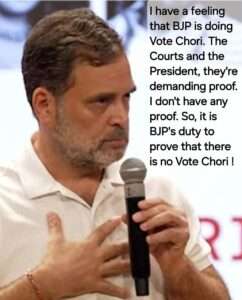
First, allege vote chori. Then, when challenged to substantiate the charge, retreat to a ‘feeling’ that vote chori must have taken place. Finally, demand that Modi prove that no votes were stolen.
Brilliant! Why go through the tiresome business of collecting evidence when you can simply ask the accused to prove a negative?
In any ordinary criminal investigation, it is for the accuser to produce evidence to support an allegation. In Rahul’s courtroom, however, the prosecution can turn up empty-handed and still demand a conviction. The defence must somehow establish that a crime did not take place.
The legal term for this little manoeuvre is reversal of the burden of proof. In political theatre, it could qualify as a particularly audacious magic trick.
From vote chori to mind-reading
The Congress leader’s campaign against alleged electoral fraud has taken several turns. The allegations have been directed at Modi, the BJP and the Election Commission (EC), with Chief Election Commissioner (CEC) Gyanesh Kumar singled out for particularly blistering attacks.
On October 12, Rahul escalated matters further, telling Gyanesh Kumar to resign and turn approver, on the ground that he was allegedly not the principal culprit. He also claimed that 200 government officers were in touch with the Opposition.
These are serious allegations. If backed by credible evidence, they deserve serious investigation. If electoral irregularities have occurred, they must be exposed and those responsible held accountable. No democracy can afford to treat the integrity of its elections as a trivial political dispute.
But surely there is a difference between presenting evidence of an alleged crime and announcing that a crime has occurred, then asking everyone else to prove otherwise.
A suspicion is a reason to investigate. It is not by itself proof of guilt. Nor does the confidence with which an allegation is delivered increase its evidentiary value.
Gyanesh Kumar, the alleged villain
The CEC has become a central character in Rahul’s narrative. The Congress leader has accused him of complicity in what he describes as vote theft and has called on him to turn approver.
But an accusation, however emphatically repeated, does not establish criminal culpability. The allegations against the CEC and the prime minister must be tested against evidence, not settled by press-conference verdicts.
Equally, the poll panel cannot expect criticism to disappear merely by dismissing it. Questions about electoral rolls, voter deletions and the conduct of elections deserve transparent answers.
An institution entrusted with safeguarding democracy must be prepared to explain its actions and submit to scrutiny.
The point is not that the EC must be presumed infallible. It is that neither the panel nor its accusers should be presumed guilty or innocent by political decree.
The Modi test: role reversal
Imagine Modi accusing Rahul of secretly conspiring to steal votes, admitting that he has no conclusive proof, and then demanding that Rahul produce evidence that he has not stolen a single vote.
Would the Congress leader accept that as a reasonable standard of political accountability? Or would he point out, quite correctly, that the person making the allegation must substantiate it?
The same principle must apply regardless of who occupies the PM’s chair and who occupies the Opposition benches.
Democracy certainly requires vigilance. It requires independent institutions, credible investigations, transparent electoral procedures and politicians who are willing to question those in power. But it also requires a healthy respect for evidence.
Otherwise, every election can be declared stolen by the losing side, every victory dismissed as fraudulent, and every accused politician sentenced in the court of public opinion before the evidence has even entered the courtroom.
A conviction in search of evidence
Rahul is entitled to question Modi, challenge the EC and demand answers about alleged electoral irregularities. As Leader of the Opposition (LOO), he has a legitimate responsibility to do so.
But that responsibility comes with an obligation to distinguish suspicion from proof, allegation from finding, and political rhetoric from demonstrable fact.
If he has evidence of vote chori, let him present it, identify the alleged wrongdoing and seek an impartial investigation. If the evidence establishes criminal misconduct, those responsible must face the consequences.
But if the argument is that vote chori must have happened because Rahul feels it happened, and that Modi must prove otherwise, we have entered rather extraordinary territory.
Perhaps we should now dispense with evidence altogether. The accuser announces that an election has been stolen, admits he cannot substantiate the charge, and then demands that the prime minister prove that it has not been stolen.
It is a remarkable inversion of logic: the absence of evidence becomes the accused’s problem, while the absence of proof becomes the accuser’s privilege.
If this is the new standard of political accountability, every suspicion can be elevated to an accusation, every accusation to a verdict, and every demand for evidence dismissed with a counter-demand to prove innocence.

