



Too much hype orchestrated by various agencies on the “Youth Dividend” (often referred to interchangeable with the “Demographic Dividend”? What is the reality? Undeniably, young people in India are not properly educated, up-skilled and integrated into the workforce. Let none suffer from illusions on the above count.
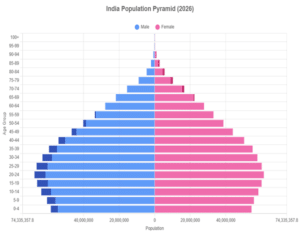
The “Youth Dividend” is commonly viewed as the potential economic growth and innovation advantage a country can achieve when its working-age youth population is larger than its dependent population (children and the elderly).
However, there is a caveat. “Youth dividend” is based on a large cohort of young people properly educated and integrated into the workforce, who can boost productivity, accelerate innovation, and sustain long-term economic expansion.
India has a population of 1,476,625,577 (projection for 1 July). That is the largest population in the world and 17.79% of the global total of 8.30 billion. Children under 15 make up 23.8% of the population (351 million) and people aged 65 and over 7.6% (112 million), that is, total of 31.59% (573 million).
But, the criteria of “under 15 and over 65” not qualifying to be classified as entering the workforce needs a pragmatic review. Surely, the benchmark must be revised to read “Under 20” and “Over 60” (retirement age). The actual active workforce depends on the Labour Force Participation Rate (LFPR) (people who are either employed or actively looking for a job). It hovers around 55.6% to 59.3% with the vast majority falling cleanly into the 20–60 age groups.
Surprisingly, the share of younger workers (20–29) in the total active workforce has also contracted significantly (dropping toward 17% in recent years) due to higher rates of extended education and structural entry-level job shortages. And, the share of seasoned workers closer to retirement has risen sharply, now commanding nearly 49% of the active employment landscape.
IRREFUTABLE FACTS:
1. Agriculture still employs roughly 43.0% of the active workforce concentrated in rural areas.
2. Services & Gig Economy is the fastest-growing economic driver, with formal services, startups, and a massive gig workforce expected to scale to 2.35 crore workers.
3. Manufacturing & Construction accounts for around 12.1% and is the primary target for expansion via national manufacturing initiatives.
Admittedly, over 43% of the active workforce in the “Agriculture Sector is manual labour only, mostly illiterate women, employed in inherited ancient cultivation practices. Rarely in a few rural areas, can one see the latest cultivation technologies (greenhouses) employing “skilled” agriculture labour.
Next, to turn a “youth bulge” into a true dividend, economists point to several critical pillars. Education must move away from merely granting degrees to fostering actual, employable skills. This includes expanding technical, digital, and professional training. More importantly, develop sectors – such as manufacturing, technology, and modern services – capable of absorbing millions of new job seekers annually. It is also ensuring access to healthcare so that the workforce remains physically and mentally resilient. Add to them, providing young entrepreneurs with access to credit, capital, and digital tools fosters self-reliance and innovation.
Ipso facto, if the above are effectively managed, a booming workforce drives higher per-capita income and GDP growth. A tech-savvy generation fuels startups, AI development, and digital transformation. Fewer dependents per worker allows families and governments to save and invest more.
Undeniably, education and health sectors – foundational sectors – have been very poorly managed, more aptly, woefully ignored in the past. India has failed to invest in the foundational structure, that is, the education sector. What the Education and HRD departments of the Centre and the states spend and that figure sits at roughly 2.7% to 2.9% of GDP. It’s been stuck in that band for years. The Economic Survey’s trend runs 2.8% in 2017-18, 2.9% around 2019-20 and 2020-21, then 2.7% in 2021-22, back to 2.9% in 2022-23, and 2.7% again in the 2023-24 budget estimate.
India is still chasing the Kothari Commission prescription of 6% budget allocation in the education sector in 1966; reaffirmed subsequently three times in three national policies. High time both Central and State Governments increase budget allotment to at least 4.5%.
Next, the budget allocation in the health sector is also grossly inadequate. Public health spending has historically faced structural limitations. Total general public healthcare expenditure (Centre + States combined – 2021-2026) stands around 1.7% to 1.9% of GDP, still short of the long-term 2.5% target.
Due to poor development of creative and innovative capabilities at the formative years of growth, large segments of educated young people remain poorly skilled: jobless or underemployed. Persistent lack of job opportunities is also leading to widespread frustration and social or political instability. Surely, all headmasters’ and teachers’ vacant posts can be filled.
Excessive politicization of educational institutions is real. The ABVP, NSUI, SFI, AISF, AAP, and its offshoot CJP, the premier student youth-wing organizations mushrooming in colleges and universities, are disturbing the atmosphere for inculcating employment skills appropriate for job employment. How can students who launch agitations/protests and seek street justice contra the laws of the Constitution and democratic process, can ever become innovators? In retrospect, protesting students ultimately become divisive/disintegration forces hell-bent on dividing society on narrow parochial lines.
Let me briefly review the state of education in Telangana. Schools in rural areas are without adequate infrastructure and teachers. 2,245 government schools have zero students registered. These empty institutions still have 1,016 teachers officially on the rolls. Telangana has 5,001 single-teacher government schools. Roughly 20% of all government schools in the state rely on a single teacher to manage all primary grades, teach up to 18 subjects, handle administrative paperwork, and oversee mid-day meals. How can creativity and innovation traits be developed with unskilled/upgraded teachers?
Bihar has around 29 schools with zero teachers; nearly 354 schools with just one; and 2,977 schools manage with only two. UP has 9,508 schools run by only one teacher. And there are thousands of Headmaster/Teacher posts vacant in all states. Quixotic, unemployment persists. Why?
And, the curriculum at all levels – from primary to higher secondary to undergraduate to graduate and PG levels – remains unchanged except in a few universities and private institutions. Surely, the inherited legacy education curriculum does not equip with employable skill development in the Technology era!
Next, the overall unemployment rate in Telangana stands at 5.7% for individuals aged 15 and above: slightly higher than the national Indian average of 5.4%. The overall youth unemployment is 19.3%. In urban environments, youth unemployment sits at 22%, while in rural areas it is slightly lower at 18.3%.
Yet, an estimated 18 lakh migrant workers are actively employed across Telangana. The state’s booming construction and real estate sectors heavily rely on this interstate workforce. In major urban hubs like Hyderabad and its surrounding real estate corridors, over 70% to 75% of the entire construction workforce consists of interstate migrant workers.
Yet another disturbing issue to note is the vast majority of the sanitation workers (19,250) sweeping the roads and streets after midnight are mostly middle-aged women. Only roughly 900 permanent sweepers are on the municipal payroll. Add to them, the total active staff of 600 to 750 workers in the Secunderabad Cantonment.
No wonder unemployed men, particularly in Telangana rural areas, are either taking to politics or working as real estate agents. Only a few of them work in agriculture. The majority of youth are taking to politics to provide them with an easy path to vent their feelings of frustration in protests. Also, the same is the case in urban areas where youth graduating in politics and history join the bandwagon of political parties hovering in college institutions and make a living in politics.
To sum up, since the country failed to invest in the two foundational pillars, the demographic advantage is decaying into a structural risk. Appropriate skill development of youth remains far-fetched even in today’s context. Surprisingly, Telangana Government data indicates that standard unemployment numbers often increase with education level, peaking at 13.4% for post-graduates, highlighting structural issues in absorbing highly qualified youth into relevant sectors
There is a disturbing lack of concern for the steep demographic divide between India’s geographic regions, particularly Central-North India (e.g., Bihar, Uttar Pradesh) and Southern & Western India (e.g., Kerala, Tamil Nadu). In Central-North India (e.g., Bihar, Uttar Pradesh), the young are expanding with higher birth rates; over 30% of Bihar’s population is under 15. The elderly share is very low, with a low dependency on senior citizens. In Southern & Western India (e.g., Kerala, Tamil Nadu) there is rapid ageing and a sharp drop in fertility and a shrinking base of the child population. A high elderly share: 19% of Kerala’s population is over 60. The workforce is already shrinking; Tamil Nadu’s median age is projected to hit 40 years by 2031. The Government of India is tracking these shifting dynamics using the framework of the upcoming Digital Census, which kicked off its primary field phases in April 2026 to update national allocation models.

