
Lakshmanrao Upadhyayula
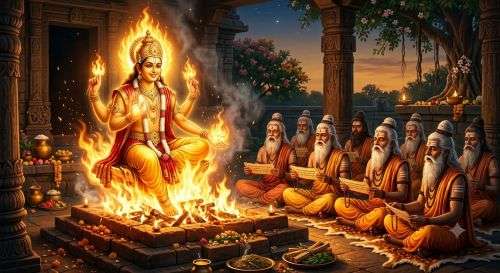
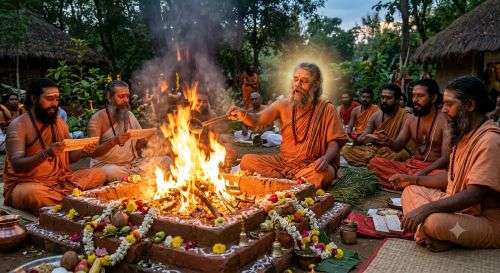
The revered sage Vishwamitra, immersed in divine contemplation, invokes Agni through the sacred metres of Gayatri, Ushnik, Tristubh, and Jagati, the celebrated chandas of the Rigvedic hymns. Each metre carries a distinct rhythm and spiritual force, harmonizing human thought with cosmic order. Through these measured hymns, the sage addresses Agni, the eternal priest of the sacrifice, the luminous messenger between humanity and the celestial realms. Agni is praised as the knower of all created beings, the witness of every birth, action, and aspiration, whose radiant intelligence pervades the visible and invisible worlds.
At the break of dawn, when darkness yields to the first rays of light and nature awakens to renewed activity, the sacred ritual begins. The sage humbly offers special oblations and prayers to Agni, requesting him to accept the sanctified offerings prepared according to Vedic injunctions. Dawn symbolizes the emergence of knowledge from ignorance, and Agni, as the embodiment of divine illumination, receives the offerings that signify the awakening of consciousness. The hymns describe him as rich in splendour, abundant in blessings, and capable of carrying the prayers of devotees to the celestial powers that uphold the universe.
The young and jubilant Agni is then invited to partake of the specially prepared sacred offering. Carefully purified through ritual discipline and consecrated with Vedic mantras, the oblation represents the devotion, gratitude, and aspirations of the sacrificer. Agni consumes the offering not merely as physical fuel but as the subtle essence of human dedication. In the Vedic vision, this sacred transformation reflects a profound scientific temperament, where energy is neither lost nor destroyed but continuously transformed. The fire converts material substances into subtle forms, symbolizing the elevation of earthly existence into spiritual realization.
As the day advances toward noon, the ritual reaches another sacred phase. The all-knowing and intelligent Agni is invoked once again to receive the special midday offerings. The brave Adhvaryus, skilled in the performance of sacrificial duties, meticulously preserve every portion of his share. Nothing is diminished, neglected, or improperly offered, for the ritual is governed by precision, discipline, and reverence. This careful attention reflects the Vedic understanding that cosmic harmony is sustained through exact action and disciplined conduct. Agni stands at the centre of this sacred order, majestic and resplendent, nourishing both the gods and humanity through the power of sacrifice.
The hymns further glorify Agni as the son of might and strength, the inner power residing within every yajna. He is not merely the visible flame upon the altar but the invisible force that sustains all sacrificial acts. He is the energy within the priest, the devotion within the worshipper, and the transforming principle within nature itself. Through this understanding, the Vedic sages perceived a profound unity between the external ritual and the inner spiritual journey. The sacrificial fire becomes a symbol of the awakened soul, continually refining itself through knowledge, discipline, and devotion.
As the third ritual of the day approaches, Agni is invited to desire and accept the specially prepared offerings dedicated to this sacred period. Nearby rests the precious Soma, pure and undiminished, rich in symbolic gems of spiritual wisdom and divine vitality. It awaits presentation before the assembly of gods amidst the resonant chanting of Vedic mantras. The atmosphere is filled with sacred sound, disciplined action, and elevated thought. Every aspect of the ritual reflects the Vedic conviction that the universe responds harmoniously when human beings align themselves with truth, order, and righteousness.
At the close of the day, when the sun descends and the world’s activities gradually come to rest, Agni receives the final sanctified offerings. The sage again addresses him as the knower of every being born in creation. Having witnessed the day’s full cycle, Agni consumes the purified oblations and carries their subtle essence to the divine realms. The completion of the ritual signifies the completion of a cosmic cycle, reminding humanity that every beginning finds fulfilment in an orderly conclusion. Through Agni, the sacrifices of the day become instruments of spiritual ascent and universal harmony.
Thus, Vishwamitra’s invocation reveals Agni as the radiant bridge between the human and the divine, between matter and spirit, between disciplined action and transcendent wisdom. The hymns celebrate not only devotion but also an intellectual appreciation of the laws governing transformation, energy, order, and continuity. Agni shines as the eternal guardian of sacrifice, the purifier of consciousness, the sustainer of cosmic balance, and the luminous guide who leads seekers from the transient world toward the imperishable light of truth.