Lakshmanrao Upadhyayula
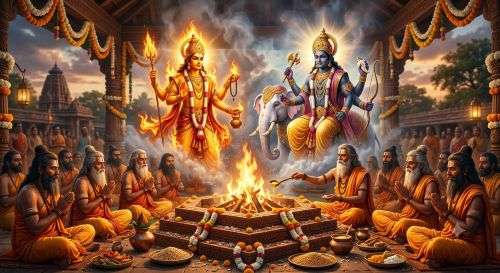
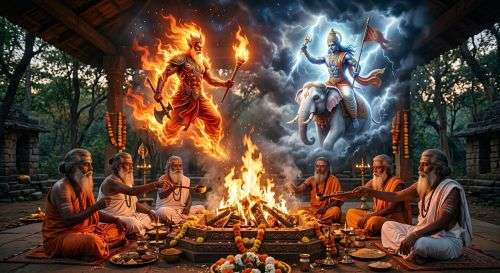
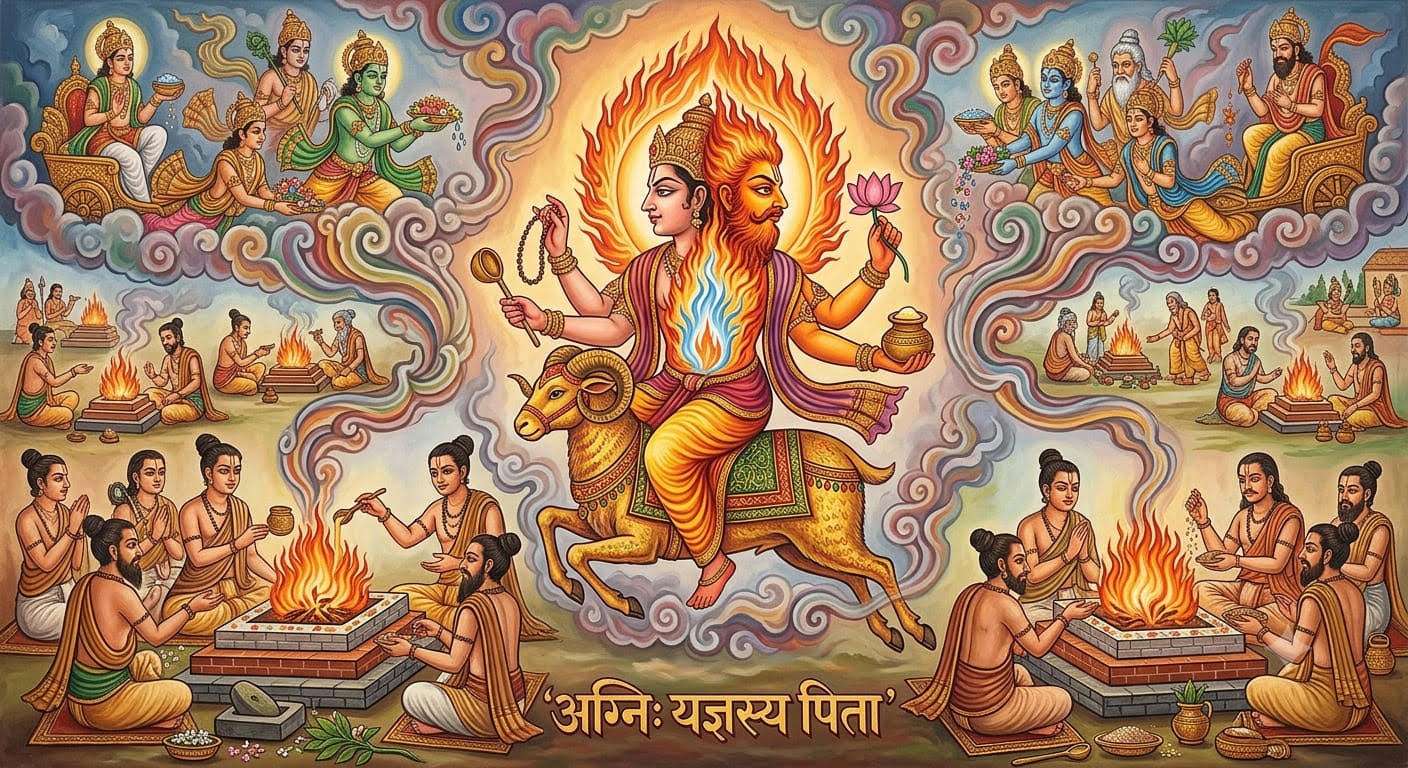
In the sacred cadence of the Tristubh metre, the venerable sage Shaunaka Grutsamada invokes Agni, the primal recipient of all oblations, whose presence bridges the mortal and the divine. Agni stands foremost among the gods, not merely as a ritual flame but as a conscious principle, akin to a पिता—the father—who nourishes, protects, and guides. In the Vedic vision, particularly within the hymns of the Rigveda, Agni is not confined to the altar; he is awakened through human participation, kindled in the yajna as both an outer fire and an inner illumination. His luminosity is complete, his essence immortal, and his influence extends into all realms of existence, becoming the very source from which nourishment flows into life.
Agni is celebrated as invincible strength and unassailable force, whose radiance spreads in multicoloured rays, unmatched and incomparable. These rays, described as विविध वर्णाः, symbolize not only physical light but also the spectrum of knowledge and energy permeating the cosmos. The hymns offered in Vedic chanting are not mere words but vibrational offerings, intended to resonate with Agni’s subtle frequencies. In a scientific sense, this reflects an intuitive grasp of energy transformation, where sound, intention, and matter converge. Thus, Agni is both the receiver and the transformer, converting the gross offerings into subtle essences that sustain cosmic harmony.
The imagery of two red horses drawing Agni across all realms evokes the dynamic motion of energy—unceasing, pervasive, and guided by cosmic law. The ritual act performed by the Adhvaryu priest, who generates fire through the friction of the Arani sticks, signifies a profound understanding of latent energy within matter. This act mirrors the principle that energy lies hidden within all substances, awaiting the right conditions to manifest. Agni, therefore, resides not only in the sacrificial fire but also in the subtle depths of herbs, plants, and all organic life, embodying the latent शक्ति that sustains biological processes and transformation.
In the stillness of night, when darkness envelops the world, Agni continues to dwell in brilliance, untouched and inexhaustible. Darkness cannot diminish him, for he is the inner light of consciousness itself. He is described as the lordly presence presiding over the universe, endowed with supreme majesty and all-pervading nature. His form is strong, his function vital, as he distributes the फल of oblations to the देवताओं, maintaining the cycle of reciprocity between humans and the divine. In modern reflection, this can be seen as an early symbolic articulation of conservation and transformation of energy—nothing is lost, only transmuted.
With reverence, the worshippers offer clarified butter—घृत—into Agni, recognizing him as omnipresent and ever receptive. The act of pouring ghee is both physical and symbolic: it feeds the visible flame while signifying the surrender of ego and the refinement of inner being. Agni, the lover of yajna, moves willingly toward the sacred precincts where devotion is sincere. The brilliance of his flames, though awe-inspiring, remains untouchable, suggesting the transcendence of ultimate reality beyond sensory grasp. Yet, through disciplined ritual and devotion, one may approach his presence inwardly.
Agni is invoked as the शक्ति that subdues negativity and dissolves hostile forces through the purity of his flames. The supplicants call upon him to listen patiently to their hymns, to grant refuge under his protective radiance, just as the primordial मानव, Manu, once did. In a deeply symbolic sense, Agni’s ability to extract sweetness, like honey from darkness, reflects the transformative potential inherent in existence—the capacity to derive wisdom, nourishment, and clarity even from ignorance and obscurity.
Thus, Agni is revered as the प्रथम होता, the first priest and the foremost consumer of offerings, who mediates between the seen and the unseen. Through the chanting of the Rigvedic hymns, the seekers invite him into their midst, not merely as fire, but as consciousness, energy, and divine intelligence. The narrative of Agni, when viewed through both spiritual insight and scientific temperament, reveals a profound synthesis: an ancient recognition that the universe is sustained by an underlying principle of radiant energy, ever-present, ever-transforming, and eternally guiding life toward harmony and illumination.