



Sanjaya, endowed with divine sight and unwavering composure, spoke to the blind monarch Dhritarashtra, who listened with inward agitation and outward curiosity, sensing that within these events lay an unforeseen turn of destiny. He narrated how Arjuna, weighed down by grief and moral perplexity, had opened his heart before Krishna. The Lord, discerning the subtle roots of sorrow, declared with serene certainty that such a crisis was but a necessary unfolding of cosmic design, wherein ignorance is stirred only to be dissolved by knowledge.
Then Krishna, intent upon the welfare of his devoted friend, seated himself facing the east, the direction of illumination, and revealed the supreme secret: that among all divine weapons, the Pāśupatāstra of Shiva stood unparalleled in power and sanctity. He instructed Arjuna that only through unwavering meditation, purified intention, and hymns sanctified by devotion to Shiva could such an astra be rightfully obtained and wielded against the destined foe Jayadratha. Thus guided, Arjuna withdrew his senses, calmed his mind, and entered into profound meditation upon the Lord of Kailāsa.
In that exalted state, beyond the confines of waking reality, Krishna and Arjuna seemed to ascend together, traversing celestial paths unseen by ordinary vision. Holding Arjuna’s hand, Krishna led him through the luminous realms of siddhas, cāraṇas, and divine hosts, until they beheld the resplendent abode of Mount Kailash, the eternal seat of Shiva. That divine region shone with rivers of purity, lakes of serenity, forests adorned with fragrant blossoms, and the radiant city of Kubera, fashioned with jewels and celestial artistry beyond mortal imagination.
There, they beheld Shiva, effulgent like a thousand suns, attended by primal energies and seated beside his divine consort Parvati. Overwhelmed with reverence, Krishna and Arjuna bowed low and saluted him with the sacred syllable Om. Shiva, smiling with boundless grace, welcomed them as Nara and Nārāyaṇa, inquiring gently of their well-being and purpose, and assuring them that their desire would be fulfilled. In this divine exchange was revealed the eternal law of hospitality: to receive with affection, to inquire with sincerity, and to grant with generosity—a dharma binding alike upon gods and mortals.
Krishna, his heart immersed in devotion, praised Shiva as the cosmic Lord whose eyes are the sun and moon, whose ornaments are serpents, whose being encompasses all worlds, and whose will governs creation, preservation, and dissolution. He extolled him as the transcendent reality beyond birth and death, untouched by the three guṇas, yet manifest to devotees through compassion. Thus glorified, Shiva became pleased and signaled Arjuna to seek the boon he desired.
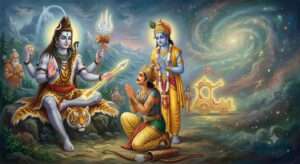
Arjuna, with single-pointed focus, perceived upon Shiva the very offerings he himself had once made in devotion, realizing the unity of all worship. With folded hands, he prayed for the Pāśupatāstra. Shiva, smiling at both Krishna and Arjuna, directed them to a sacred lake where his bow and arrow lay hidden. Obeying his command, they proceeded there, guided by divine will, and beheld fierce serpents guarding the waters, blazing with fire and terror. Recognizing this as the Lord’s play, they purified themselves and chanted the Śatarudrīya hymns, fixing their minds upon Shiva. By his grace, the serpents transformed into the celestial bow and arrow.
Rejoicing, they brought the divine weapons before Shiva. Then, in a mysterious vision, a radiant boy appeared, skillfully demonstrating the manner of stringing, invoking, deploying, and withdrawing the weapon. Through this subtle instruction, Arjuna grasped not merely the form but the essence of the astra, understanding that true mastery lies in inner alignment rather than outward force. Returning the weapons to the lake as ordained, he stood once more before Shiva, filled with gratitude and remembrance of the boon earlier granted during his forest exile.
Shiva then affirmed that this attainment was but the fruition of that prior blessing, for divine grace unfolds only in accordance with cosmic law. Arjuna, overwhelmed with joy, realized that the weapon was not merely an instrument of destruction but a symbol of divine trust and responsibility. With reverent salutations at every step, Krishna and Arjuna took leave of the Lord and returned.
Thus concluded the wondrous vision, which appeared to Arjuna as a dream yet bore the weight of divine reality. As dawn broke, Krishna conversed calmly with his charioteer Daruka, while Arjuna awakened, inwardly transformed. Hearing this narration, the king Janamejaya questioned Vaishampayana regarding the fulfillment of their purpose, even as Sanjaya continued to recount these sacred events to Dhritarashtra, revealing that behind the movements of war lay the deeper current of divine will, guiding the righteous toward their destined triumph.

