



Brig (Retd.) G.B. Reddy
Who has floated the Cockroach Janta Party (CJP), which is neither a recognised political party nor, at least as of now, an officially registered political party under the Election Commission of India? Is it merely a satirical social media movement, or is there a larger political objective behind its emergence?
Sections of the media have described CJP as an Indian satirical political movement founded on May 16, 2026, by 30-year-old political communications strategist Abhijeet Dipke. Publicly available information suggests that Dipke had earlier associations with the Aam Aadmi Party (AAP), whose politics has often been described by both supporters and critics as anti-establishment or anarchist in nature.
The movement reportedly emerged in response to controversial remarks made by the Chief Justice of India during a Supreme Court hearing, in which references to “cockroaches” and “parasites of society” triggered outrage among certain sections of unemployed youth and activists. Subsequently, the CJI clarified that his remarks had been taken out of context and that he had not intended to brand India’s youth or the entire student community as “cockroaches”.
If that clarification is accepted at face value, an obvious question arises: why did the Cockroach Janta Party choose to position itself as a representative of students and unemployed youth? Is it genuinely a youth movement or merely political satire being converted into political capital?
Abhijeet Dipke was born on September 29, 1995, in Aurangabad, Maharashtra. He presently serves as the founding president of the movement. He reportedly studied journalism in Pune before earning a Master’s degree in Public Relations from Boston University in the United States.
Before launching the CJP, Dipke worked as a political communications strategist. He also volunteered with the Aam Aadmi Party’s social media team between 2020 and 2023, participating in meme-based digital campaigning during the Delhi Assembly elections.
It was reportedly Dipke’s online post asking, “What if all cockroaches came together?” that triggered the social media phenomenon. What began as a satirical response rapidly gained traction, reportedly attracting millions of followers across social media platforms within weeks.
Soon, the online movement transformed itself into street-level activism, raising issues relating to education, unemployment and alleged irregularities in competitive examinations such as NEET. Dipke subsequently led public demonstrations at Jantar Mantar, organised protests demanding the resignation of Union Education Minister Dharmendra Pradhan and faced temporary detention by Delhi Police during protest marches.
The origin of the controversy lies in proceedings before the Supreme Court concerning a contempt petition arising from the Delhi High Court’s delays in designating Senior Advocates. During the hearing, Chief Justice Surya Kant criticised individuals who, he said, misuse social media activism and frivolous litigation to attack constitutional institutions.
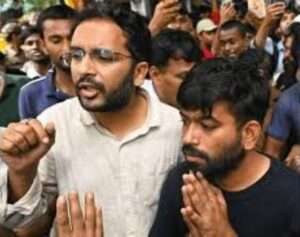
Following criticism, Justice Kant clarified that his remarks were directed at individuals misusing noble professions and were not intended to demean India’s youth. Nevertheless, the “cockroach” metaphor had already acquired a life of its own on social media.
Sensing an opportunity, Dipke launched the Cockroach Janta Party as a satirical political platform on May 16, 2026. Its tagline, “Voice of the Lazy & Unemployed”, and its deliberately humorous eligibility criteria were clearly designed to attract digitally savvy young Indians dissatisfied with conventional politics.
Interestingly, the name “Cockroach Janta Party” is not only a reference to the judicial remarks but also an unmistakable play on the name of the Bharatiya Janata Party. Whether that was intended merely as satire or as a political statement remains open to interpretation.
Dipke has publicly stated that CJP is not affiliated with any political organisation. However, his previous association with AAP naturally invites scrutiny and raises political questions. Is CJP an independent youth movement? Is it an extension of anti-establishment politics? Or is it an experiment in converting viral social media activism into future political mobilisation?
The movement has openly acknowledged the use of artificial intelligence tools, including ChatGPT and Claude, for designing its website, manifesto and campaign material. Its social media growth has been phenomenal. Within days of its launch, its Instagram following reportedly surpassed that of several established political parties.
The Ministry of Electronics and Information Technology subsequently restricted its X account in India under Section 69A of the Information Technology Act, adding another chapter to the controversy surrounding the movement.
Today, the Cockroach Janta Party continues to organise community activities, clean-up drives and political protests. Whether it remains a satirical protest movement or eventually evolves into a political outfit is something only time will tell.
What is beyond dispute, however, is that every political movement—particularly one that claims to represent India’s youth—must itself remain open to the same public scrutiny and accountability that it demands from others.

