Upadhyayula Lakshman Rao
In the sacred hymns of the Rigveda, the seer Deerghatama raises his contemplative voice in the resonant measures of Virāt and Ushnik chandas, weaving together insight, devotion, and observation. His vision does not merely praise but penetrates; it journeys inward into the subtle architecture of nature, where the human spirit and cosmic forces are intertwined in a silent yet dynamic communion. His poetry reveals an early yet profound inquiry into the evolutionary unfolding of existence, where simplicity of expression conceals the depth of discovery, touching both the human psyche and the universal order.
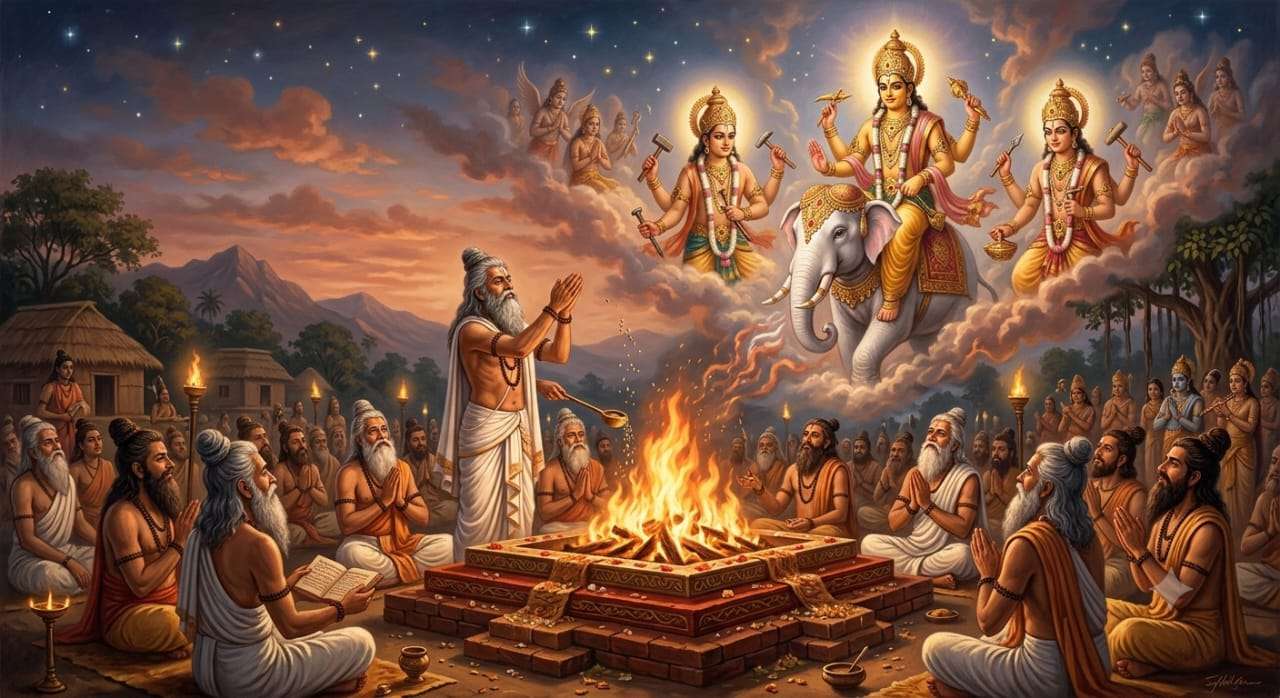
Agni, in this vision, stands not only as a deity but as the very principle of transformation. He is venerable and worthy of worship, for he embodies the energy that converts potential into manifestation. The seer recognizes Agni as the granter of material prosperity, yet his role transcends mere wealth; he is the medium through which desire is refined into offering, and offering into fulfillment. Swift and radiant, Agni advances into the sacred precincts, entering the holy halls as the Lord of Lords, taking his seat upon the consecrated altar—the eternal source from which all forms of abundance arise.
The imagery of patrons serving Agni with grinding stones in hand reflects an ancient ritual symbolism, where human effort and natural process converge. These stones signify the churning of existence, the friction that gives birth to energy, echoing a scientific intuition of transformation through interaction. Agni is thus both the fire kindled by human hands and the cosmic force that animates all processes. He is the creator of manifold forms of life, present as the digestive fire within the body, sustaining metabolism and enabling the continuity of life. In a deeper biological insight, he is envisioned as the seed-force between beings, nurturing lineage and ensuring the perpetuation of existence.
The seer further beholds Agni as established by devoted patrons in the northern quarter, shining with undiminished brilliance. Here, Agni is not confined to ritual space but expands into a universal principle—intelligent, swift, and all-pervading, like life-breath moving through the vast expanse. He embodies all forms of divinity, freely traversing realms, suggesting an early philosophical understanding of energy as both immanent and transcendent, manifesting in diverse forms yet remaining essentially one.
From the union of the Aranis—symbolizing earth and space—Agni is born, illustrating a profound cosmological metaphor. This birth is not a singular event but a perpetual emergence, reflecting the continuous generation of energy through the interaction of fundamental forces. Agni shines across the three worlds, illuminating all planes of existence, and acts as the summoner of divine forces, a mediator between the seen and the unseen. His presence in water signifies latent energy, hinting at the subtle recognition of life’s dependence on hidden forces within elemental substances.
Born of dual forces, Agni assumes the central place in sacrifice, upholding righteousness and sustaining the cosmic order. He desires oblations, not as a mere ritual demand, but as a symbolic exchange—where human intention meets universal law. Those who offer with sincerity are blessed, their lineage flourishing, their lives enriched with harmony. Agni becomes the bestower of boons, yet his gifts are aligned with the principles of balance and reverence.
The seer humbly acknowledges that even the act of offering arises through Agni’s grace, for he is both the giver and the receiver. This reflects a refined philosophical insight into the cyclical nature of existence, where all actions are interconnected. Devotion to Agni is likened to the service rendered by a faithful attendant, emphasizing discipline, humility, and continuity. Yet, a discerning note is struck—the seer implores Agni not to bestow wealth upon those who neglect sacred duties, who fail to honor the divine through ritual and remembrance. Wealth, in this context, is meaningful only when aligned with higher purpose.
Agni is praised as intelligence itself, the luminous awareness that guides and elevates. Among the celestial hosts, he stands supreme, and those who worship him shine with a radiance akin to the moon in the heavens. This metaphor reveals an understanding of reflected brilliance—the devotee, through alignment with Agni, partakes in his light and becomes a bearer of that illumination.
Thus, the devotees declare their allegiance, recognizing that their own majesty arises from their connection with this eternal flame. In this hymn, the spiritual and the scientific are not separate domains but unified expressions of a single truth. Agni emerges as the principle of energy, transformation, and consciousness—a bridge between matter and spirit, between ritual and realization, between the finite and the infinite.