



In the midst of the raging war, Arjuna stood like a blazing storm upon the battlefield. With calm determination he surrendered thousands of men and countless animals to the terrible sacrifice of war, as though the field itself had become an altar where blood, bones, and flesh were offered to the inexorable Lord of Death. Surrounded by loyal warriors and vigilant soldiers, his protectors formed an impregnable circle around him, guarding their hero from every threat while he directed the tide of battle.
His rising anger burst forth like a tempest. Arrows poured from his bow like relentless rain, while the wind of his weapons cut through the ranks of the enemy. The mighty defensive strategies of the Kauravas, so carefully arranged, were scattered like clouds torn apart by a violent storm. Witnessing this devastation, Sanjaya spoke to Dhritarashtra, lamenting that their forces were being blown away like tufts of cotton caught in the whirlwind of Arjuna’s arrows.
Meanwhile Shikhandi advanced boldly and released sharp and piercing arrows upon the venerable grandsire Bhishma. The mighty elder, however, paid little heed to these attacks. Ignoring Shikhandi’s assault, he continued striking other warriors with terrifying precision. Royal umbrellas were shattered, banners torn apart, and proud standards fell from broken flagpoles as his arrows raged across the battlefield.
At the urging of Arjuna, Shikhandi continued his attack, sending shafts that pierced the broad chest of Bhishma. Deep wounds opened and blood flowed from the body of the aged warrior. Yet Bhishma laughed loudly, like a mighty elephant facing a feeble challenger. Though it would have taken but a moment for him to counter Shikhandi, he chose instead to strike fiercely at Arjuna.
In the confusion of battle, Dushasana fell like an uprooted hill before the furious assault of Arjuna, and after causing great turmoil he fled the field when he encountered the Pandavas’ terrible might. Observing this, Duryodhana raised his arm in alarm and commanded the warriors of Kalinga, Malava, Bahlika, Videha, and Surasena to advance against Arjuna. These forces hurled countless spears into the sky and released torrents of arrows, surrounding him with the might of their fourfold army.
Yet Arjuna shattered these surging hosts with divine weapons. His celestial astras tore through the enemy ranks, and the remaining soldiers began to retreat in terror. Amidst this chaos, Shikhandi again struck Bhishma with sharp arrows. To protect the grandsire, Dushasana returned with warriors such as Kripa, Shalya, Vivimsati, and Vikarna, forming a defensive circle around him. But Arjuna shattered this guard as fire consumes dry wood, destroying their chariots and slaying their horses.
Soon Duryodhana himself surged forward with renewed fury, and the battlefield erupted into a terrible and fearful struggle between the Kauravas and the Pandavas. The fierce courage displayed by the Pandava warriors pleased the martial spirit of Bhishma. With grave resolve he prepared to release a sacred and formidable weapon. He placed the shaft upon the bowstring and drew it with immense force, about to sanctify it with divine power.
At that very moment, Shikhandi stood before him. Seeing him there, Bhishma lowered his bow and withdrew the weapon, refusing to strike. Sanjaya reported to the blind king that at this moment of hesitation, the warriors of Drupada and Virata, along with many others, surged forward like flames erupting from the earth and showered arrows upon Bhishma. Yet the grandsire remained steadfast. Without losing even a moment, he rained arrows upon the fourfold army and destroyed their skill and confidence. Like a dancing god of destruction, he struck down elephants, horses, soldiers, warriors, kings, and princes alike.
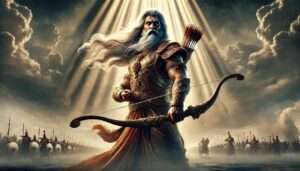
In a short time Bhishma spread terror throughout the enemy ranks, shifting the balance of enthusiasm and courage. The brilliance of his valor forced all who watched to acknowledge that his chivalry and prowess were unmatched upon the battlefield.
Then, Satanika, the brother of Virata, confronted the mighty elder and unleashed a fierce volley of arrows. Bhishma, filled with wrath, broke the prince’s bow, slew his horses, and cut down his charioteer. The young warrior responded by hurling a powerful weapon known as Shakti, but Bhishma shattered it in mid-air. In swift retaliation he hurled a blazing spear that severed the prince’s head from his body. Seeing their prince slain, the forces of Virata fled in fear.
The battlefield around Bhishma soon appeared barren and desolate. Amid the fallen warriors, he stood radiant, his brilliance resembling the blazing sun in the sky. Observing the situation, Krishna warned Arjuna that the death of Satanika had shaken the confidence of their army. If they failed to confront Bhishma at that moment, their purpose would be lost. He urged Arjuna to intensify his attack without hesitation.
Arjuna immediately released a torrent of arrows that covered Bhishma’s chariot like a curtain of steel. Shikhandi also continued his relentless assault, while the grandsire still refused to counter him. Warriors such as Shalya and others tried to resist Arjuna but were unable to withstand his fury. Crying for aid to protect Bhishma, they called upon the Kuru army. Instantly, the Kaurava forces surged forward like a vast ocean.
Recognizing the gravity of the moment, Bhima, Satyaki, and Abhimanyu rushed into battle with reckless ferocity, driving the enemy back with relentless power. The armies clashed like demons battling the gods.
Sanjaya then declared to Dhritarashtra that Arjuna was smashing the Kaurava forces with divine weapons while placing Shikhandi before him like the fierce goddess of war, tormenting the grandsire with countless arrows. Arjuna repeatedly broke Bhishma’s bow, not allowing him even a moment to take up another. Bhishma launched the powerful Shakti weapon against Arjuna, yet it too was shattered. Arjuna struck down the grandsire’s charioteer, broke his banner, and destroyed the guide of his chariot.
Inwardly, Bhishma reflected with the calm reasoning of a seasoned warrior. He thought that if Krishna had not stood beside the Pandavas, he could have won the war alone. The Pandavas, though brave, had come to him for guidance in earlier days, and he himself had revealed the secret of his death. From that moment, he resolved that he would no longer fight with full zeal and would accept the course of destiny.
As these thoughts passed through his mind, celestial beings in the heavens heard them and spoke in voices audible only to him. They praised his resolve and declared that his path was in harmony with the will of the divine. By the grace of Vyasa, Sanjaya perceived these divine events and reported them to the blind monarch.
When Bhishma heard the celestial voices, the atmosphere changed. Gentle rain began to fall, a cool breeze spread across the field, heavenly drums resounded in the sky, and flowers showered down from above. Yet these wondrous signs were visible only to the grandsire.
After a moment of reflection, the great hero considered that if he simply ceased to resist, the Kauravas might accuse him of deception or partiality. Therefore he lifted his bow once more and twanged its string with thunderous force, a sound that echoed across heaven and earth. What course he would follow next, within the righteous code of war, was yet to be revealed by the unfolding destiny of the battlefield.

