Lakshmanrao Upadhyayula
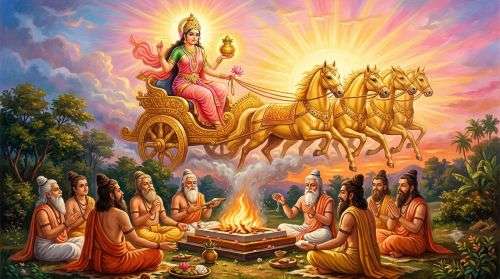
The venerable sage Śaunaka Gṛtsamada, illumined by the vision of the Vedic seers, raised his voice in the stately cadence of the Jagatī metre to invoke the divine powers who govern the universe. His hymn, preserved in the sacred current of the Rigveda, is not merely a liturgical composition but a profound synthesis of spirituality, cosmology, and disciplined ritual science. Every syllable was uttered with precision, every gesture aligned with cosmic order, and every offering transformed into a bridge between the human and the divine.
To Indra, the mighty sovereign of the celestial hosts, the priests presented Soma—the luminous elixir of inspiration and divine vitality. This sacred juice, pressed from consecrated plants, was mingled with pure water and substances derived from the cow, especially milk and curds, symbols of nourishment, fertility, and abundance. The blending of these elements reflected an intuitive scientific understanding: the harmonisation of botanical essence, mineral purity, and animal sustenance into a sacramental preparation designed to elevate consciousness. Purified through repeated filtrations and accompanied by precise chants, the Soma was offered to Indra, Lord of the universe and foremost among the gods, that he might descend and empower the sacrifice.
The hymn declares Indra to be the primeval and unconquerable deity, the force that awakens courage, dispels obstruction, and restores order. The priests, seated upon carefully arranged mats of sacred kuśa grass, recited resonant verses while the sanctified offering was placed before him in golden vessels. They invited him to accept the Soma and be gladdened, for in his satisfaction lay the strengthening of both cosmic and human endeavour. The ritual thus revealed a profound psychological truth: that divine power is invoked through disciplined intention, purified thought, and reverent action.
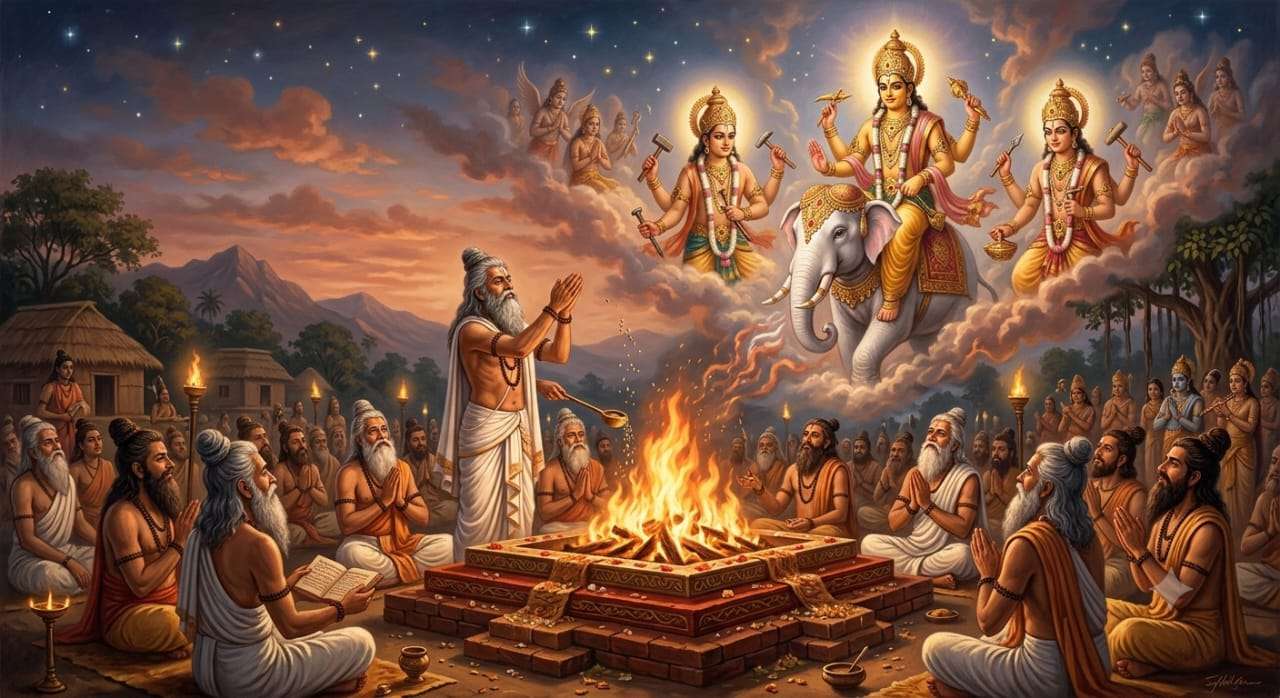
The sacred fire, Agni, stood at the centre of the ceremony as both priest and messenger. Agni is the luminous intelligence that carries offerings from the visible realm to the invisible. Installed in the three principal fires—the Gārhapatya, Dakṣiṇāgni, and Āhavanīya—he represented the continuity of domestic life, ancestral memory, and divine aspiration. Through his transforming flame, gross substances were transmuted into subtle essences. In scientific terms, combustion altered matter into heat, light, and vapour; in spiritual terms, Agni elevated human devotion into divine communion.
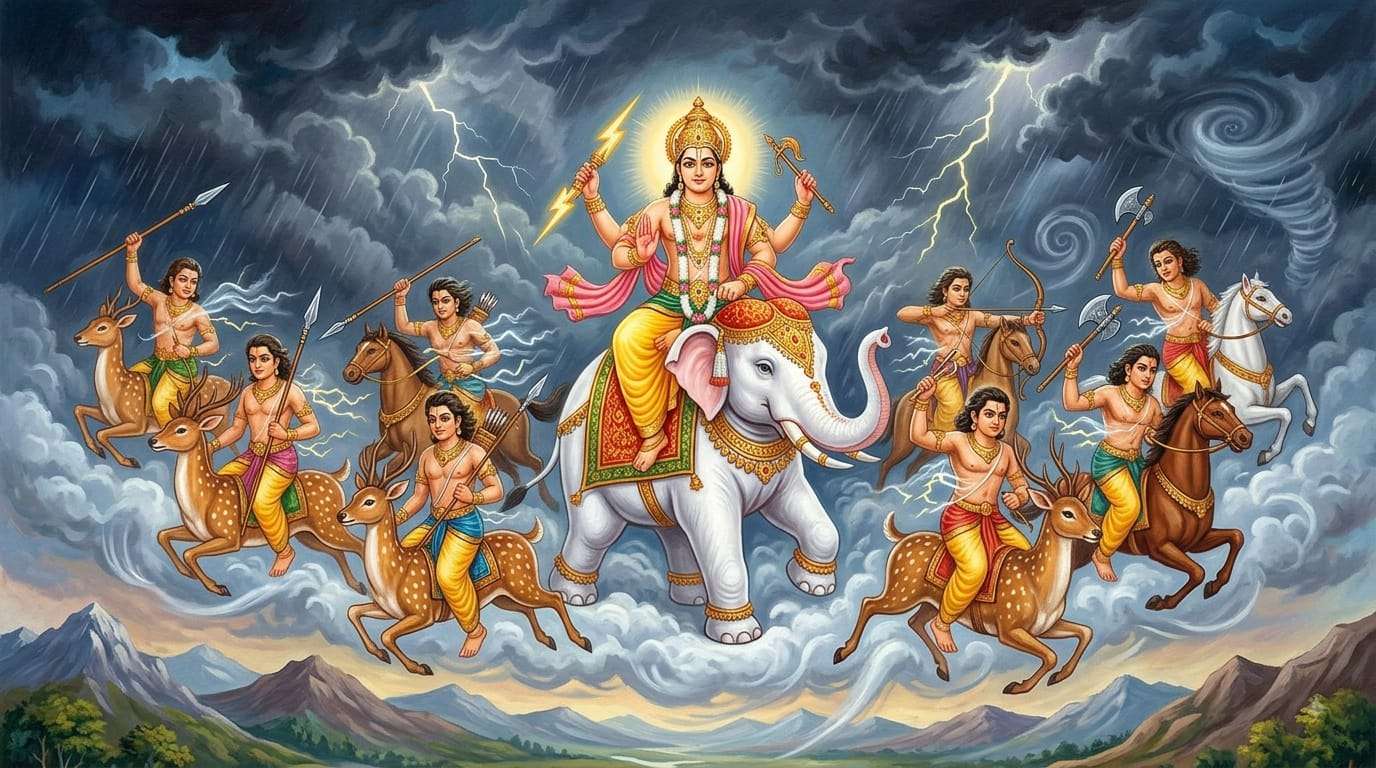
The Maruts, the radiant sons of Rudra, were then invoked. These youthful storm deities, leaders of the atmospheric regions, rode in resplendent chariots drawn by spotted deer, adorned with gleaming weapons and encircled by flashes of lightning. They embodied the dynamic energies of wind, pressure, and electrical force that animate the skies. Yet they were also symbols of inner vitality—the powerful currents of prāṇa that stir the human being toward spiritual awakening. Seated upon the sacred grass, they were asked to receive the offerings and bestow vigour, clarity, and fearless enthusiasm.
The officiating priest known as the Potṛ purified the oblations and presented them to the assembled gods. The Adhvaryu measured each movement with mathematical exactness; the Hotṛ recited the invocatory hymns; the Udgātṛ sustained the melodic current; and the Brahman supervised the rite in contemplative silence. The yajña thus functioned as a finely coordinated system in which sound, geometry, timing, and intention converged. Far from being arbitrary ceremony, it reflected an early scientific temperament rooted in observation, order, and repeatable precision.
The gracious deities were invited to enter the consecrated precincts and to be seated upon the sacred grass as honoured guests. Their arrival sanctified the yajña hall, transforming it into a meeting place of worlds. The divine artisan Tvastar, accompanied by the gods and their consorts, was called to receive the oblations. As the celestial architect, Tvastar represents the formative intelligence through which latent potential assumes harmonious structure, whether in the shaping of organisms, the forging of tools, or the refinement of thought.
Agni was again entreated to summon the gods and to carry the offerings from the northern altar, where the Soma, radiant like distilled moonlight, awaited divine enjoyment. Drawn forth from the sacred vessels and purified by fire and chant, it symbolised the essence of life itself—extracted, refined, and offered back to its cosmic source. The rite thus mirrored the universal law that all energies are cyclic, arising from the whole and returning to it in transformed form.
Finally, Indra was invoked as the ancient and inexhaustibly generous lord. The priests, steadfast upon their kuśa seats, chanted with concentrated devotion as the sanctified food and Soma stood before him. They requested him to honour their invitation, partake of the offering from the holy vessel, and grant strength, prosperity, and illumination. His acceptance signified the union of human aspiration with divine power.
This majestic hymn of Śaunaka Gṛtsamada reveals the Vedic sacrifice as a grand act of alignment between the microcosm and the macrocosm. The sacred fires correspond to the powers of transformation within nature and within the human heart. The Soma represents refined consciousness. The gods personify both cosmic principles and inner faculties. Through disciplined ritual, poetic invocation, and reverent insight, the seers demonstrated that spirituality and scientific temperament are not opposing paths but complementary approaches to the same eternal truth: that the universe is an ordered, conscious, and sacred whole.