



The venerable sage Nārāyaṇa, absorbed in profound devotion, worshipped Lord Shiva with unwavering concentration and offered exalted hymns of praise. Acknowledging Shiva as the Absolute Reality, the eternal foundation of all existence, he declared that whoever truly realizes this supreme truth attains the highest merit and ultimately reaches liberation. With a heart overflowing with devotion, he prayed, “O Deva, my devotion to You is exceptional and steadfast. Bestow upon me a divine power and influence unattainable by others.”
Pleased by such sincere devotion, Lord Shiva, the ocean of compassion, manifested before the sage and spoke with affection. “O Nārāyaṇa, by My grace you shall be victorious over humans, Garuḍas, Gandharvas, Kinnaras, and countless celestial hosts. I bestow upon you divine splendor beyond measure. Cast away all fear, for neither death nor bodily suffering shall approach you. No object in the moving or unmoving universe shall cause you pain. Weapons, whether celestial or earthly, shall never harm you. The five great elements themselves shall be incapable of troubling you. Neither dry nor wet substances, nor any force in creation, shall have the power to injure you. Such is the strength I grant you that, should resistance arise, you would possess the power to contend even against Me.”
Having received these extraordinary boons from Mahādeva, Sage Nārāyaṇa flourished in immeasurable strength, radiance, and invincibility. Alongside him appeared Nara, manifested through the power of intense penance. The two divine sages moved together for the welfare of the world, performing sacred deeds and divine pastimes that captivated all beings. Noble beyond compare, they descended whenever righteousness required protection, destroying demonic forces and re-establishing Dharma. In later ages, they manifested as Krishna and Arjuna, while the mighty Aśvatthāma himself possessed a portion of divine power.
Addressing Aśvatthāma, Sage Vyāsa revealed a deeper truth. “You too were born from a divine portion and possess purity, austerity, brilliance, and vast learning. Yet there remains a distinction between you and Nara-Nārāyaṇa. In a former birth, you worshipped Lord Shiva with intense concentration. Fashioning an image from clay, you invoked the divine presence into it through heartfelt devotion and offered your worship. Krishna and Arjuna, however, performed severe austerities and worshipped Shiva in the form of the sacred Liṅga with magnificent reverence and unwavering discipline. Though all sincere worship reaches the Lord and fulfills the devotee’s aspirations, worship of the Liṅga is praised as possessing a unique spiritual potency. Therefore, how could victory over them be easily attained? The results of past actions and worship inevitably bear fruit, and every soul must experience the consequences of its own spiritual endeavors.”
These words dispelled Aśvatthāma’s doubts and calmed the turmoil within his heart. Filled with transcendental peace, he meditated upon Parameśvara and praised Krishna. Offering respectful prostrations to Vyāsa, who had rescued him from confusion through divine wisdom, he watched as the sage disappeared. Thereafter Aśvatthāma mounted his chariot and departed.
As the sun descended toward the western mountains and evening approached, Duryodhana came forward and declared that the day’s battle should cease. The armies withdrew to their respective camps. The Kaurava warriors returned in dejection, burdened by discouragement and loss, while the Pandava forces advanced joyfully, proclaiming victory and sounding conches, drums, and other martial instruments. Their jubilant ranks resembled a mighty ocean surging with irresistible energy. Krishna praised the valor of the warriors, and the Pandava army proceeded without anxiety, confident in righteousness and divine favor.
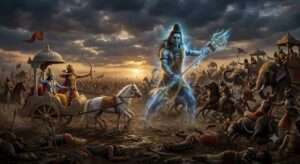
At that time Arjuna beheld the illustrious Krishna Dvaipāyana Vyāsa. Merely seeing the sage inspired reverence and the desire to bow in submission. His divine aura shone with extraordinary brilliance, as though the very Goddess of Justice had assumed human form. He radiated like sacred fire blazing upon a sacrificial altar. His profound wisdom, majestic presence, and incomparable leadership inspired awe in all who approached him. Saved the noble lineage of Pratīpa and celebrated throughout the world as Vedavyāsa for dividing and preserving the Vedas, he ever desired the triumph of righteousness and therefore stood firmly beside the Pandavas.
Seeing the sage from afar, Arjuna hastened toward him, bowed at his feet, respectfully escorted him, offered an honorable seat, and worshipped him according to sacred custom. Folding his hands, he spoke with humility. “O revered sage, kindly listen to my words. During battle I witnessed a wondrous and blazing figure moving ahead of me. His feet did not touch the ground, yet wherever he advanced, destruction fell upon our enemies. In his hand he carried a radiant spear, and from that single weapon countless spears seemed to emerge, striking down warriors on every side. Astonished by this divine spectacle, I followed him while releasing showers of arrows, believing myself to be the slayer. Yet though he destroyed the foes, the glory of victory appeared to come to me. O noble sage, reveal to me clearly the identity of that mysterious being.”
Hearing these words, Vyāsa smiled with delight and began extolling the greatness of Lord Shiva. “O Arjuna, that divine figure is none other than Parama Shiva, the Supreme Reality beyond all limitations. He is the eternal Lord whose cosmic play transcends understanding. It was He who, after the self-immolation of Satī, displayed immeasurable power and destroyed the sacrifice of Dakṣa Prajāpati. He is called Mahādeva because He surpasses all gods in greatness. He is known as Paśupati because He is the Lord of all beings. He is called Shiva because He is the source of all auspiciousness.”
The sage continued, “O Arjuna, Lord Parameśvara stands beside you to fulfill your righteous aspirations. Such fortune is as rare and precious as sudden wealth bestowed upon a destitute man. Through His grace you shall conquer your enemies and attain victory. The mighty Andhaka and many other scourges of the worlds were destroyed by Him. If such a Lord walks before you on the battlefield, victory is assured. He has become deeply pleased by your austerities and has already bestowed upon you the Pāśupata weapon and many celestial astras. Even now He assists you in the destruction of hostile forces. Therefore consider yourself truly blessed. Fix your mind upon Him, bow before Him, and seek refuge in the Protector of the Universe. He grants longevity, health, prosperity, and enduring well-being to those who worship Him with sincerity.”
Deeply moved by these words, Arjuna fixed his mind entirely upon Shiva and offered heartfelt salutations. Then he bowed at the feet of Vyāsa with profound devotion. The sage, pleased by Arjuna’s humility and faith, blessed him abundantly and departed to continue his sacred mission elsewhere.
Thereafter Sañjaya narrated these events to King Dhṛtarāṣṭra, just as Vaiśampāyana later recounted them to King Janamejaya. Filled with joy upon hearing that Droṇācārya had attained an exalted place in the sacred realms, Janamejaya eagerly desired to hear what followed. The sage prepared to unfold another magnificent chapter, rich with virtue, wisdom, guidance, and spiritual instruction.
The teachings contained within this sacred narrative are not confined to an ancient age alone. They remain a treasury of insight for every generation. For minds torn by confusion, disturbed by restless desires, weakened by impatience, or clouded by distorted thinking, these timeless lessons offer clarity and direction. They inspire the young to pursue noble character, encourage the troubled to regain inner balance, and remind all seekers that devotion, righteousness, humility, and divine grace remain the enduring foundations of a meaningful and victorious life.

