



Dronacharya, the venerable preceptor of the Kuru princes, spoke gravely to his son Ashwatthama. Observing the battlefield with a mind sharpened by long experience in war, he said that the countenance of Yudhishthira, the steadfast Dharmaraja, appeared to glow with a rare and unsettling anger. Such a sight was unusual, for a man of unwavering righteousness seldom allowed wrath to disturb his composure. If even such a soul trembled with indignation, it could only portend grave misfortune for the Kaurava host. The strange temper of the moment disturbed Drona deeply, and he felt an ominous foreboding that danger might soon descend upon the life of the venerable grandsire Bhishma.
Drona continued that the sons of Draupadi, along with the valiant twins Nakula and Sahadeva, were pressing fiercely upon him in battle. Surrounded by such determined warriors, it had become impossible for him to break through that difficult strategic position and hasten to the side of the grandsire. Therefore, he instructed Ashwatthama to ride swiftly across the field and stand guard on both flanks of Bhishma, the commander-in-chief. This, he said, was not the hour to think of preserving their own lives, but rather the time to protect the pillar of the Kuru army.
Ashwatthama, obedient to his father’s command, sped across the field with great speed and urgency. As he approached the region where Bhishma stood, he perceived a strange and troubling spectacle that seemed to defy the established codes of warfare. The mighty Bhima and the incomparable archer Arjuna were assaulting Bhishma and the Kaurava ranks with irresistible fury. Arjuna advanced like a blazing inferno, placing before his chariot the warrior Shikhandi, while Bhima tore through the Kuru formations like a tempest. With terrible strength Bhima crashed into the ranks of the Kuru warriors, breaking their lines and opening a clear path through which Arjuna could advance directly toward the grandsire.
Bhima raged across the battlefield like a wrathful demon, devouring the foremost ranks of the army. To restrain him, many renowned Kuru warriors rushed forward together—Bhagadatta, Shalya, Kripa, Kritavarma, Jayadratha, Chitrasena, Durmarshana, Vinda, Anuvinda, and Vikarna. They surrounded Bhima from all sides and showered him with arrows and weapons, seeking to halt his terrible advance.
At that moment Arjuna rushed forward to aid his brother. With a storm of arrows, he shattered the bows of his adversaries, tore down their banners, severed the poles of their standards, and swept away the royal umbrellas that crowned their chariots. Horses were struck down, charioteers were wounded, and warriors fell under the relentless precision of his shafts. Within moments the field was transformed into a scene of confusion and alarm.
Seeing the havoc caused by Arjuna, Duryodhana commanded Susharma and his forces to confront the Pandava hero. The warriors who had earlier surrounded Bhima were now themselves shaken by the wounds inflicted by Arjuna’s arrows. Bhima, encouraged by this support, resumed his assault with renewed vigor, smashing through the enemy ranks with unstoppable speed.
Observing the perilous turn of events, Duryodhana ordered all available forces to converge upon Bhima and Arjuna. The Kaurava armies gathered in great numbers and pressed hard upon the two Pandava heroes, seeking to restrain their advance and prevent them from reaching Bhishma. Yet even amid this fierce resistance, the young warrior Abhimanyu and the valiant Satyaki entered the fray, cutting their way into the hostile ranks and fighting with brilliant skill.
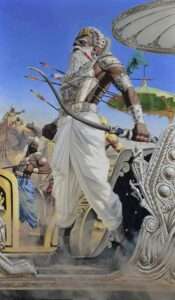
Bhishma, witnessing the astonishing courage and determination of the Pandava forces, felt a surge of warrior pride rising within him like a fountain. With the majesty of an enraged lion that rends an elephant with claws and fangs, he hurled himself into the Pandava ranks. His arrows struck relentlessly; charioteers were thrown from their seats, horses collapsed upon the ground, and chariots splintered beneath the fury of his assault. Appearing everywhere at once, the grandsire shook the Pandava army like a hurricane sweeping across the sea.
Yet as the sun moved past midday, a profound weariness entered Bhishma’s heart. For many days he had fought ceaselessly, cutting down kings and warriors with terrible efficiency. The relentless slaughter began to disgust his noble spirit. In the silence of his own thoughts, he resolved that the time had come to cast aside his mortal body. Moving through the tumult of the battlefield, he approached Dharmaraja and spoke to him in a subdued voice.
“O Dharmaraja,” said Bhishma, “my life has long been spent in the ruthless destruction of kings and warriors. My cruelty has exceeded all bounds, and my heart has grown weary of these merciless deeds. I desire now to halt this dreadful slaughter. If you truly wish for my welfare, place Shikhandi before your army and let all your warriors confront me together with unwavering resolve. Let them release their arrows upon me without hesitation, for the time has come to bring this battle of mine to its destined end.”
Having spoken thus, Bhishma returned to the front, once more appearing as though he were fiercely engaged in combat. Dharmaraja then turned to Dhrishtadyumna and said that the grandsire’s words had been heard clearly, and the moment had arrived to surround him with the combined strength of the Pandava forces. He commanded Dhrishtadyumna to direct all warriors toward Bhishma while Bhima and Arjuna struck with blazing fury against those guarding him.
Dhrishtadyumna signaled to the king of Virata, to the valiant rulers of the Kekaya brothers, and to many other warriors who surged forward like a rolling mountain descending upon Bhishma. With the powerful support of Bhima and Arjuna they hurled themselves into the assault.
Meanwhile Duryodhana, together with his brothers and loyal companions, stood firmly to guard the grandsire and repel the attacking forces. The clash became extraordinarily fierce. Abhimanyu struck Duryodhana with grievous wounds, while Satyaki filled Ashwatthama with a storm of arrows. Warriors from the Chedi and Paurava realms fought with exceptional valor, each side striving with desperate courage.
The battle thus revealed a profound irony. On one side, the Pandava warriors struggled to bring down the mighty Bhishma, while on the other side the Kaurava host fought desperately to protect the very same warrior whose fall seemed inevitable. Weapons flashed in countless forms, strategies unfolded in intricate patterns, and the entire battlefield became a grand theater of opposing destinies.
Bhishma and Arjuna confronted one another like two wild lions locked in a struggle for dominion. At that critical moment Dushasana rushed forward to shield the grandsire. His courage and steadfast loyalty drew admiration from warriors on both sides, for he resisted the advancing enemies with remarkable determination and stood firmly as Bhishma’s protector.
Yet Arjuna soon surged forward again. With a curtain of arrows, he forced Dushasana to withdraw from the field. Turning his attention to Bhagadatta, he shattered the king’s weapons and broke the strength of his war chariot. Bhagadatta’s great white elephant became drenched in its own blood, its body appearing like a crimson mountain amid the chaos of battle, yet the proud king continued to fight with unyielding spirit against the aged king Drupada.
Thus, the war raged like a tempest of torrential rain and violent winds, all moving toward a destiny ordained by righteousness and fate. These events were faithfully narrated by Sanjaya to the anxious and trembling king Dhritarashtra, who listened with a heart heavy with dread as the fortunes of his sons and their allies unfolded upon the terrible field of Kurukshetra.

