



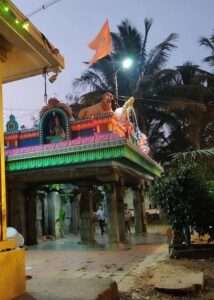
Sri Banashankari Devi Temple is situated at Devihosur in Haveri district, Karnataka. Devihosur is a historically important village known for its ancient temples, inscriptions, sculptures, and medieval heritage. In old inscriptions, the village is mentioned by names such as Posavur, Deyvada Posavur and Deviyahosavur.
The shrine has a documented history of more than 1,100 years. An inscription dated to 907–908 CE, during the reign of Rashtrakuta King Krishna II, establishes the antiquity of the Banashankari shrine. Another inscription of 1063 CE, from the Western Chalukya period, specifically mentions the temple of Malajadevi at Deyvada-Posavur, the ancient name of present-day Devihosur.
The Goddess is worshipped today as Sri Banashankari Devi and is historically associated with the ancient Malachi or Malajadevi of Devihosur. Malajadevi was regarded as a powerful manifestation of Shakti and was associated with fierce forms of the Divine Mother. The ancient shrine was known as Malajapeetha, indicating its importance as a centre of Shakti worship.
The ancient Malajadevi shrine represents the medieval temple architecture of Karnataka, with a garbhagriha, antarala, navaranga and mukha-mantapa. Its surviving remains include carved pillars, sculptures, serpent motifs and representations of Gajalakshmi and other deities.
A notable feature is the ornate makaratorana, or decorative gateway. An inscription of 1063 CE records that this gateway was constructed by Indrapayya, a royal bodyguard, and its sculptural work includes deities, devotees, elephants and horse riders.
Devihosur was an important agrahara and religious centre during the Rashtrakuta and Western Chalukya periods. Malajadevi received patronage from rulers, officials and local chiefs, and inscriptions record grants and religious endowments made to the Goddess.
The continuity of inscriptions from the early 10th century onwards demonstrates that the shrine was an established centre of Shakti worship for many centuries. The ancient Malajadevi tradition subsequently became associated with the present Banashankari identity.
According to the local tradition, a long time ago, the powerful demons Mani and Malla became a great source of trouble to the people and disturbed the peace of the region. Unable to bear their oppression, the people sought the divine intervention of Lord Shiva.
Lord Shiva then manifested himself in the powerful form of Mailara Martanda and came to destroy the demons. A fierce battle followed between the divine force and the two asuras. After a prolonged struggle, Mailara Martanda defeated Mani and Malla and restored peace to the land.
It is believed that Gangimalavva, also known as Malachi Devi, accompanied Mailara Martanda and became his divine consort. In the traditions of North Karnataka, the Goddess is also associated with names such as Malavva, Banayi and Banashankari. At Devihosur, this ancient form of the Goddess came to be revered as Malajadevi.
Malajadevi was worshipped as a powerful manifestation of Shakti, capable of destroying evil and protecting her devotees. Her sacred seat at Devihosur came to be known as Malajapeetha, which became an important centre of Goddess worship.
According to local tradition, the original shrine of Malajadevi stood near the large lake to the north of the village. Over time, the worship of the Goddess became established at the shrine within the village, where she is revered today as Sri Banashankari Devi.
Thus, the story of Devihosur brings together the traditions of Mailara Martanda, Malajadevi and Banashankari, while the inscriptions found at the site independently establish that the worship of Malajadevi existed here more than a thousand years ago.
Historical inscriptions confirm that festivals dedicated to Malajadevi were celebrated during the medieval period. One inscription refers to a festival and Uyyala Parva, associated with special worship and offerings to the Goddess.
The Goddess continues to be worshipped with regular pujas, special offerings and devotional observances. These traditions preserve the religious heritage of one of Karnataka’s lesser-known ancient Shakti centres.


