



Karna yielded neither to fear nor to the irresistible advance of Arjuna. Standing firm upon his chariot, his spirit remained unbroken as he answered Arjuna’s shafts with three keen arrows, while five more sped toward Krishna, the divine charioteer. Yet those arrows, though loosed with tremendous force, were rendered powerless by the sanctifying glory surrounding Krishna. His divine radiance dissolved their fury before they could accomplish their purpose, revealing that celestial majesty cannot be overcome by mortal strength alone.
Consumed by anger and mounting frustration, Karna fixed his gaze upon Krishna and discharged another deadly shaft. Before it could reach its mark, Arjuna intercepted it in midair, shattering it into countless fragments. The spectacle deeply disturbed the Kaurava ranks, for every failed attempt against Krishna and Arjuna diminished their confidence while strengthening the resolve of the Pandava warriors.
Arjuna immediately pressed his advantage, releasing a relentless succession of arrows whose impact was both fierce and precise. Though Karna endured the assault with remarkable composure, recovering his balance almost instantly, he answered with equal mastery. His bow sang continuously as torrents of arrows poured forth, filling the heavens with whistling and twanging sounds. Their blazing flights resembled streams of living fire, illuminating the battlefield with dreadful brilliance and transforming the sky into a theatre of celestial warfare.
Such was the density of those arrows that warriors upon chariots, cavalrymen, elephants, and infantry alike lost all sense of direction. The entire battlefield disappeared behind a curtain of flashing steel and flaming shafts. Soldiers from both armies, unable to distinguish friend from foe or perceive the positions of the two great heroes, fled in confusion. Fear seized every heart as the earth trembled beneath the fury of that unparalleled contest.
Observing the confusion, Duryodhana could not understand why Bhima and the other Pandava heroes had ceased their advance. Unable to comprehend the overwhelming storm of arrows exchanged between Karna and Arjuna, he raised both hands high and shouted with commanding force, “Do not allow Arjuna to escape! Surround him and crush him into the earth!” His words, though spoken with confidence, concealed the anxiety that had begun to trouble his own heart.
For a brief moment the Pandava soldiers halted their engagement, and the Kaurava forces likewise paused, overwhelmed by the astonishing spectacle before them. Then Arjuna drew the Gandiva once more. Its mighty twang reverberated through the heavens like the proclamation of destiny itself. Instantly he released another irresistible volley of arrows that drove back the advancing divisions, scattering their aggressive formations and restoring the initiative to the Pandava cause.
Duryodhana, unable to restrain his disappointment, addressed the assembled kings with cutting reproach. “Though all of you are mighty warriors,” he declared, “you have placed the entire burden of this war upon Karna alone. Why do you remain at a distance while he alone confronts Arjuna? Is such caution worthy of kings who boast of their valor?” Stung by his words, the reluctant monarchs gathered their courage and advanced once more toward the son of Pandu, compelled more by wounded pride than genuine enthusiasm.
Yet the combined prowess, unwavering resolve, and flawless mastery of Arjuna proved impossible to withstand. Wherever he directed his chariot, hostile ranks collapsed before him. His arrows swept through the enemy host with irresistible force, and the celestials, assembled in the heavens, applauded his incomparable skill. Witnessing their armies shattered and driven back, many of Duryodhana’s warriors retreated in terror, standing afar only to watch the duel in speechless amazement. The supporting divisions surrounding Karna steadily perished beneath Arjuna’s relentless assault.
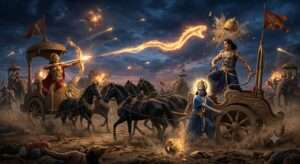
Thereafter the two supreme archers stood alone before each other like rival manifestations of cosmic power. Though both bore the exhaustion of prolonged combat, neither permitted fatigue to weaken his determination. Their thirst for victory strengthened their endurance, and they invoked countless astras and shastras with astonishing precision. The ceaseless rain of arrows darkened the sky until daylight itself seemed eclipsed by their deadly exchange.
Those who witnessed the duel stood spellbound. They marvelled at the extraordinary strength of their arms, the lightning swiftness of their shoulders, the unerring precision of their aim, and the unimaginable speed with which they strung, released, and replaced their arrows. It seemed that no mortal eye could fully follow the movements of either warrior, for each appeared equal to the other in courage, discipline, and martial excellence.
At that critical moment, the serpent Aswasena, son of the mighty serpent chief and brother of Takshaka, entered the blazing missile prepared by Karna. Sanctified by the power of the Nagastra, the weapon blazed like the fire of dissolution and was destined to pierce Arjuna’s neck with irresistible certainty. Perceiving its dreadful potency, Shalya sought to divert Karna’s attention. He respectfully advised that the chosen line of aim was not the most suitable if the intention was to sever Arjuna’s neck completely, urging him to adjust his aim before releasing the weapon.
Karna turned toward Shalya with eyes burning like molten copper. His voice carried both pride and indignation. “Do you presume to instruct one who has mastered every science of archery? Once I have fixed my aim, I do not alter it. A warrior of honor never redirects a weapon already dedicated to its target.” His words reflected the stern code by which he had lived throughout his life, valuing steadfastness even when it stood against prudence.
The blazing Nagastra then rushed forth, breathing flames in every direction and filling the heavens with terrifying radiance. Krishna instantly recognized its irresistible power. In a moment that revealed His divine wisdom, He pressed the chariot into the earth by the measure of a few inches. That subtle yet immeasurable act altered the course of destiny itself. The universe silently adored the Lord’s unfathomable intervention, for what no warrior could have prevented was overcome through divine foresight alone.
Sanjaya, narrating these events to Dhritarashtra, declared that the serpent weapon released by Karna shook the hearts of the Pandavas. Descending with the force of Indra’s thunderbolt cleaving a mountain peak, it struck Arjuna’s resplendent crown instead of his neck. The impact momentarily drained the brilliance from Arjuna’s face, and the celestial crown, adorned with incomparable jewels, was hurled from his head.
As the crown descended to the earth, it shone with dazzling radiance. Countless gems scattered streams of exquisite light in every direction, illuminating the battlefield with celestial splendor. Smoke from the blazing Nagastra mingled with deafening thunder, filling the heavens with echoes that seemed to shake the worlds themselves. Even Indra and the guardians of the directions had never touched that divine crown, yet it now lay upon the earth through the power of Karna’s mighty weapon. Listening with intense curiosity and growing wonder, Dhritarashtra urged Sanjaya to continue the magnificent narration of that unforgettable duel, wherein human valor and divine providence stood face to face upon the field of Kurukshetra.

