



Sanjaya, whose words were never colored by affection or hatred, narrated the events before King Dhritarashtra with unwavering honesty and deep concern. He observed that Karna, despite his extraordinary prowess, had become increasingly consumed by pride and self-exaltation. Such arrogance, Sanjaya implied, clouded the judgment even of the greatest heroes. He reflected upon the tragic end of the venerable Drona, a preceptor unequaled in martial wisdom, whose death had become futile because it was brought about through deception and the relentless demands of war. Such a departure, he suggested, was unworthy of one whose life had been devoted to righteousness, knowledge, and the sacred duty of a teacher.
Karna, however, remained unmoved by such reflections. Addressing Shalya, he proclaimed with immense confidence that Arjuna, who had slain mighty warriors such as Bhishma, Drona, and countless invincible kings, would soon fall beneath his arrows. He declared that Arjuna had become death incarnate to the foremost heroes of the Kaurava host, yet the time had come to close Arjuna’s chapter on earth. Even if all the sons of Pandu attacked him together, Karna boasted that he would sever their limbs with effortless skill, shatter their pride through his martial excellence, and demonstrate the irresistible strength of his own hands.
He continued by recalling that although the heroic Bhishma had fallen and Dronacharya, endowed with celestial weapons, immense physical strength, inexhaustible quivers, and the glory of being the foremost among the Atirathas, had also perished in battle, the courage of the Kaurava army had withered after their deaths. Their confidence had vanished, and despair had spread throughout the ranks. Yet Karna assured Shalya that he alone would restore their fortunes. Armed with the celestial weapons bestowed upon him by the illustrious Parashurama, and supported by his magnificent chariot, he vowed to conquer Arjuna and repay forever the debt of gratitude he owed to the generous Duryodhana.
Shalya answered with piercing sarcasm. He rebuked Karna, declaring that anyone listening to such excessive boasts would think him bereft of sound judgment. No measure of self-praise, he said, could elevate Karna anywhere near the incomparable valor of Arjuna. Shalya reminded him that Arjuna had defeated the mighty Gandharva Angaraparna in the night, had humbled Chitraratha after Duryodhana was captured during the royal hunting expedition, had compelled even Indra to abandon the defense of the Khandava forest, and had fought Lord Shiva Himself, disguised as a hunter over the enchanted boar, displaying such heroic endurance that he earned the divine Pashupata weapon. If such celestial beings and unconquerable heroes had struggled before Arjuna, how absurd was it for an ordinary mortal to proclaim his intention of taking that warrior’s life?
Shalya further reminded Karna of the humiliation suffered during the invasion of the Matsya kingdom. While the Kaurava army sought to seize King Virata’s cattle, Arjuna, concealed in the guise of Brihannala and serving merely as Prince Uttara’s charioteer, single-handedly routed the assembled Kuru heroes. They had fled the battlefield and returned to their capital in disgrace. Was Karna now imagining that the Gandiva had grown weak with age or that its divine arrows had rusted? Escape from public reproach was no longer possible. Karna himself had once proclaimed that death was preferable to dishonor. That declaration, Shalya observed with grim irony, would soon be fulfilled when Karna met his destined end upon the battlefield, for confronting Arjuna was no ordinary undertaking.
Though anger flared within him, Karna restrained himself. He replied that he had no desire to hear endless praises of Arjuna. When he stood face to face with his rival, the world would witness whose strength, courage, and steadfastness proved superior. Until that decisive encounter, Shalya should refrain from uttering needless words. Recognizing Karna’s mounting irritation, Shalya fell silent and guided the horses according to his warrior’s command.
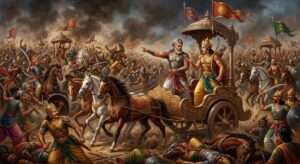
Surveying the vast Kaurava host, Karna’s spirit swelled with renewed enthusiasm. Raising his voice so that the assembled warriors might hear, he announced magnificent rewards to anyone who could point out Arjuna’s whereabouts. He promised chariots adorned with gold, swift horses of the finest breed, mighty elephants, beautiful maidens, prosperous hamlets, flourishing villages, and whatever riches were desired. His generosity seemed boundless. He went further still, proclaiming that once Arjuna’s chariot was identified, he would slay both Krishna and Arjuna and bestow half of their immense wealth upon the fortunate informant.
Having spoken these extravagant vows, Karna sounded his conch with tremendous force. Duryodhana and his brothers rejoiced at his fearless declarations. Conches, drums, cymbals, and war trumpets thundered across the heavens, while the Kaurava army roared with renewed confidence, believing victory already within their grasp.
Shalya, however, smiled quietly and answered with cutting wisdom. He told Karna that no guide was needed to find Arjuna, for he would soon behold him with his own eyes. Empty promises, he warned, only brought disappointment to those who believed them. Wealth was meant to be used with discernment and righteousness, not squandered upon impossible boasts. Without understanding the measure of his own strength, Karna had dared to proclaim victory over Krishna and Arjuna. Could a fox ever triumph over a lion? To challenge Arjuna in single combat was to invite destruction willingly. Therefore, instead of indulging in vain declarations, Karna should marshal the entire fourfold army and prepare wisely for the dreadful encounter ahead. Shalya insisted that, however unpleasant his counsel might sound, every word arose solely from his desire for the welfare of the Kauravas, and Karna would do well to heed sincere advice rather than resent it.
Karna’s patience finally wore thin. He declared that he had resolved to meet Arjuna relying upon his own valor and strength, a determination that even Indra himself could not prevent. Shalya’s so-called wise counsel would never shake his purpose. Yet the king of Madra persisted. He warned that Karna’s obstinacy would endure only until the Gandiva released its torrents of arrows and left him helpless upon the battlefield.
Still unsatisfied, Shalya intensified his rebuke. He compared Karna’s proposed duel with Arjuna to a timid deer charging against a lion, a frightened hare challenging a maddened elephant, a barking dog rushing upon a tiger, or a feeble serpent attacking a mighty eagle. From every conceivable perspective, he declared, Karna lacked the power necessary to contend with the unrivaled mastery of Arjuna, whose skill in warfare and command over celestial weapons had no equal among living warriors.
These relentless words inflamed Karna’s heart. His eyes reddened with fury, yet he answered with measured dignity. True greatness, he declared, could be recognized only by one who possessed greatness himself. Those who lacked such stature could never comprehend the excellence of another. He affirmed that he alone fully understood the true extent of Arjuna’s mastery and the immeasurable might of Krishna. Precisely because he knew the magnitude of their power, he had prepared himself with unwavering resolve. Every day he worshiped the formidable serpent weapon with profound devotion, believing that this divine missile possessed the strength to destroy Arjuna, Krishna, and any warrior who stood against him. With absolute conviction, he declared that victory would be his.
Sanjaya concluded this remarkable exchange by revealing the deeper truth hidden beneath the words. Shalya had deliberately provoked Karna, steadily draining his confidence and disturbing the clarity of his mind. This fulfilled the solemn promise Shalya had once given to Yudhishthira at Upaplavya, where he had pledged that, while serving as Karna’s charioteer, he would weaken the great warrior’s spirit through relentless discouragement. Thus Karna, instead of preserving calm concentration for the decisive battle of his life, became increasingly entangled in anger, wounded pride, and restless emotion. Hearing this astonishing revelation, King Dhritarashtra listened in silent amazement, realizing that destiny often accomplished its purposes not only through weapons, but also through words that pierced deeper than arrows.

