



Karna, with unwavering confidence, addressed the King of Madra, Shalya, declaring that if he emerged victorious over Arjuna, death itself would never approach him. This conviction was firmly rooted in his heart. He proclaimed that he would stand fearlessly before Arjuna, the peerless wielder of celestial weapons, and maintained that if his chariot did not sink into the earth and hinder his combat, he would undoubtedly humble Arjuna’s pride through the unmatched excellence of his archery. Though Shalya’s words might intimidate lesser warriors, Karna declared that one renowned for courage and glory would never be shaken by harsh speech. He reminded Shalya that only because he had once promised not to retaliate against his insulting words had the King of Madra been spared from his wrath.
Shalya replied with composed wisdom, asking what purpose such empty boasts could possibly serve. He asserted with absolute certainty that even if a thousand Karnas were to unite in battle, they would still fail to conquer Arjuna. Those words pierced Karna’s pride like sharpened arrows, filling him with burning indignation. Overcome by anger, Karna abandoned restraint and spoke with bitter contempt, accusing the people of Madra of living without righteousness, indulging in flesh, intoxicating drink, and immoral conduct. He condemned the entire kingdom as unprincipled and declared that its king shared the guilt of his subjects because he had failed to restrain their unrighteous ways. Comparing the people of Bahlika and Madra, he asserted that both competed only in acts of moral corruption. He concluded by telling Shalya that a ruler of such a kingdom possessed no authority to lecture another and would do well to remain silent.
Shalya answered without losing his composure. He reminded Karna that when Bhishma had assessed the ranks of the warriors, he had classified Karna merely as an Ardha-Ratha, one not equal to the foremost heroes. He urged Karna to lay aside his anger and remember that painful truth. Then, turning Karna’s accusations against him, Shalya observed that the people of Anga were themselves known for abandoning even their closest companions and violating the sanctity of marriage. Since Karna ruled over that very land, it was unreasonable for him to condemn others while ignoring the faults within his own kingdom. He further remarked that ignoble men delight in exposing the failings of others while remaining blind to their own far greater defects. Therefore, he urged Karna not to allow anger to overpower wisdom.
Continuing his measured counsel, Shalya declared that every kingdom possessed both virtuous and wicked people. Only those endowed with wisdom spoke of both qualities with fairness and impartiality. No land could be judged entirely righteous or wholly corrupt, for only the Divine fully knew the true measure of every nation and every heart. Therefore, Karna’s sweeping condemnation was neither just nor worthy of a noble warrior.
Observing that the dispute between Karna and Shalya had grown dangerously intense, Duryodhana intervened with tact and diplomacy. He praised Karna’s valor while requesting Shalya to respond with equal generosity, restoring harmony between the two warriors before the decisive battle commenced. Karna then instructed Shalya to drive the chariot forward with greater speed toward the battlefield.
Even as he obeyed, Shalya continued to extol Arjuna’s greatness. He declared that if Karna truly succeeded in defeating such a warrior, he would deserve to be acknowledged as the sovereign of them all. Pointing toward the advancing chariot of Arjuna, Shalya warned that it had already penetrated their strategic formation and was disturbing the entire Kaurava disposition. He urged constant vigilance, drawing attention to the dreadful omens surrounding them. The shrill cries of foxes echoed through the air, violent winds swept across the field, eagles circled overhead, and crows uttered ominous calls. Their banner fluttered unnaturally, while strange flames appeared to dance around the chariot itself. These fearful portents foretold that an extraordinarily fierce battle was about to unfold.
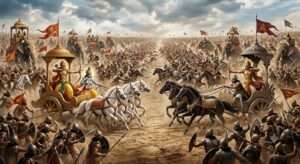
Hearing these warnings, Karna surveyed the battlefield with careful attention. Observing the strategic arrangements of Yudhishthira, he prepared his own counter-formation with deliberate precision. At that very moment, Shalya pointed toward Arjuna’s magnificent chariot, whose banner proudly bore the image of Hanuman. Arjuna advanced with irresistible martial enthusiasm as the Trigarta warriors surrounded him on every side. Yet from within their encirclement, he released an unending torrent of arrows that overwhelmed every opponent.
Karna observed that Arjuna, though surrounded by enemies, resembled the radiant sun momentarily veiled by passing clouds. Shalya immediately answered that just as the lord of waters could never become powerless within the ocean, and fire could never lose its strength within burning wood, so too Arjuna’s prowess could never be diminished by surrounding foes. Even if the winds ceased to blow or the oceans became exhausted of their waters, no warrior—not even the gods themselves—could hope to conquer Arjuna. Therefore, he advised Karna to abandon vain boasts and recognize the immeasurable power of his adversary.
Shalya continued by drawing Karna’s attention to the greatness of the entire Pandava host. He described Bhima as immovable as Mount Meru, praised the generosity and righteousness of Yudhishthira, admired the valor of Nakula and Sahadeva, and commended the youthful Upapandavas, whose courage adorned the battlefield. He concluded that the Pandavas stood firmly established in righteousness, and wherever dharma prevailed, victory would inevitably follow.
Soon the united Kaurava forces surged toward Arjuna, while the vast fourfold army of the Pandavas advanced to meet them. Their collision resembled the majestic confluence of the sacred Ganges and Yamuna, two mighty currents rushing together with irresistible force. Beholding Karna, Shalya, and the assembled kings, Duryodhana spoke with solemn encouragement. He promised that if they destroyed the Pandavas, immeasurable wealth and an undisputed kingdom would become theirs. Yet even should they fall in battle, they would attain the celestial worlds and enjoy everlasting glory. His inspiring words rekindled the spirit of the Kaurava army, whose warriors answered with thunderous cries of victory.
Thereupon Ashwatthama stepped forward and vowed that he would never remove his armor until he had slain Dhrishtadyumna, whom he held responsible for the deceitful killing of his father, Drona. Should Bhima or Arjuna attempt to shield Dhrishtadyumna, Ashwatthama swore they too would be consumed by the blazing fire of his arrows. Strengthened by such terrible vows, the Kaurava ranks advanced with renewed determination against the Pandavas.
The battle that followed astonished even the celestial hosts, whose eyes beheld scenes of indescribable heroism and destruction. As Sanjaya narrated the terrible carnage, it seemed as though the final dissolution of the world had drawn near. Warriors who fell with fearless hearts were welcomed by celestial nymphs, who adorned them with heavenly garlands while showers of fragrant blossoms descended from the skies. Gentle breezes carried the sweet perfume across the battlefield, offering a brief moment of relief to exhausted soldiers amid the relentless fury of war.
In another quarter of the field, Duryodhana advanced against Bhima with a formidable force of rogue elephants. Bhima answered by releasing devastating showers of arrows that shattered the confidence of the Kaurava warriors. Amid the deafening tumult of clashing armies, Karna’s chariot, surrounded by his loyal companions shouting cries of triumph, charged directly toward Yudhishthira. Yet before Karna could strike decisively, Arjuna swiftly intervened, placing himself between his elder brother and his lifelong rival.
The soldiers on both sides watched with breathless anticipation. Murmurs spread throughout the battlefield as they wondered whether Karna’s long-cherished desire to overcome Arjuna would finally be fulfilled. Some believed that if Karna prevailed, Duryodhana would reign securely over a kingdom freed forever from his enemies. Others waited silently, eager to witness the supreme display of archery that destiny itself had prepared. The approaching duel promised to reveal whether Karna’s lifelong aspiration would culminate in immortal victory or whether fate had already written another ending beyond the power of even the greatest of warriors.


worthy article. Excellent work. great work