



Happy Krishna Janmashtami
Shri Krishna Janmabhoomi is one of the holiest pilgrimage sites in Mathura, Uttar Pradesh, situated in the heart of Braj Bhoomi on the banks of the Yamuna. It is revered as the sacred birthplace of Lord Krishna, where, according to Hindu tradition, Sri Krishna manifested in the prison cell of King Kansa. The present temple complex includes the Keshav Dev Temple, the sacred Garbha Griha marking the traditional birthplace, and the Bhagavata Bhavan.
The sacred site has a very ancient history, although the exact date of the first temple cannot be established with certainty. According to Hindu tradition, Vajranabha, the great-grandson of Lord Krishna, established an early shrine at the birthplace. Historical evidence points to the existence of important temples at this location many centuries ago. The present temple complex, however, belongs mainly to the modern period and was developed through the efforts of devotees during the 20th century.
The main deity worshipped here is Lord Krishna in the form of Keshav Dev. The most sacred part of the complex is the Garbha Griha, traditionally identified as the prison cell where Devaki gave birth to Lord Krishna. Devotees also remember Vasudeva and Devaki, whose devotion and suffering form an important part of the story of Krishna’s birth.
For devotees, the importance of this place goes beyond the deity alone. Standing at the Janmabhoomi is considered a deeply emotional experience because it is believed to be the very place where the Divine appeared in human form to protect dharma and destroy evil.
The present Krishna Janmabhoomi complex consists of several important religious structures, including the Keshav Dev Temple, the Garbha Griha and the Bhagavata Bhavan. The temple buildings display elements of North Indian temple architecture, with traditional shikharas, decorated entrances and spacious prayer areas.
The Garbha Griha is especially significant because it represents the prison cell associated with Krishna’s birth. The simplicity and sacred atmosphere of this area make it different from the grand temple structures around it. For devotees, its spiritual importance is far greater than its architectural appearance.
Mathura is one of India’s oldest and most historically important cities. It has been associated with Lord Krishna since ancient times and has remained an important centre of Vaishnavism. Over the centuries, the sacred temple at Krishna Janmabhoomi was built, destroyed and rebuilt several times.
One of the most famous temples at the site was built during the reign of Raja Veer Singh Deo of Orchha in the early 17th century. It was a magnificent temple and became an important centre of Krishna worship. In 1670, during the reign of Mughal emperor Aurangzeb, the temple was destroyed, and the Shahi Idgah was later built adjacent to the sacred birthplace.
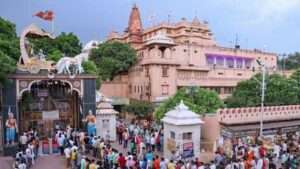
In the modern period, devotees once again worked towards restoring the importance of the sacred site. Jugal Kishore Birla played a major role in acquiring and developing the property, and the Shri Krishna Janmabhoomi Trust was established in the 20th century. The present temple complex gradually took shape through the efforts of many devotees and supporters.
The most sacred story of Shri Krishna Janmabhoomi begins with King Kansa, the ruler of Mathura. Kansa was the brother of Devaki. During Devaki’s marriage to Vasudeva, a divine prophecy announced that Devaki’s eighth child would become the cause of Kansa’s death.
Terrified by this prophecy, Kansa imprisoned Devaki and Vasudeva. Their children were born in the prison, but Kansa cruelly killed them one after another. Devaki and Vasudeva lived in constant fear, waiting for the birth of their eighth child.
At midnight, Lord Krishna was born as the eighth child of Devaki and Vasudeva. According to the Bhagavata tradition, at the moment of his birth, the prison was filled with divine light. Lord Vishnu appeared before Devaki and Vasudeva and revealed his divine identity. He assured them that he had taken birth to protect the righteous and destroy evil.
By divine grace, the prison guards fell asleep and the doors opened. Vasudeva placed the newborn Krishna in a basket and carried him through the night towards Gokula. The Yamuna was in flood, but Vasudeva crossed the river safely with the divine child.
He reached the home of Nanda and Yashoda and exchanged Krishna with their newborn daughter, Yogmaya. When Kansa later tried to kill the baby, she slipped from his hands and revealed her divine form, warning him that the child destined to destroy him was already beyond his reach.
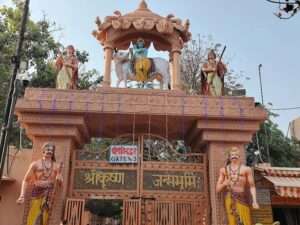
Krishna then grew up in Gokula and Vrindavan, where his childhood was filled with beautiful leelas. He later returned to Mathura and defeated Kansa, bringing an end to his cruel rule.
This is why Shri Krishna Janmabhoomi holds such a special place in the hearts of devotees. The story reminds us that even when darkness appears to have taken complete control, divine light can arise at the most unexpected moment. Krishna’s birth in a prison is therefore seen as a message of hope — that dharma will ultimately triumph over adharma.
The most important festival celebrated at Shri Krishna Janmabhoomi is Shri Krishna Janmashtami, which marks the birth of Lord Krishna. Devotees observe fasting, prayers, bhajans and religious ceremonies throughout the day. At midnight, the traditional hour of Krishna’s birth, special prayers and celebrations are held, and the temple becomes filled with devotional chants and the joyful remembrance of Balakrishna.
The entire city of Mathura comes alive during Janmashtami, with processions, decorations, bhajans and cultural programmes. Dahi Handi and other Krishna-related celebrations are also associated with the wider Braj region. Other important festivals celebrated with devotion include Radhashtami, Holi, Govardhan Puja and Diwali.

