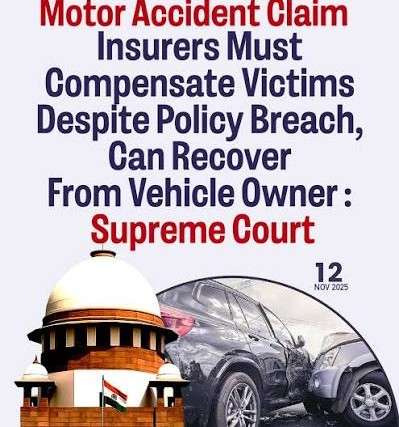
New Delhi: In a significant verdict aimed at bringing uniformity to motor accident compensation, the Supreme Court on Wednesday laid down guidelines on how courts should determine the annual income of deceased victims or injured claimants on the basis of Income Tax Returns.
The top court held for salaried individuals, only the Income Tax Return (ITR) of the previous year will be sufficient for showcasing the annual income and for self-employed persons, it held that the average income disclosed in ITRs for up to the previous three years should ordinarily serve as the reference point.
A bench of justices Sanjay Karol and N Kotiswar Singh held that there cannot be a rigid formula for computing annual income under the Motor Vehicles Act, but drew a clear distinction between salaried employees and self-employed persons for the purpose of assessing compensation based on their ITRs.
- Documented Income: Tribunals must count all valid salary components and emoluments, deducting only the tax liability. If formal proof is absent, a degree of reasonable guesswork based on oral evidence and the concept of “preponderance of probability” is permissible.
- No Proof of Income: If the victim’s income cannot be established, tribunals must reckon income using the state’s applicable minimum wage.
- Homemakers: Recognizing the profound economic value of unpaid domestic work, the Court established a minimum notional income of ₹30,000 per month for homemakers and introduced ‘Loss of Domestic Care’ as an independent head of compensation.
- Minors: Children who suffer death or permanent disability cannot be treated as non-earning. Their income is calculated using the minimum wage of a skilled workman.2. Additions for Future Prospects
- Below 40 years: 50%
- 40 to 50 years: 30%
- 50 to 60 years: 15%
- Bachelors / Unmarried: 50%
- Married (up to 3 dependents): 33%
- Married (4 to 6 dependents): 25%
- Married (more than 6 dependents): 20%
- 15 to 25 years: 18
- 26 to 30 years: 17
- 31 to 35 years: 16
- 36 to 40 years: 15
- 41 to 50 years: 14
- 51 to 55 years: 11
- 56 to 60 years: 10
- Above 60 years: 9 5. Conventional Heads & Additional Rulings
- Standard Additions: Fixed amounts are awarded under conventional heads like Loss of Estate (₹15,000), Funeral Expenses (₹15,000), and Spousal/Filial Consortium (₹40,000), with a 10% enhancement every three years. [1]
- Disability Claims: The Court recently ruled (in SC rules that motor accident compensation must be based on….) that compensation for permanent injury must be based on functional disability and loss of earning capacity, rather than just the physical disability percentage assessed by doctors. [1]