Dr Sandhya Bombay
Three Puranas—the Matsya, Vayu, and Brahmanda—preserve the names of every king who ruled after the Kurukshetra War and before the historical king Mahapadma Nanda.
They preserve even the duration of each king’s reign, down to the minutest detail.
This detailing continues for every king of the Nanda, Maurya, Sunga, Kanva, and Satavahana dynasties, while the Guptas are mentioned as a group.
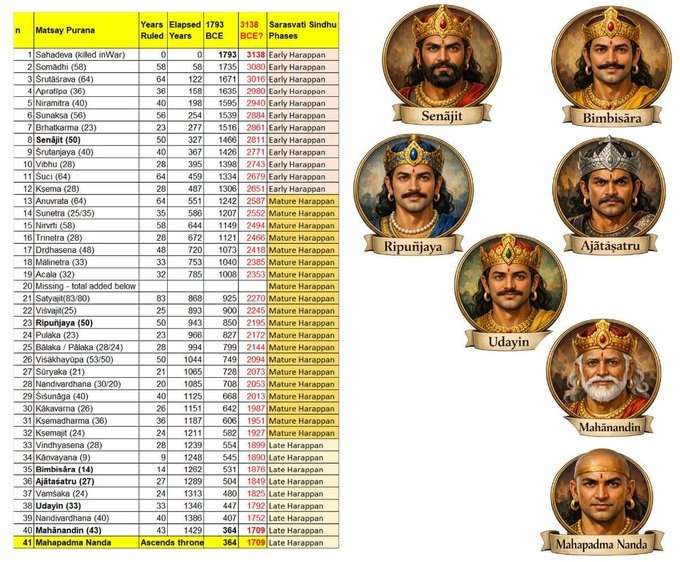
We present here the chronology up to the coronation of Mahapadma Nanda.
Have you ever seen all these names together in one picture?
While the Buddhist and Jain sources preserve many events related to a few of these kings because of their interactions with Buddha or Mahavira, only the Puranas preserve the full chronology from the Kurukshetra War to the rule of the Nandas, Mauryas, Sungas, Kanvas, and Satavahanas.
But the most important revelation is this:
The Puranic chronology makes coherent historical sense only if the Kurukshetra War is dated to 1793 BCE, or to a date close to itA simple glance at this research will tell you why.
Look at the table listing every king who ruled after the Kurukshetra War up to the coronation of Mahapadma Nanda.
One column gives their regnal years based on the Kurukshetra War being dated to 1793 BCE.
Another is based on 3138 BCE as the date of the Kurukshetra War—a representative date for the 3200–3000 BCE period.
Now, here is the interesting part.
If we place the Kurukshetra War in 3138 BCE, all these kings become contemporaries of the Sarasvati-Sindhu Civilization and its Early, Mature, and Late Harappan phases.
We all know that this great civilisation flourished in north-western India in the region of the Sarasvati, Sindhu, and their tributary networks.
But these kings ruled to its east, along the Ganga, Sarayu, Gandaki, and Shona rivers in present-day Uttar Pradesh and Bihar.
Can you detect the anomaly?
There is not even a single mention in the Puranas of the great Sarasvati-Sindhu Civilization as being contemporary with any of these kings.
We also know that when the Early and Mature phases of the Sarasvati-Sindhu Civilization flourished between 3300 and 1900 BCE, its eastern region around the Ganga was comparatively less developed and less prosperous.
Yet, those who date the Kurukshetra War to the 3200–3000 BCE period argue that these kings ruled as the eastern neighbours of the highly prosperous IVC/Harappan/Sarasvati-Sindhu region along the Ganga Basin.
However, they have produced no evidence to demonstrate that the Ganga Basin enjoyed a level of prosperity comparable to that of the Sarasvati and Sindhu regions during 3300–1900 BCE.
Contrast this with our chronology.
We identify the Early and Mature Harappan phases (3300–1900 BCE) of the Sarasvati-Sindhu Civilization as corresponding to the Rigvedic period.
Our chronology places Santanu in 1950–1850 BCE, and dates the Kurukshetra War to 1793 BCE.
The regnal periods of these kings then align correctly with the Late Harappan period and its continuity up to 364 BCE, when the coronation of Mahapadma Nanda took place, in accordance with the mainstream chronology.
Not even a single year needs to be added or subtracted.
Every king aligns perfectly.
This includes Jarasandha’s son Sahadeva, who was killed in the Kurukshetra War; his last descendant, Ripunjaya; and the later Magadha kings such as the famous Bimbisara and Ajatasatru, who are correctly placed as contemporaries of the Buddha in the 6th and 5th centuries BCE, as well as Mahanandin and his ouster by Mahapadma Nanda in 364 BCE.
Everything aligns perfectly.