



Mantra 6
अथादित्य उदयन्यत्प्राचीं दिशं प्रविशति तेन प्राच्यान् प्राणान्
रश्मिषु सन्निधत्ते । यद्दक्षिणां यत् प्रतीचीं यदुदीचीं यदधो
यदूर्ध्वं यदन्तरा दिशो यत् सर्वं प्रकाशयति तेन सर्वान् प्राणान्
रश्मिषु सन्निधत्ते ॥ १.६॥
athāditya udayanyatprācīṃ diśaṃ praviśati tena prācyān prāṇān
raśmiṣu sannidhatte . yaddakṣiṇāṃ yat pratīcīṃ yadudīcīṃ yadadho
yadūrdhvaṃ yadantarā diśo yat sarvaṃ prakāśayati tena sarvān prāṇān
raśmiṣu sannidhatte .. 1.6..
Now, the sun rises towards the east, and it embraces all creatures in the east with its rays. Then it lights up the southern, the western, the northern quarters, the above, the below, and the intermediary quarters, and all; by that it absorbs all creatures with its rays.
This mantra talks of the Sun as the presiding deity of prana, which is energy, and the Moon is the presiding deity of matter. The master is glorifying the Sun that which vitalises energy. The pictures of Earth from the Moon show that half the hemisphere is bright and the other half hemisphere is dark because the reflection of the Moon is falling on the Earth. When the Sun rises, the entire hemisphere gets into activity and vibrancy. The other hemisphere gets into sloth, inactivity. Master is giving a poetic expression of the Sun, prana, which is the energy. Energy + Matter = Life. That which vitalises life is the Sun.
Mantra 7
स एष वैश्वानरो विश्वरूपः प्राणोऽग्निरुदयते ।
तदेतदृचाऽभ्युक्तम् ॥ १.७॥
sa eṣa vaiśvānaro viśvarūpaḥ prāṇo’gnirudayate .
tadetadṛcā’bhyuktam .. 1.7..
He is Vaishvanara – the totality of all living beings, assuming all forms of prana, the fire that rises every day. This has been said in the mantra of Rig Veda.
The Guru refers to Vaishvanara at the macrocosm as energy, the sun, prana, which vitalises everything, and at the microcosm it is referred to as the fire within.
There is direct mention of the word Vaishvanara in the Bhagavad Gita – Chp. 15 – Vs. 14. It is the same as mentioned in the Vedas. Vedas are the source, and the Bhagavad Gita is the explanatory text of the Vedas.
Consciousness expresses at the microcosm and macrocosm level as:
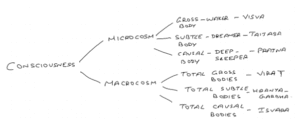
These are various terminologies used in the shastras / Vedantic language to describe Consciousness with reference to microcosm and macrocosm. At the microcosm level, when Consciousness operates through the gross body, you become the waker known as Visva; through the subtle body, it is the dreamer Taijasa; and through the causal body, you become the deep-sleeper Prajna. At macrocosm level, the Consciousness operating through the total gross body is called Virat, the total subtle body is called Hiranyagarbha, and the total causal body is called Isvara.
In mantra 7, the Guru is talking of the microcosm. In the waker, the hunger or fire in an individual is referred as Vaishvanara. Without the fire, there is no hunger; you cannot eat and you cease to exist. To perform action karma, you draw the energy from the food, you need the fire within. Sun is the Vaishvanara at macrocosm.
This has been said in the mantra of Rig Veda. Prashnopanishad appears in Atharvana Veda, and it is a Brahmanopanishad, an explanatory text. Rig Veda is a Mantropanishad, which is an authoritative text. The Guru is mentioning that it is not his own words but is quoting the great Gurus of the authoritative text. The Guru, by referring to the Rig Veda, does not make himself any less than the Gurus of Rig Veda.
Each Guru brings in their personality and wisdom in disseminating this profound knowledge of Sanatana Dharma. Every Guru, with humility refers to the Gurus of past. Though they have realised the Self, they do not claim or arrogate them to be their wisdom.
Sage Vyasa codified the Vedas. Vyasa means one who has codifier. His name was Krishna Dwaipayana but was well known as Veda Vyasa. The Vedas were given many centuries ago, and Vyasa came much later and codified it into different texts. The chronological order of the Vedas is:
- Rig Veda
- Sama Veda
- Yajur Veda
- Atharvana Veda
Atharvana Veda is a more practical and explanatory textbook. Whereas the Rig Veda is brief, short, profound, intense, cryptic with divinity.
Mantra 8
विश्वरूपं हरिणं जातवेदसं
परायणं ज्योतिरेकं तपन्तम् ।
सहस्ररश्मिः शतधा वर्तमानः
प्राणः प्रजानामुदयत्येष सूर्यः ॥ १.८॥
viśvarūpaṃ hariṇaṃ jātavedasaṃ
parāyaṇaṃ jyotirekaṃ tapantam .
sahasraraśmiḥ śatadhā vartamānaḥ
prāṇaḥ prajānāmudayatyeṣa sūryaḥ .. 1.8..
The knowers know that, which is of all forms, the resplendent, the highest goal, the one light, and the radiator of heat. It is the thousand-rayed rising sun, existing in a hundred forms as the life of all creatures.
The Rig Veda as well describes the sun as creator, Prajapati. Sun is not to be perceived as mere light, but as a vitality which expresses through matter. Those who have gone through subjective experience and meditated on the sun may realise it. One who is able to perceive Self-realisation as the goal and act towards it, every other pursuit in life seems dwarfed.
Just as, every other mountain gets dwarfed in the presence of mighty Mount Everest. Sun being glorified as the highest goal means Self-realisation is the highest pursuit. The floodlight of a stadium becomes insignificant in sunshine. Similarly, nothing else should matter in life other than the goal of Self-realisation. The same macrocosm sun, is referred to as the microcosm, the life of all creatures.

