



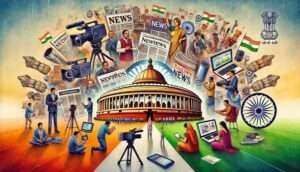
The true test of democracy lies not in the strength of power, but in the safety of those who question it. A country where journalists can openly question government policies, administrative failures, corruption, and anti-people decisions, democracy thrives. However, in a system where those who question are viewed with suspicion, criticism is treated as hostility, and dissent is criminalized, concerns about the strength of democratic institutions are natural. Press freedom is not just a journalist’s right, but also the public’s right to know. The provision for freedom of expression in Article 19(1)(a) of the Constitution is the foundation of this democratic consciousness. In cases like Romesh Thapar v. State of Madras (1950) and Indian Express Newspapers v. Union of India (1985), the Supreme Court recognized press freedom as an essential component of the right to expression. This right is not a gift bestowed by power, but rather a part of the constitutional dignity of citizens in a democracy.
The responsibility of journalism is not merely to report events, but also to expose the truth behind them. It’s easy to publicize the success of government schemes, but it takes courage to expose the corruption within them, the true plight of beneficiaries, administrative apathy, and the suffering of the public. When a journalist investigates a scam, holds an official accountable, brings a victim’s voice to power, or questions the consequences of a policy decision, they protect democracy. However, if the media becomes a platform for the achievements of power and remains silent on its failures, journalism deviates from its original purpose. In a democracy, power may be uncomfortable with questions, but being uncomfortable with questions and suppressing them are two different things.
The biggest crisis facing the media today is not only the safety of journalists, but also their independence and credibility. Pressure on journalists comes in many forms: threats to stop advertising, fear of lawsuits, denial of government access, institutional pressure, and attempts to silence their voices through outright violence. This crisis is even more acute for independent journalists, as they lack the legal teams, financial resources, and institutional protections of larger media organizations. A freelancer or local journalist often lacks the economic and social protection they need to meet the risks they take while investigating a story. Journalistic courage is measured not by awards and accolades, but by the risks they take to uncover the truth.
Violence against journalists is the most horrific manifestation of this crisis. The murder of Gauri Lankesh in 2017 shocked the nation and raised questions about how safe dissenting journalists are. The murder of a journalist not only silences the voice of one individual, but also creates an atmosphere of fear in society. When a journalist is attacked, many others begin to reconsider their reporting, their words, and their questions. The real purpose of violence is not merely to silence the victim, but to intimidate all those who dare to speak the truth. The self-censorship born of this fear can be more dangerous than any direct ban, as it leads journalists to withhold their pens.
The digital age has given journalism new strength, but this same digital world has also created a new arena for harassment for journalists. Trolling, threats, character assassination, public disclosure of personal information, and organized online attacks on social media particularly target women journalists. Disagreeing with a news story is a democratic right, but attacking a journalist’s family, personal life, and character is not criticism but an intimidation tactic. When a woman journalist is insulted based on her identity, personal life, or gender, rather than her views, it is not merely personal harassment but an attempt to corrupt public discourse. In such circumstances, journalists’ retreat is not merely a personal loss but a loss to society’s right to information.
Digital surveillance has also emerged as a serious challenge to independent journalism. The threat of monitoring journalists’ phones, digital devices, and communication media threatens the confidentiality of sources. In investigative journalism, informants often uncover facts related to corruption, administrative irregularities, or sensitive matters. If they fear their identities may be exposed, they may refrain from speaking out. As a result, many important stories may die before they reach the public eye. The Pegasus controversy and the Supreme Court’s 2021 investigation into the matter have brought the issues of surveillance, privacy, and journalistic freedom to the forefront of national debate. The protection of sources is not only a technical necessity of journalism but also a fundamental condition of democratic trust.
Internet shutdowns, restrictions on digital content, and disruptions to the flow of information also impact the functioning of journalism. In Anuradha Bhasin v. Union of India (2020), the Supreme Court emphasized the need to review internet restrictions and the principle of proportionality. Digital media is today a major medium for news gathering, broadcasting, communication, and public relations. Internet disruptions not only impact citizens’ expression but also journalists’ reporting, access to news, and public discourse. Restrictions may be justified in the name of security and public order, but their indefinite, widespread, and opaque use can undermine democratic rights.
Additionally, digital journalism is facing an economic crisis. A significant portion of advertising is going to technology platforms, while news organizations’ revenues are declining. Social media algorithms determine which news reaches the most people and which is left out of reach. Sensational content, emotional reactions, and controversies often outweigh serious journalism. In this system, journalists face a double crisis—on the one hand, the responsibility to produce credible news, and on the other, the pressure to survive in digital competition. When journalism’s economic independence weakens, editorial independence is also threatened. Advertisers, political interests, and platform priorities begin to influence the direction of news.
Freedom of journalists does not mean that they are above the law or that they should be allowed to spread misinformation, defame, or incite social violence. Article 19(2) of the Constitution allows for reasonable restrictions on freedom of expression. However, the restrictions must be fair, clear, necessary, and proportionate. In Media One v. Union of India (2023), the Supreme Court underscored the importance of judicial review and fair process for restrictions imposed on national security grounds. Critical views cannot be labeled anti-national or anti-establishment simply because they disagree with government policies. The government and the nation are not synonymous; criticism of the government is part of democratic citizenship.
To safeguard independent journalism, laws alone are not sufficient; a democratic culture is also essential. Cases of violence against journalists must be investigated impartially and promptly. Police and administration must adopt clear protocols for legitimate journalistic activities. Independent journalists must be provided with legal assistance, digital security training, secure communication channels, and protection of source confidentiality. Media organizations must also prioritize the safety, mental health, and financial stability of their journalists. Social media companies must be held accountable so that online harassment and organized threats are not ignored in the name of freedom of expression.
In a democracy, journalism’s job isn’t to praise the government or oppose every decision; its job is to expose the truth based on facts. Journalists are neither permanent opponents of power nor permanent supporters. Their allegiance should be to the Constitution, truth, and the people. If press freedom is weakened, citizens’ rights will be weakened, public accountability will be weakened, and democracy will gradually become a mere formality. In a society where those who ask questions are protected, the government remains accountable; and in a society where those who ask questions are intimidated, gradually fewer truth-tellers and more silent ones emerge. To save democracy, elections alone are not enough; a free press is also essential—because power may change, governments may change, but the public’s right to know the truth must never be altered.


