



For decades, the phrase Vishwa Guru was dismissed by critics as civilisational nostalgia or political rhetoric. Today, however, there are increasingly tangible signs that Bharat is not merely aspiring to regain its place as a global teacher, but is beginning to influence how other nations think, govern and conduct their affairs.
The latest example is particularly striking. US President Donald Trump has pointed to Bharat’s voter-identification system while campaigning for tighter electoral safeguards in America. His administration’s proposed SAVE America Act seeks, among other things, to require valid identification and proof of citizenship in federal elections. Trump has specifically cited Bharat’s practice of voter identification to make the case that electoral integrity measures are both practical and necessary. The US House has also considered the Voter ID Act, H.R. 9368, which would make identification a condition for voting in federal elections.
The significance goes beyond one piece of American legislation. For years, the West often presented its institutions as the template that developing countries should emulate. The direction of influence is now becoming less one-sided. Bharat’s electoral experience, digital public infrastructure and civilisational knowledge are increasingly being examined abroad not as curiosities, but as workable models.
Consider digital payments. UPI has transformed everyday transactions in Bharat by making instant payments cheap, accessible and ubiquitous. By July 2026, UPI was processing about 24 billion transactions a month, with a value of nearly ₹29.87 trillion. Its architecture is also attracting international interest, with several countries adopting or linking to UPI-based systems.
Then there is Yoga. What was once derided in parts of the West as an exotic Indian practice has become a global wellness phenomenon. The United Nations declared June 21 the International Day of Yoga in 2014 after a record 175 member states supported the proposal. In 2026, the UN and WHO continued to recognise Yoga’s contribution to physical and mental well-being, with this year’s theme being “Yoga for Healthy Ageing”.
These examples matter because genuine civilisational influence is rarely created through speeches. It happens when the rest of the world begins voluntarily adopting what Bharat has developed or preserved.
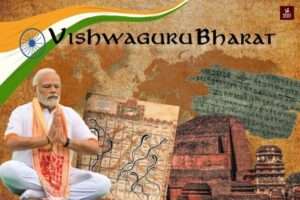
Yet, declaring Bharat already a Vishwa Guru would be premature. A teacher must first demonstrate excellence at home. Bharat still has enormous unfinished business—poverty, unequal access to quality education and healthcare, judicial delays, urban congestion, bureaucratic inefficiency, unemployment and regional disparities. Becoming a $5-trillion or larger economy is important, but economic size alone does not confer civilisational leadership.
The real test is whether Bharat can combine economic power with social stability, technological innovation with human development, military strength with strategic wisdom and ancient wisdom with modern scientific thinking.
That is why 2047—the centenary of Independence—is not merely an arbitrary date. It provides a national deadline to convert aspiration into achievement. The vision articulated by national leaders of a developed Bharat by 2047 is ultimately about building a country capable of shaping global outcomes rather than merely responding to them. President Droupadi Murmu, too, has repeatedly linked Bharat’s development journey to that centenary milestone.
The emerging picture, therefore, is neither that Bharat has already arrived nor that Vishwa Guru is an empty slogan. The more convincing conclusion lies somewhere in between: the journey has unmistakably begun.
When Washington looks at Bharat’s voter-ID experience, when the world embraces Yoga rooted in Indian civilisation, and when countries explore Bharat’s digital public infrastructure, these are not isolated compliments. They are early indicators of a changing global equation.
For centuries, Bharat’s knowledge travelled outward. Colonialism interrupted that civilisational confidence. The task before the present generation is not to boast about a glorious past, but to build a future worthy of it.
Vishwa Guru cannot be demanded. It has to be earned. And increasingly, the world is beginning to notice that Bharat may once again have something worth learning from.

