


How TG20’s Glittering Inaugural Auction Spat in the Face of an Entire State
Special Correspondent
Someone had a beautiful dream.
They dreamt that Tilak Varma — Telangana’s brightest cricketing star, the boy who escaped this very system and conquered every stage placed before him — stood up at the TG20 auction and said something extraordinary.
“Take my entire ₹33 lakh auction value. Don’t give it to me. Distribute it equally among every district player in this league.”
It was a dream.
Of course, it was a dream.
Because reality looked very different.
Welcome to the Telangana Premier League.
Population: Hyderabad.
The Grand Production
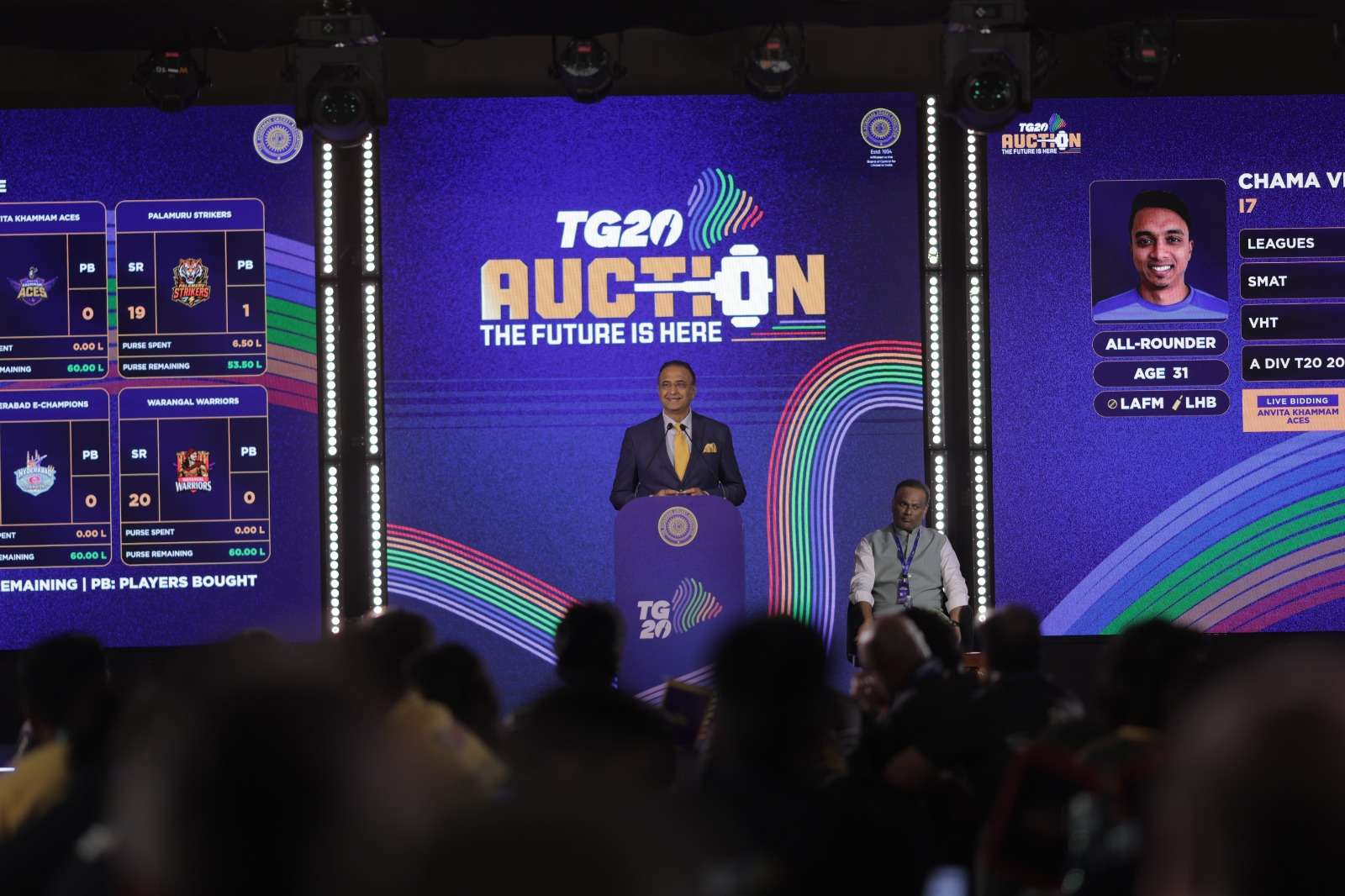
The setting was impeccable.
A five-star hotel on the outskirts of Hyderabad. Chandeliers. Lavish hospitality. Eight franchise owners are seated at decorated tables. One of India’s finest broadcasters, Charu Sharma, is conducting proceedings with his customary professionalism.
The cameras rolled.
The social-media machinery hummed.
Every detail appeared meticulously planned.
And why not? If presentation alone could build a cricket ecosystem, Telangana cricket would already be a global powerhouse.
For a few hours, TG20 looked every bit the ambitious league its promoters had promised.
Then the numbers arrived.
And the numbers told a very different story.
The Numbers. Just the Numbers.
Let us put aside emotions and focus only on the auction results.
Because arithmetic is often the most unforgiving critic.
A total of 160 players were selected across eight franchises.
Of those 160 players, only 32 came from Telangana’s districts.
Twenty percent.
The combined purse available to all franchises stood at ₹4.8 crore.
The amount spent on district players was approximately ₹35 lakh.
Seven percent.
Now consider Telangana’s geography.
Hyderabad accounts for roughly 15 percent of Telangana’s population.
Yet Hyderabad-based players received 93 percent of the auction money and occupied 80 percent of all squad positions.
A city representing 15 percent of the state’s population received 93 percent of the financial rewards.
The remaining 85 percent of Telangana received just 7 percent.
If these figures emerged from a government allocation, a development programme or a corporate distribution model, serious questions
would be raised immediately.
In TG20, they were presented as a celebration of Telangana cricket.
The Quota. The Farce. The Forcing.
The district-player quota was supposedly designed to ensure statewide representation.
In reality, it appeared more like an afterthought.
Instead of being integrated into the auction process from the beginning, district players were pushed into an accelerated segment after franchises had already spent the bulk of their budgets on Hyderabad cricketers.
The consequence was predictable.
District players who had trained, qualified and registered for the auction found themselves being considered only after most teams had exhausted their spending power.
Many were selected not because franchises actively pursued them but because regulations required their presence.
Some teams appeared reluctant even then.
Ranga Reddy Risers deserve recognition for completing their district-player quota without controversy or hesitation.
Others were not so enthusiastic.
Karimnagar Diamonds reportedly had to be reminded repeatedly to complete their district quota.
Consider the irony.
Karimnagar was one of the emotional centres of the Telangana statehood movement. Its students, activists and ordinary citizens played a defining role in the struggle that eventually created Telangana.
Today, Telangana has its own cricket league.
That league has a franchise carrying Karimnagar’s name.
And during the inaugural auction of the so-called Telangana Premier League, that franchise reportedly needed persuasion to select cricketers from Telangana’s districts.
The contradiction is difficult to ignore.
Only Charu Sharma’s repeated interventions from the dais ensured that the district quota was eventually completed.
He arrived to conduct an auction.
Instead, he found himself repeatedly reminding franchises of their obligation to represent the state whose name the league proudly carries.
That fact alone raises uncomfortable questions about the priorities of those running the show.
The Agents Take the Stage
For years, Hyderabad cricket has been dogged by allegations involving agents, academy operators and influence networks that allegedly shape opportunities for young cricketers.
Parents have complained.
Questions have been raised.
Concerns have repeatedly surfaced regarding how opportunities are distributed within the system.
The TG20 auction did little to dispel those perceptions.
Individuals long associated with these discussions were visible around the auction ecosystem, advising franchises and influencing decisions, reinforcing the belief that the same power structures continue to dominate Hyderabad cricket.
The result was predictable.
Academy-linked players often appeared to enjoy stronger visibility, better categories and greater bidding interest.
Others seemed destined merely to fill squad numbers.
Whether by design or by circumstance, the auction reflected existing hierarchies rather than challenging them.
The pools.
The categories.
The reserve prices.
The sequencing.
Almost every structural element appeared to favour the established Hyderabad ecosystem.
Far from creating a fresh pathway for talent across Telangana, the inaugural auction largely reinforced the structures already controlling the game.
The old system was not disrupted.
It was televised.
Back to the Dream
Someone dreamt that Tilak Varma gave it all away.
Every rupee of his auction value redistributed among the boys the system forgot.
It was a beautiful dream.
But dreams are not the problem.
Reality is.
The reality is that Telangana cricket cannot truly grow if Telangana itself remains an afterthought.
Every district has cricketers.
Every district has coaches.
Every district has parents sacrificing time, money, and hope in pursuit of a sporting future for their children.
They are not asking for charity.
They are asking for an opportunity.
The inaugural TG20 auction revealed a league that carried Telangana in its name but Hyderabad in its heart, purse and priorities.
The challenge before TG20 is not organising a larger auction next season.
It is not booking a bigger ballroom.
It is not creating more social-media buzz.
The challenge is much simpler.
Decide whether this league genuinely belongs to Telangana or whether it is merely a Hyderabad cricket festival wrapped in a Telangana label.
Until that question is honestly answered, the scorecard from the inaugural auction will remain impossible to ignore.
Eighty percent of the players.
Ninety-three percent of the money.
One city.
The rest of Telangana got the leftovers.



Few points to add from my view:
1. Refer to C2 grade player announcing..it was mentioned only “pre – nominated” and is only 150 to 200 max out of 900+ players
2. It was mentioned that pre- nominated” are players selected from trails from franchises
– but they limited the trails to certain groups and references only..
Due this reason ..many players out performed are not even got auction announcement..