Lakshmanrao Upadhyayula
The venerable sage Śaunaka Gṛtsamada, endowed with profound insight into the mysteries of the Veda, raises this majestic hymn to Brahmaṇaspati, the Lord of the sacred utterance, in the exalted metres of Jagatī and Triṣṭubh as preserved in the Rigveda. In these resonant verses, Brahmaṇaspati is invoked as the sovereign of wisdom and prosperity among the gods, the divine power who presides over prayer, knowledge, and the creative potency of speech. He is hailed as Gaṇapati, the leader of celestial hosts, and as the foremost poet among poets, whose insight gives birth to all inspired expression. His nourishment is supreme, not merely as material abundance, but as the subtle sustenance of intellect, virtue, and spiritual illumination.
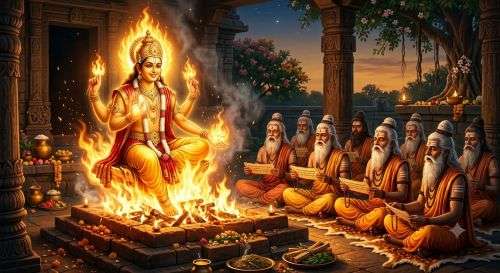
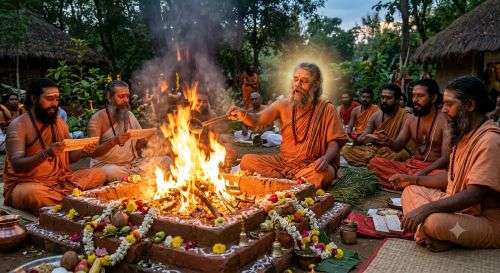
The seer invites Brahmaṇaspati to the sacred precincts of the yajña, entreating him to hear the hymns of devotion and to take his seat upon the consecrated altar. In the Vedic worldview, the yajña is not a mere ritual performance, but a profound act of harmonising the individual with the cosmic order known as Ṛta. Brahmaṇaspati, as the Lord of the mantra, transforms human speech into a force that resonates with universal intelligence. Just as sound waves in modern science organise matter into coherent patterns, so the disciplined vibration of mantra aligns thought, emotion, and action with the sustaining principles of the universe.
Brahmaṇaspati is praised as the destroyer of the Asuras, the powers that obstruct light and truth. These adversaries are not only mythic beings but also symbolic representations of ignorance, arrogance, and inner fragmentation. Through the radiance of his wisdom, the gods secure their rightful share of the yajña, signifying that noble faculties flourish when consciousness is properly ordered. As the sun releases its rays from a central flame, so Brahmaṇaspati emanates all hymns from the inexhaustible source of divine intelligence.
The hymn depicts him as subduing hostile forces in all four directions and dispersing the darkness that veils perception. He rides in a resplendent chariot sanctified by sacrifice, fierce in splendour and irresistible in power. This image conveys the dynamic movement of awakened consciousness. The chariot symbolises disciplined intellect, the horses represent vital energies, and the luminous path reflects the journey from confusion to clarity. Scientific inquiry likewise advances by removing obscurity and bringing hidden patterns into the light of understanding.
Brahmaṇaspati guides those who offer oblations along the righteous path and protects them from the consequences of sin. Here sin is understood as action arising from ignorance and disharmony. Those who honour sacred wisdom are guarded by the very order they uphold, while those who despise truth and mock the Vedic word become victims of their own anger and confusion. The hymn thus presents a universal law: alignment with truth fosters stability, whereas hostility toward truth generates suffering.
Whomever Brahmaṇaspati protects is freed from grief, injury, and fear. Neither enemies, thieves, nor violent forces can prevail against one who lives under the guardianship of divine wisdom. On an inner level, this protection signifies freedom from destructive thoughts and emotional disturbances. In psychological terms, a mind grounded in higher principles becomes resilient and less vulnerable to anxiety, manipulation, and moral decline.
The sage prays for Brahmaṇaspati to remove the arrogant and greedy who obstruct the righteous path. Pride intoxicates the mind and causes one to grasp at everything while remaining blind to the sacred purpose of life. The prayer does not arise from hatred but from a desire that disorder should be neutralised and the path of yajña made clear. Spiritually, it is an appeal for the removal of all tendencies that hinder self-mastery and noble action.
Brahmaṇaspati is invoked as the protector of descendants and future generations. The Vedic seers understood that the preservation of wisdom is the highest inheritance. Wealth and power are transient, but knowledge, character, and devotion endure. To seek the blessing of Brahmaṇaspati for one’s children and grandchildren is to pray that they may inherit discernment, ethical strength, and reverence for truth.
Those who oppose yajña, whether from near or far, are to be restrained by the divine power of Brahmaṇaspati. The hymn recognises that disruptive influences may arise externally as social hostility or internally as doubt and negligence. The prayer asks that these forces be treated as enemies of harmony and transformed or removed. In modern terms, it reflects the need to protect meaningful work and moral purpose from both visible and subtle forms of interference.
Brahmaṇaspati is celebrated as the fulfiller of worthy aspirations, the giver of nourishing food, and the bestower of prosperity grounded in righteousness. True abundance in the Vedic sense includes physical sustenance, intellectual clarity, emotional balance, and spiritual insight. The devotee prays not merely for possessions but for excellence of character, elevation to honourable status, and the capacity to contribute to the welfare of the world.
In battle, Brahmaṇaspati is the divine strategist and protector. He is invited to the field of conflict, meditated upon with reverence, and trusted to overturn the violence of hostile armies. Yet the deepest battle is the struggle within the human heart, where truth contends with falsehood and discipline with impulsiveness. Brahmaṇaspati grants courage, composure, and moral strength, enabling the seeker to conquer the enemies of the soul.
The hymn asks that the weapons of those who deny the divine and seek to injure the righteous may fail. This expresses confidence that destructive intentions lose their power when confronted by integrity and divine protection. From a psychological perspective, the focused and disciplined mind is less affected by negativity, just as a stable system resists external disturbance.
Brahmaṇaspati is associated with radiant wealth, or Brahma-tejas, the splendour born of spiritual knowledge. This luminous power enlightens rituals, brightens intellects, and causes all noble endeavours to flourish. Unlike material riches, which diminish with use, Brahma-tejas grows through sharing and practice. It is the inner brilliance that inspires learning, ethical conduct, and compassionate leadership.
The hymn recalls that Tvaṣṭṛ fashioned Brahmaṇaspati as the most excellent among beings and the source of correct pronunciation and naming. In Vedic thought, naming is an act of cognition that reveals the essence of things. Language structures understanding, and precise articulation reflects disciplined awareness. This insight harmonises with modern linguistics and cognitive science, which recognise that language shapes perception and conceptual thought.
As a descendant of the illustrious Angiras lineage, Brahmaṇaspati is the revealer of the hidden cows imprisoned within the mountains. The cows symbolise rays of knowledge concealed by ignorance. Assisted by Indra, he breaks open the cave and releases both the cows and the waters restrained by Vṛtra. This celebrated myth represents the liberation of insight and life energy when obstructions are overcome. It parallels the scientific act of discovery, in which hidden principles are uncovered and new streams of understanding are released.
Brahmaṇaspati is finally praised as the ordainer of worlds and the guardian of sacred knowledge. The very name “Brahmaṇaspati” means “Lord of the Brahman,” the divine Word and the wisdom preserved in the Vedas. He protects revelation, increases sustenance, and preserves the yajña from all harm. Those under his protection become auspicious wherever they dwell, and their lives radiate order, generosity, and serenity.
With children and grandchildren gathered around the sacrificial fire, the devotees sing melodious hymns to Brahmaṇaspati, seeking not only prosperity but enduring participation in cosmic harmony. This ancient prayer remains timeless. It teaches that speech becomes sacred when aligned with truth, knowledge becomes luminous when joined with humility, and prosperity becomes meaningful when dedicated to the welfare of all beings. Brahmaṇaspati thus stands as the eternal guardian of wisdom, the power behind inspired speech, and the divine intelligence that leads humanity from darkness to light.