



Siwani’s decade-old just demands
Democracy is not just a system of voting; it is also a continuous process of governance in accordance with the needs, conveniences, and aspirations of the people. In any democratic system, administrative boundaries are not permanent. They are reorganized according to time, circumstances, population, development, and public convenience requirements. Administrative units are created to ensure citizens have easy access to governance and government services. If an administrative system begins to cause inconvenience rather than convenience to the public, the need for its reconsideration becomes natural and justified. The demand to separate the Siwani subdivision of Haryana from Bhiwani district and include it in Hisar district is a practical, logical, and public-interest demand that has been raised continuously for the past ten years.
This demand isn’t the result of political gain, regional rivalry, or emotional impulse. It’s driven by numerous compelling reasons, including the Siwani region’s geographical location, transportation system, economic activities, social relations, and administrative needs. Launched in August 2016 by a few conscious citizens and social workers, this campaign has gradually become the collective voice of the entire region. At the time, it was just an idea, but today it has become the shared aspiration of thousands.
The most important feature of this demand is its consistency and mass support. The movement formally began in August 2016, when six conscious citizens—Badwa’s prominent social worker Mahendra Lakhera, Sunil Singhmar (Advocate), Lal Singh ‘Lalu’, Dr. Satyawan Saurabh, Surendra Bhukkal, and Mukesh Bhukkal—joined forces to elevate the issue beyond personal inconvenience and raise it as a matter of public interest. Perhaps no one at the time imagined that this initiative would become the voice of Siwani’s collective consciousness in the years to come. Initially, the struggle was limited to a few meetings, memorandums, and discussions, but as ordinary people began to see their everyday problems connected to this demand, the movement’s scope expanded. Farmers, businessmen, students, employees, and social organizations began to support the issue. As a result, the campaign became the common voice of the entire Siwani subdivision, not the initiative of any one individual, committee, or organization. This struggle, which has been going on peacefully and democratically for almost a decade, is proof that this demand is not the result of any momentary sentiment, but is a serious issue related to the real needs and public convenience of the area.
If we look at this issue from a geographical perspective, Siwani’s connection to Hisar seems more natural. Many villages in the Siwani region are relatively close to Hisar, while Bhiwani is much further away. In many places, the distance to Hisar is approximately 25 to 30 kilometers, while reaching Bhiwani requires a journey of 65 to 70 kilometers or more. This difference is not only a matter of distance, but also of time, money, and labor. For the average citizen, farmer, student, or businessman, this additional distance directly impacts their daily routine and economic situation. When people have to spend more time and resources on administrative tasks, it raises questions about the utility of the system.
In terms of transportation, life in Siwani appears to be more closely connected to Hisar. Regular bus services, shared vehicles, and other modes of transport are relatively more readily available in Hisar. People can easily commute to and from Hisar for daily work, education, employment, and business. In contrast, traveling to Bhiwani can often prove time-consuming and inconvenient, requiring many to change buses or wait for long periods. Administratively, connecting an area to a district that requires less time and less expense for the public to reach is considered in keeping with the spirit of good governance.
The situation becomes even clearer when we consider the educational and healthcare needs of the Siwani region. A large number of students travel to Hisar for higher education. Universities, colleges, technical institutes, and other educational facilities are concentrated in Hisar. Similarly, Hisar is the primary reliance of the population for specialized medical services, major hospitals, and specialist doctors. When the majority of a region’s population naturally gravitates toward a single city to meet its primary needs, the administrative system must also recognize this reality. Currently, administrative orders are administered from Bhiwani, while the necessities of life are met from Hisar. This contradiction has been causing inconvenience to the public for years.
Siwani also has deep economic ties with Hisar. Farmers’ agricultural produce, merchants’ business relationships, market activities, and employment opportunities are heavily linked to Hisar. Hisar is a major hub of regional economic activity, and the people of Siwani are naturally connected to it. The administrative structure of any region should be considered to reflect the direction in which the economic flow is directed. This facilitates the implementation of development plans and accelerates regional development.
Siwani and Hisar also share a deep social and cultural connection. Family ties, social contacts, marriage ties, educational exchanges, and cultural activities connect the two regions. Considerable similarities are also evident in folk life, language, and social behavior. Communication between the public and the government becomes more effective when administrative boundaries reflect social realities. Conversely, if administrative boundaries do not reflect the actual lifestyles of the people, they become merely formal boundaries.
Another hallmark of this movement is that it has been entirely peaceful, democratic, and constructive. Over the years, people have attempted to convey their views to the government through memorandums, meetings, public dialogues, and social campaigns. Keeping a public issue alive without any form of confrontation or violence is an example of democratic maturity. This is why this demand is no longer just the opinion of a few individuals, but has become a widespread public opinion.
This movement was given a clear identity by the slogan that has been giving voice to the public sentiment of the Siwani region for years—”We refuse Bhiwani, we want Hisar district.” This is not just a slogan written by Dr. Satyavan Saurabh, but a concise declaration of the region’s geographical reality, administrative convenience, and public aspirations. This is why this slogan became popular in community gatherings, social meetings, and public meetings, and became the ideological identity of the movement.
Today, when governments talk about “ease of living” and “ease of governance,” the Siwani issue poses a true test of those principles. If an administrative change can save thousands of people time, facilitate access to government services, stimulate economic activity, and provide greater public convenience, it deserves serious consideration. Administrative restructuring is also aimed at bringing governance closer to the people and minimizing hardship for citizens.
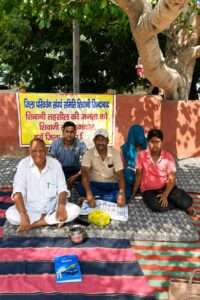
The demand to include Siwani in the Hisar district is not a political protest, but rather a demand for convenience, practicality, and administrative justice. This demand is not a question of raising or lowering the prestige of any district, but rather a request to acknowledge the real needs of the people. In a democracy, the sensitivity of government is evidenced by its courage to listen to the public’s problems and make decisions based on the circumstances.
This voice, which has been raised for nearly a decade, remains as relevant today as it was in 2016. Over time, its support has grown, and the arguments in its favor have become stronger. It is no longer merely a slogan—“We refuse Bhiwani, we want Hisar district”—but has become a symbol of the collective aspiration, geographical reality, and demand for administrative justice in the Siwani region. This is an opportunity for the government to seriously consider this issue, taking into account public sentiment, geographical realities, and administrative practicalities. If the government is truly committed to public convenience and the principles of good governance, it is time to listen to this decade-old, peaceful, and just demand of Siwani and take a positive decision on it.
Bhiwani is refused, Hisar district is required
People should do Siwani but refuse Bhiwani.
This is the demand of every person; now, Hisar should be a district.
Hisar is just a short distance from Siwani.
If we go to Bhiwani, it will take many hours.
Public convenience says, listen to the right call-
This is the demand of every person; now, Hisar should be a district.
The bus tracks say, ” Where is the world connected?
Life goes on with Hisar, every day again and again.
Why are you still maintaining distance, the rights of the people?
This is the demand of every person; now, Hisar should be a district.
Education, market, hospital, and got admission in Hisar.
Every day life, special things related to it.
Time and money are wasted, and only a burden is created.
This is the demand of every person; now, Hisar should be a district.
Relationships, public opinion, and behavior remained the same.
The same foundation was found for culture and society.
Now public sentiments get their due and expansion –
This is the demand of every person; now, Hisar should be a district.
The voice of the people has been rising for ten years.
Look at this style of peaceful struggle.
Save the dignity of democracy, listen, O government—
This is the demand of every person; now, Hisar should be a district.
‘Saurabh,’ the public asks, when will we be saved?
Accept this geographical truth as appropriate.
This time, decide on the interest of Siwani.
This is the demand of every person; now, Hisar should be a district.

