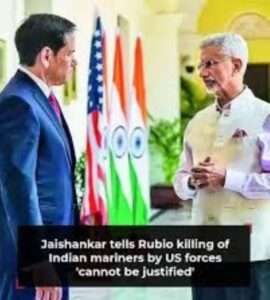
Politics often compels parties to oppose each other even when national interest demands unity. Yet, there are moments when a political demand transcends partisan boundaries and deserves serious consideration. The Congress party’s call for Prime Minister Narendra Modi to raise the issue of US Secretary of State Marco Rubio’s remarks with US President Donald Trump during their meeting on the sidelines of the G7 Summit is one such instance. This is not about scoring political points. It is about defending the dignity of Bharateeyan citizens and asserting Bharat’s sovereign right to seek accountability when Bharateeyan lives are lost. The immediate context is deeply disturbing. Three Bharateeyan mariners lost their lives in US military action against commercial vessels operating in and around the Strait of Hormuz. External Affairs Minister S. Jaishankar lodged a strong protest with Rubio, unequivocally stating that “lethal actions against commercial shipping are not justified” and that civilian deaths cannot be brushed aside as collateral damage. Bharat also formally protested through diplomatic channels. However, what followed has understandably raised eyebrows in Bharat. Instead of expressing regret over the loss of Bharateeyan lives or acknowledging New Delhi’s concerns, Rubio reportedly stressed that all commercial vessels must comply with orders issued by US forces and that violations would not be tolerated. No sovereign nation can be expected to accept such a response without question. Bharat and the United States today share one of the most consequential strategic partnerships in the world. They cooperate in defence, trade, technology, maritime security and Indo-Pacific stability. Friends are expected to speak honestly with each other. But friendship cannot mean silence when citizens are killed. The issue is not whether the United States had security concerns in the Strait of Hormuz. Nor is it about endorsing Iran’s actions or taking sides in the wider regional conflict. The issue is whether the deaths of three Bharateeyan sailors warranted a more sensitive and responsible diplomatic response from Washington.
When citizens of a friendly nation are killed, the minimum expectation is empathy, transparency, and a commitment to investigate. A response that appears to justify the action before addressing the human tragedy inevitably creates resentment and raises uncomfortable questions. Bharat has consistently demonstrated strategic maturity in its foreign policy. Whether dealing with Russia, Israel, Iran, Europe or the United States, New Delhi has sought to balance national interests without succumbing to bloc politics. That very maturity now requires Bharat to firmly communicate that Bharateeyan lives cannot become casualties of geopolitical calculations. Prime Minister Modi enjoys a unique rapport with President Trump. That personal equation should be used not merely to celebrate growing ties but also to discuss difficult issues candidly. Raising the matter would not weaken Bharat-US relations. On the contrary, it would strengthen them by ensuring that the partnership rests on mutual respect rather than diplomatic convenience. The world today is witnessing increasing instability in vital maritime corridors. Thousands of Bharateeyan sailors serve aboard vessels navigating these dangerous waters. Bharat supplies one of the largest pools of seafarers to the global shipping industry. Their safety is not a peripheral issue; it is a national concern. The message that Bharat sends now will be closely watched—not only by Washington but by every major power. If the deaths of Bharateeyan civilians elicit only routine protests and no serious diplomatic engagement at the highest level, it risks creating a dangerous precedent. Congress may have raised the demand, but the issue belongs to the nation. Modi’s government has already protested strongly. The logical next step is to take the matter directly to President Trump and seek clarity, accountability, and assurances that such tragedies will not recur. In international relations, strength is not measured merely by military power or economic growth. It is also measured by a nation’s willingness to stand up for its citizens, wherever they may be. Three Bharateeyan sailors paid the ultimate price. Their sacrifice deserves more than diplomatic formalities. It deserves a firm and unequivocal message: Bharateeyan Lives Matter.