There was a time when a JCB backhoe loader almost needed no introduction on an Indian construction site. The yellow machine had become part of the landscape. But the landscape itself is changing, with India’s construction equipment market slipping in FY26 even as exports moved sharply higher, leaving JCB in the enviable position of remaining the dominant player while facing the rather different pressures that come with a maturing market.
The question at bauma CONEXPO INDIA 2026 is therefore not whether JCB can demonstrate scale; it clearly can.
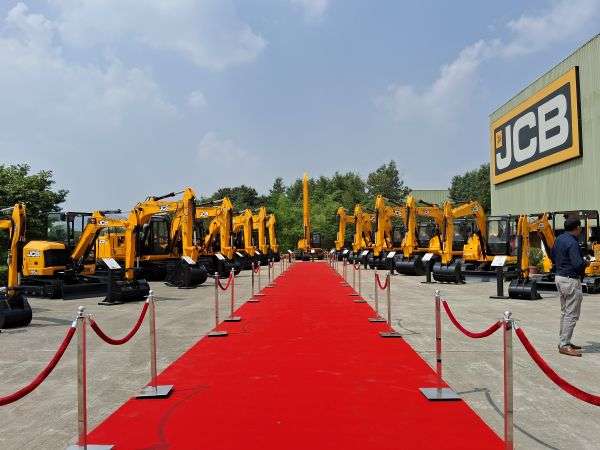
The more interesting question is where that scale goes next. At Greater Noida, the company will bring a remarkably broad machine portfolio, with the familiar backhoe loader still firmly at the centre, surrounded by excavators, wheel loaders, compactors, telehandlers, access equipment and gensets, alongside an electric wheel loader, a new 1.8-tonne mini excavator and quarrying equipment, including the 520X aimed squarely at mining.
There is Stage V, then LiveLink, and behind both is the increasingly important business of making machines work harder without necessarily making them larger. JCB’s 2026 presence therefore looks less like a product parade than a fairly revealing picture of where the company thinks Indian construction equipment is heading, and that is where the interesting story begins.
Market Shift
The Indian construction equipment market is not collapsing, nor is it enjoying the kind of uninterrupted expansion that allows everybody in the industry to sleep comfortably at night. FY26 closed with sales of about 136,995 machines, down from 140,191 in FY25, with domestic demand weaker even as exports rose by more than 30 percent. By the first quarter of FY27, however, the market had begun to show signs of recovery, with industry sales rising 11 percent and exports again growing much faster than the domestic market.
For JCB, that combination matters because the company is operating from a position most competitors would probably like to have. CRISIL’s latest assessment puts JCB India’s FY26 operating income at Rs 19,710 crore, compared with Rs 20,201 crore in FY25, while margins improved to around 16 percent. Exports accounted for roughly 22–23 percent of revenue, helping cushion the softer Indian market. The company continues to hold a leadership position across the domestic construction equipment industry, with more than 40 percent overall market share according to CRISIL and an especially formidable position in backhoe loaders.
That is why the Noida display deserves to be read rather differently from a conventional exhibition stand. JCB does not need to convince the Indian market that it knows how to build a backhoe loader. The 3DX family has already done that job rather thoroughly.
What it needs to demonstrate is how a company built around one of India’s most recognisable machine categories intends to remain relevant as contractors diversify fleets, infrastructure work becomes more specialised, urban jobs become tighter and equipment owners become increasingly interested in productivity, operating cost and data rather than simply horsepower.
Bigger Portfolio
The answer begins with the sheer breadth of the machine line-up. JCB’s official bauma CONEXPO INDIA 2026 display includes the 3DX, 3DX Plus, 3DX Super, 3DX Xtra and 3DXL Plus backhoe loaders, alongside the Agrimax 4WD and 4DX, but the stand moves considerably beyond that familiar territory. The company is showing the newly launched 18Z mini excavator, the 35Z, 81 Eco+, 150FM and 215FM excavators, the 225 QM, 385LC and 345HD quarry-oriented machines and the 520X mining excavator.
That spread is important because it reflects something happening across the Indian equipment market: the customer base is becoming more segmented. The contractor who once wanted one machine capable of doing several jobs may now want different machines for increasingly specific applications, particularly where infrastructure, quarrying, urban utilities, material handling and mining demand different combinations of reach, productivity, footprint and operating cost. JCB’s display therefore looks less like an attempt to replace the backhoe loader and more like an attempt to surround it with an increasingly complete equipment ecosystem.
The 18Z is particularly interesting in that context. At approximately 1.8 tonnes and with zero tail swing, it is designed for urban construction, landscaping and confined applications where a larger excavator can become an inconvenience rather than an advantage. JCB’s own specification emphasises compactness, serviceability and operator usability, with LiveLink available as an option. The machine may be small, but its presence says something quite large about the direction of the market: there are plenty of jobs in India where getting smaller can be as valuable as getting more powerful.
Beyond Backhoes
The same logic can be seen further up the range. JCB is bringing wheel loaders, including the 440-5 and 455-5N, alongside the 440 Electric Wheel Loader, while the telehandler line includes the 530-110 and 540-70. Compaction equipment, skid steer loaders, gensets and access platforms complete a display that moves well beyond the traditional earthmoving conversation.
The 440 Electric Wheel Loader may attract particular attention because it puts electrification into a category where Indian customers are likely to ask a much more practical question than whether the technology is fashionable: where does it actually make commercial sense? JCB describes the machine as offering zero tailpipe emissions and quieter operation, characteristics that become considerably more interesting in indoor, urban or noise-sensitive applications than they might in a conventional quarry.
That is also where JCB’s broader technology strategy becomes easier to understand. The company is not abandoning diesel overnight, and neither is the Indian market. Stage V machines have become part of the mainstream since January 2025, while fuel efficiency, remote diagnostics, machine monitoring and maintenance intervals are becoming increasingly important parts of the purchasing decision. The interesting contest is therefore not diesel versus electric in isolation, but how much more useful a machine can become through better engineering, better information and better control.

Digital Layer
Live Link is hardly new to JCB, but its significance changes as connected equipment becomes less of a novelty and more of an operating tool. JCB’s current machines increasingly combine machine information with service support, allowing owners to look at fuel consumption, working hours, idle time and operating patterns rather than discovering a problem only when the machine stops working. The 440-5, for example, incorporates LiveLink reporting and remote diagnostics alongside longer service intervals.
This is perhaps one of the less dramatic changes taking place in Indian construction equipment, precisely because it does not necessarily produce the sort of machine that attracts a crowd around a demonstration area. Yet for fleet owners it could become more consequential than another incremental increase in bucket capacity. When a contractor has dozens or hundreds of machines spread across projects, knowing which machine is working, which one is idling, which one is consuming unusually large amounts of fuel and which one needs attention can begin to influence profitability in ways that a brochure specification rarely captures.
JCB’s opportunity is that its installed base gives it an enormous platform on which to build this digital layer. The challenge is equally obvious: once connected equipment becomes normal, the advantage moves from having telematics to making the information useful.
Global Muscle
The Indian operation also sits inside a much larger global engineering network. JCB’s headquarters are at Rocester in Staffordshire, UK, and the company has built a substantial international manufacturing and engineering footprint over decades. Its Indian operations have become particularly important within that network, with the Pune engineering centre playing a significant role in developing machines for markets beyond India.
That international connection is becoming more relevant as exports assume greater importance for Indian construction equipment manufacturers. JCB India has already established itself as an export platform serving markets across the world, while the company continues to invest globally, including the large new manufacturing facility being developed in San Antonio, Texas. At the other end of the technology spectrum,
JCB’s recent hydrogen-powered Hydromax programme, which achieved a reported 406.320 mph land-speed record, illustrates how seriously the company continues to investigate alternative power technologies for heavy-duty applications.
None of this means that a construction site in India is about to become hydrogen- powered. It does suggest, however, that JCB is trying to keep several technological options open while the market works out which solutions make economic and operational sense.
India Advantage
The Indian operation has another advantage that is harder to replicate than a new product launch: scale. JCB entered India in 1979 and has built manufacturing operations, a substantial supplier ecosystem, engineering capability, dealer coverage and a large installed base over more than four decades. The company says it now offers more than 60 products across its Indian portfolio, exports to more than 125 countries and has developed a high degree of localisation in its Indian-made backhoe loaders.
That creates an interesting strategic balance. India is no longer simply a market into which JCB sells machines manufactured elsewhere. It is simultaneously a major customer base, manufacturing location, engineering centre and export platform. As domestic growth becomes less predictable, that combination gives JCB the ability to use Indian manufacturing capacity against global demand rather than relying entirely on the Indian construction cycle.
It also changes the competitive equation. Tata Hitachi, ACE, Escorts Kubota, SANY, Hyundai, Komatsu, Caterpillar and others are not standing still, while Chinese manufacturers have become increasingly visible across several equipment categories.
JCB’s competitive advantage therefore cannot rest indefinitely on brand recognition.
The market is too sophisticated for that, and customers have become too conscious of total cost of ownership.
No Easy Win
This is where JCB’s dominance becomes slightly uncomfortable, because being the market leader is wonderful until the market starts asking what comes after leadership.
The company has the scale, the dealer network, the manufacturing base and the engineering resources to keep expanding its portfolio, but each new category brings competitors with their own strengths. Mining demands a different proposition from backhoe loaders; telehandlers involve a different customer conversation; electric machines bring questions around charging infrastructure and duty cycles; access equipment introduces another set of buyers altogether.
JCB’s Noida stand consequently needs to do more than impress visitors with the number of machines it can place on an exhibition floor. It needs to demonstrate that these machines belong to a coherent strategy, one in which the company can move from being the manufacturer people instinctively associate with one machine to becoming the equipment partner they consider across an entire project.
Noida Test
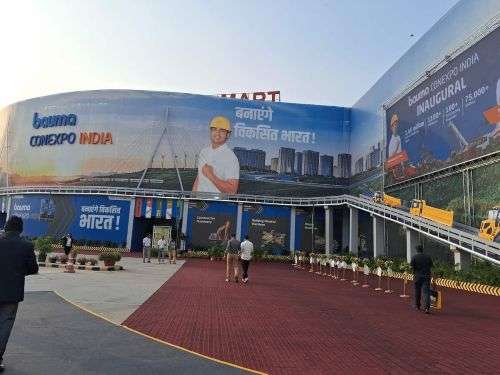
That makes bauma CONEXPO INDIA 2026 a useful test of JCB’s next chapter. Positioned at Stall OD40, the company is explicitly positioning the show around its new backhoe loader range as well as a broader portfolio of construction and earthmoving equipment.
There will be plenty of yellow iron to photograph, naturally, and the new machines will get the attention they deserve. But the more revealing story may sit slightly behind the machines themselves: how JCB balances an exceptionally strong core business with the need to diversify, how it uses India as both market and global production base, and how quickly electrification and digitalisation can move from technology demonstrations into equipment that customers actually want to pay for.
JCB probably does not need another trophy for being No. 1. The more difficult assignment is making sure that when the Indian market eventually looks substantially different from the one that made the 3DX famous, the company still looks as though it belongs at the centre of it.