
A detailed review of the children’s poetry collection, awarded the Haryana Sahitya Akademi’s Best Work Award for the year 2023, written by senior litterateur Suresh Chandra ‘Sarvahara’
Suresh Chandra
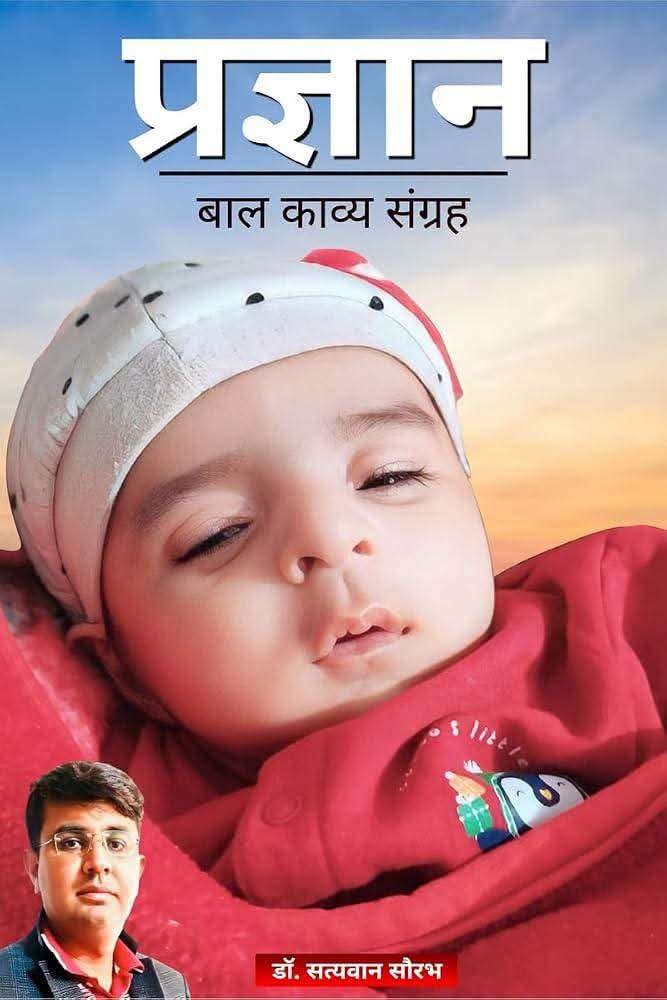
“Pragyan” is a beautiful collection of children’s poetry by children’s author Dr. Satyawan “Saurabh,” containing 51 children’s poems. Honored with the 2023 Best Work Award by the Haryana Sahitya Akademi, this book is a must-read, expressing the child’s innate curiosity, imagination, sensibilities, and values. Its poems reflect the diverse colors of life.
Born in Haryana in 1989, Dr. Satyawan Saurabh is a well-known figure in children’s literature. As a writer, journalist, and translator, he has produced a vast body of literature for both children and adults. In addition to children’s poetry, he has made significant contributions to Hindi literature through numerous works of couplets, short stories, poetry, translations, adaptations, and editing. For nearly two decades, he has been enriching literature through independent writing.
The first poem in the collection “Pragyan” is “Bane Santan Adarsh Hamari.” In it, parents cherish beautiful dreams for their future child. They want their children to imbibe the noble qualities of our ideal great men and great women and follow their path. The poem effortlessly portrays ideal characters like Prahlad, Dhruv, Maitreyi, and Gargi. The poet believes that every child should possess qualities like morality, truthfulness, and a dedication to knowledge.
Children’s literature is literature for children. It requires attention to their tender emotions and psychological needs. Children enjoy entertainment, but the poet wants them to also become familiar with the realities of life and society. He considers it his responsibility to raise awareness of the discrepancies surrounding them. The poem “In the Lap of Google” poignantly expresses the growing influence of modern technology and the diminishing communication within families. The poet presents the loss of childhood in the digital world and the loneliness of his grandmother’s generation in these lines:
The phone has taken away all my childhood hobbies.
Grandmother sits and watches the change in the generation.
The mind yearns for words, who in the house can understand?
Everyone is sitting silently, holding the phone.
Today’s children are the leaders of tomorrow. When they grow up, they will be in charge of the nation. Therefore, it is essential to instill in them a sense of patriotism and national pride from an early age. In the poem “Ude Tiranga Beech Nabh,” the poet instills in children a sense of respect for the tricolor and devotion to the nation.
Patriotism is that love which pulls you towards itself.
The tricolor flies in the sky, creating a lot of waves.
The pride of the tricolor should remain; take this resolution in your heart.
May it remain in every home, every heart, and become an identity.
Childhood is the golden age of life. This time determines the direction of a person’s future. The values acquired during childhood have a lifelong impact. The poet wants children to respect their teachers, adopt moral values, and achieve new milestones in life. The poem “The Path of Morality” highlights gratitude to teachers and the importance of morality in life.
We should never forget the kindness of our teachers.
Create a new record and give the gift of Guru Dakshina.
Give us the steps of life through the path of morality.
With his blessings, we become human beings.
Environmental protection is a pressing need today. Increasing pollution, deforestation, and damage to the ozone layer are matters of concern for all of human society. Trees provide us with life-giving air and play a vital role in maintaining ecological balance. Through the poem “Ozone,” the poet raises awareness among children about the environment and conveys the message of nature conservation.
Who will keep an eye on the poisonous gas today?
Fire-spewing chimneys, tearing apart the ozone.
Whether pollution increases or decreases, what does it matter to us today?
Together we are looting the honour of the earth.
Parents play a paramount role in children’s lives. They depend on them for their needs and happiness. The poem “Relationships” from the collection sensitively expresses the contributions of mothers and fathers—
Father saves every penny here day and night.
Gives the gift of happiness to his children.
A mother should understand the pain of her children as her own pain.
Only he has this effect.
It’s essential to remain dynamic in life. The path to success lies in constantly moving forward, rather than pausing in the face of obstacles. In the poem “Samay Sindhu,” the poet conveys the message of facing life’s struggles and maintaining patience even in adverse circumstances.
If the traveler’s feet are afraid of the thorns on the path.
How will he reach his beloved’s village?
Don’t stop, keep moving, life is a struggle.
Live like Neelkanth, drink poison happily.
Childhood is a time of sweet imaginations and beautiful dreams. Every child harbors big dreams. In the poem “Childhood Songs,” the poet brings to life his childhood memories, games, and rural surroundings. It reflects the intimacy of the past and a love for nature—
There were many different games in childhood too.
Boats sailing in the sand, trains flying in the sky.
That village of my childhood remained in my memories.
The courtyard of a mud house and the shade of a neem tree.
Children feel a natural affinity with nature. Natural scenery captivates them. The poet’s inner child also returns to childhood memories, communing with fairies, games, and village streets. The poet also highlights the decline in children’s traditional games and family interactions due to changing times and the use of mobile phones.
The poem “Grandparents” expresses the intimacy and importance of elders in our lives. Grandparents tell stories to children, impart values, and provide emotional support to the family. Their absence leaves the home desolate. The poet writes:
Without grandparents, the door is deserted.
Who will tell the story now, give me the love of a lullaby.
Became grandparents, only now complaining.
Keep remembering the happiness of your courtyard.
The poet’s sensitivity is also evident in the fact that he sees the image of elderly people even in an old broom. The poet draws a profound social parallel between the tendency to discard objects after use and the neglect of the elderly in old age. The poem “Vruddhon Ki Har Baat Ka” questions the mentality of neglecting the elderly under the guise of modernity.
Who takes care of every thing that the elderly say?
Under the guise of modernity, every home is in trouble.
This is the proven step towards fame, glory, happiness and peace.
The house is empty, without the elderly.
It is clear from the above examples that the dominant tone of the compositions in the children’s poetry collection “Pragyan” is human empathy, compassion, morality, and social consciousness. The poet has presented compositions in accordance with child psychology on diverse topics such as the environment, weather, sunshine, morning, birds, butterflies, squirrels, leaves, grass, elephants, clouds, lakes, the moon, the sun, childhood, parents, lamps, letters, daughters, the New Year, the country, festivals, forgiveness, martyrs, tuition, Google, the tricolor, books, school, the police, grandparents, and other family relationships.
The collection’s language is simple, engaging, and easily understandable. The poems contain childlike imagination and life-affirming messages. Their distinctive feature is that, rather than preaching, the poet introduces children to life’s important values through entertainment and empathy. The book’s printing is beautiful, and the charming cover portrait of the poet’s son, Pragyan, lends it a special appeal.
Undoubtedly, “Pragyan” is not just a collection of children’s poems, but a meaningful literary effort to develop human values, love of nature, family intimacy, patriotism, and social sensitivity in children. The Haryana Sahitya Akademi’s 2023 Best Work Award underscores this book’s literary achievements. This work, adorned with entertaining and sensitive poems that captivate children’s minds, holds a unique identity in the world of children’s literature. Hearty congratulations to Dr. Satyavan “Saurabh” for creating this beautiful collection.