



A viral Facebook video has been making the rounds in recent weeks, leaving many viewers stunned. It presents a side of Mughal emperor Akbar rarely encountered in school textbooks.
For generations of Bharatiya taught to remember him almost exclusively as ‘Akbar the Great’, the video comes as a surprise, even a shock.
Whether every assertion in such videos withstands scholarly scrutiny is a separate question. But their popularity reflects a growing curiosity about whether our history education has presented the full picture. That curiosity deserves an honest answer.
The history we inherited
Every nation tells its story through the history taught in its classrooms. The question is not whether history should inspire pride or provoke introspection. It must do both. It must tell us what our ancestors achieved, where they failed, and what shaped the civilisation we inherited.
For generations of Bharatiya, however, school history often seemed to present a selective narrative.
Students learnt in detail about the Delhi Sultanate and the Mughal Empire, the administrative genius of Akbar, Babur’s conquests, Shah Jahan’s architectural legacy and the grandeur of imperial courts.
The Industrial Revolution, the Renaissance and the French Revolution also found generous space. In contrast, many indigenous kingdoms and their contributions appeared only in passing.
How many students left school with a meaningful understanding of the Cholas’ naval expeditions to Southeast Asia, the Kakatiyas’ engineering marvels, the Vijayanagara Empire’s prosperity, the Ahoms’ successful resistance to Mughal expansion, or the scientific and mathematical advances made in ancient Bharat? For many, the answer is: very little.
More than one freedom story
The freedom struggle too was often narrated through a predominantly Gandhian lens. Mahatma Gandhi’s contribution to Bharat’s independence is beyond dispute.
But the sacrifices of Bhagat Singh, Sukhdev, Chandrashekhar Azad, Subhas Chandra Bose, Veer Savarkar, the INA, and even the Royal Indian Navy mutiny deserved far greater attention than they often received.
The issue is not that Gandhi or Akbar occupied the textbooks. They unquestionably deserve to be there. The issue is that others frequently did not.
For several decades after Independence, many Indian history textbooks were influenced by historians associated with what is often called the ‘Marxist’ or ‘secular’ school. Their work made valuable contributions in many areas, but critics have long argued that it also downplayed aspects of India’s civilisational heritage and certain episodes of religious conflict.
The uncomfortable chapters
History also has an obligation to confront uncomfortable truths. The destruction of temples, plunder of wealth, massacres following conquests, the devastation of centres of learning such as Nalanda, the Goa Inquisition, religious persecution under different regimes, and the economic exploitation of Bharat during colonial rule are all part of the historical record.
They should neither be denied nor sensationalised. They should simply be taught honestly, with evidence and context.
Likewise, medieval rulers should not be reduced either to saints or villains. Akbar, for instance, was an able administrator who introduced important revenue reforms and later pursued policies of religious accommodation.
At the same time, contemporary sources such as the Akbarnama and the Fathnama-i-Chittor record the massacre following the conquest of Chittor and the triumphal language used to commemorate it.
The Fathnama-i-Chittor contains language that is markedly more militant than the image of the later Akbar often found in textbooks. It invokes verses about fighting infidels (unbelievers) and presents the campaign as a religious victory.
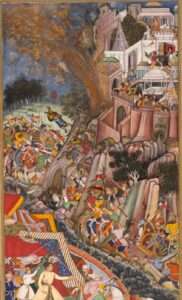
Recent curriculum revisions suggest that this debate is beginning to influence the way history is taught. The revised NCERT Class 8 Social Science textbook (Exploring Society: India and Beyond), introduced under the new curriculum, contains a section that explicitly discusses what it calls the ‘darker periods’ of medieval Indian history.
Students are mature enough to understand that historical figures can embody both achievement and brutality. The same balanced approach should apply to every period of Indian history.
Bharat beyond empires
Ancient Bharat’s contributions to mathematics, astronomy, metallurgy, medicine, philosophy and linguistics deserve greater prominence.
The Bhakti movement, Adi Shankaracharya’s philosophical revival, the evolution of universities such as Nalanda and Takshashila, and the achievements of regional kingdoms across the subcontinent should form an integral part of the national narrative rather than remain peripheral topics.
The internet changes everything
Thankfully, access to history is no longer confined to school textbooks. Digitised manuscripts, archaeological discoveries, translations of Persian chronicles and the internet have opened doors that previous generations never had.
Social media, despite its many flaws, has also drawn attention to forgotten episodes and overlooked personalities.
Yet social media is a double-edged sword. Alongside genuine discoveries travel fabricated quotations, doctored images and exaggerated claims.
Fortunately, today’s readers also have unprecedented access to fact-checking tools, academic journals and primary sources. Curiosity should therefore be accompanied by scepticism.
History deserves completeness
Bharat does not need one ideological version of history to replace another. It does not need glorification in place of omission, or selective outrage in place of selective silence. It needs history that is complete.
A civilisation as old and diverse as Bharat’s cannot be understood through the stories of a handful of emperors or a single political movement. It deserves a curriculum that celebrates its intellectual brilliance, acknowledges its tragedies, recognises the achievements of all its peoples and examines every chapter – glorious or grim – with equal intellectual honesty.
History should not be rewritten to suit the politics of the day. Nor should it remain frozen in the prejudices of the past. Its purpose is not to manufacture pride or guilt, but to illuminate the truth as faithfully as the evidence allows.



It is aptly said that history is never completely written. It is an example of work-in-progress. At the same time objective history remains an ideal to achieve. Historians are divided over objectivity in history. If it is to remain a litany of cold facts it ceases to be history and will remain a mere chronicle of events. Historians place themselves in the context and imagine a time where they become actors and observers and commentators which explains why there are histories and not history. To recall EH Carr, history is a continuum, a dialogue with the past which flows into the present. That is why every generation revisits history in the quest for the ultimate truth.