Lakshmanrao Upadhyayula
The sage Vamadeva’s invocation to Indra and Vayu, expressed in the Gayatri metre of the Rigvedic hymns, presents a profound meeting point between spirituality, ritual symbolism, disciplined thought, and an early scientific temperament. The hymn is not merely a prayer requesting divine favour; it portrays the yajna as an ordered process through which human aspiration, cosmic forces, purified offerings, disciplined action, and higher consciousness are brought into harmony. Indra represents dynamic power, illumination, courage, and the capacity to overcome resistance, while Vayu represents movement, breath, life-force, and the invisible energy that connects different dimensions of existence.
Vayu is invoked as the force associated with the yajna and with the attainment of the higher realm. The purified Soma is prepared and offered as a sacred substance worthy of the divine powers. The imagery of Soma should not be understood only in a literal sense. Within the symbolic language of the Vedic tradition, purification signifies the transformation of something ordinary into something refined, disciplined, and worthy of higher participation. The repeated emphasis on purified Soma therefore suggests a fundamental principle: whatever is offered to the higher order must first undergo refinement. In human life, too, thoughts, emotions, intentions, and actions acquire value only when they are purified through knowledge, discipline, and ethical conduct.
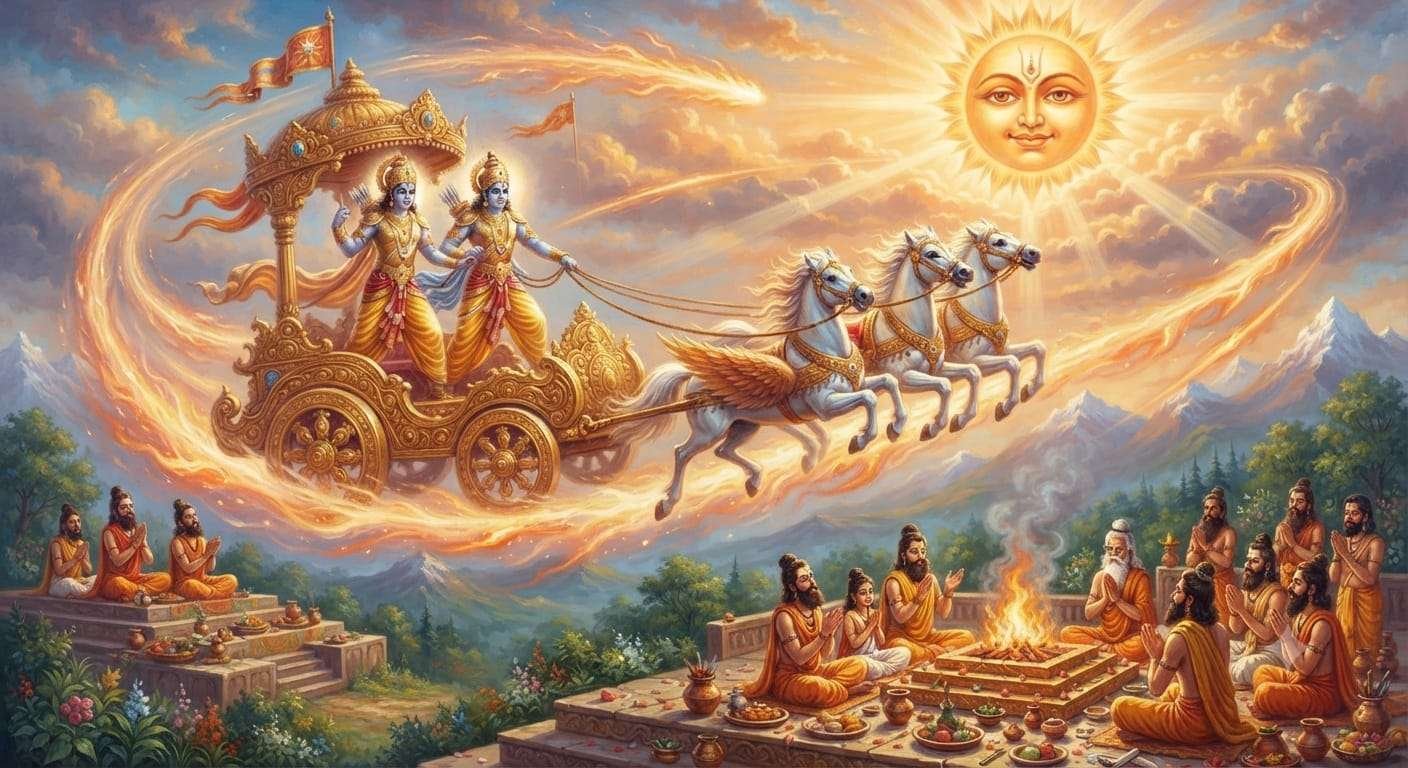
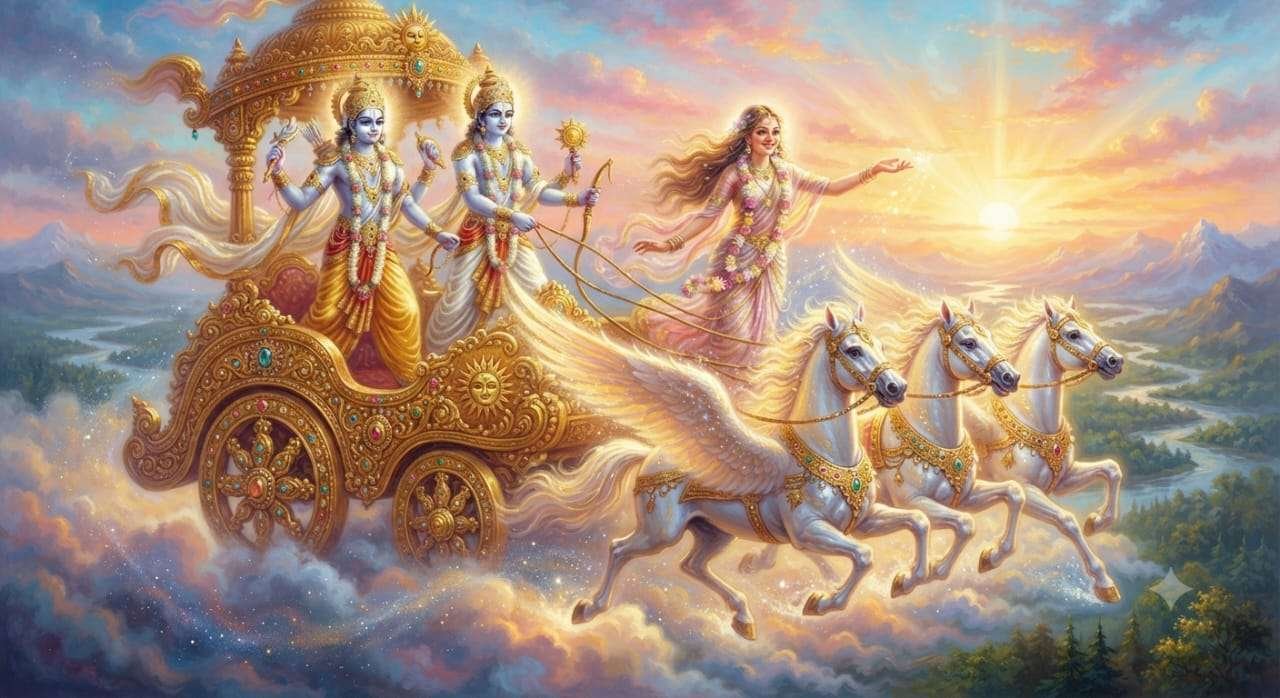
The hymn describes Vayu as possessing an uninterrupted succession of words and being drawn by swift horses. The horses are among the most powerful images of Vedic poetry. They may be understood at one level as the actual animals associated with the ritual imagination, while at a deeper symbolic level they represent movement, vitality, sensory energies, and the forces that carry intention into action. The chariot is the organised vehicle through which these forces are directed. Thus, the hymn presents an important psychological insight: energy by itself is insufficient; it must be harnessed, directed, and placed under intelligent guidance.
The statement that Indra becomes the charioteer introduces an even deeper dimension. Vayu provides movement, while Indra provides direction and strength. In symbolic terms, life-force requires enlightened intelligence to become purposeful. Uncontrolled energy can become destructive, whereas energy guided by discernment can accomplish great things. The Vedic imagination therefore brings together movement and intelligence, vitality and wisdom, force and direction. The prayer to come and fulfil the many desires of the worshippers is consequently not merely a request for material prosperity; it can also be read as an aspiration for the fulfilment of legitimate human purposes under the guidance of higher consciousness.
Indra and Vayu are described as possessing thousands of horses, an expression characteristic of the expansive and hyperbolic language of Vedic poetry. The number suggests abundance, immeasurable power, and inexhaustible movement rather than a simple numerical calculation. Their invitation to come swiftly and partake of the purified Soma conveys urgency in the sacred act. The yajna is presented as a living encounter rather than a passive ceremony. The human participant prepares, purifies, invokes, and offers; the divine powers are invited to respond. This reciprocal relationship reflects the Vedic conception of yajna as an exchange between human effort and the larger cosmic order.
The hymn then turns to the magnificent chariot of Indra and Varuna, described as golden, spacious, powerful, and associated with sacred woods. Gold traditionally represents brilliance, purity, incorruptibility, and splendour. Wood, on the other hand, comes from the living natural world and becomes useful through human craftsmanship. The combination of gold and wood therefore creates a striking image of nature refined through human skill and elevated through sacred purpose. The chariot is described as touching the heavens, suggesting a symbolic bridge between the earthly and celestial realms. It is simultaneously beautiful, sacred, purposeful, and connected with the cosmic order.
The chariot may also be interpreted through the intellectual temperament of the Vedic seers. A chariot is not simply a vehicle; it is a carefully integrated system consisting of a structure, wheels, axle, harness, horses, driver, and destination. Its successful movement depends upon the coordination of multiple components. This observation resonates with a scientific way of thinking: complex movement requires organised forces, appropriate control, functional relationships, and a defined objective. The Vedic poet expresses such an understanding through sacred imagery rather than through the technical vocabulary of modern science.
Indra and Varuna are invited to mount this holy chariot and proceed towards the sacrificial assembly. Their vast and powerful vehicle is associated with the giver of oblations and the sacred precincts of the yajna. Here, the relationship between the giver and the divine is central. The yajna is sustained by offering, generosity, participation, and responsibility. The individual does not merely ask from the universe; the individual also gives. This reciprocal principle is fundamental to Vedic thought and may be understood in contemporary terms as a recognition that every system survives through responsible exchange rather than one-sided consumption.
The purified Soma is then described as being prepared and kept ready. The careful preparation of the offering demonstrates that sacred action requires order, timing, cleanliness, attention, and precision. This is one of the places where the ritual tradition reveals a disciplined temperament. The yajna is not portrayed as spontaneous emotional expression alone. It involves preparation, sequence, recitation, material arrangement, coordination, and precise observance. Such characteristics reveal an intellectual culture that valued order and repeatable procedure, even though its explanations were expressed primarily through religious and cosmological language.
The invitation for the gods to come with compassionate minds adds an ethical dimension to the hymn. Divine power is not desirable merely because it is powerful; it must also be aligned with benevolence and protection. Strength without compassion can become destructive. Authority without restraint can become oppressive. The Vedic imagination therefore seeks a union of power, wisdom, order, and compassion. This principle remains relevant to human civilisation: technological capability and material power become truly beneficial only when guided by responsibility and humane purpose.
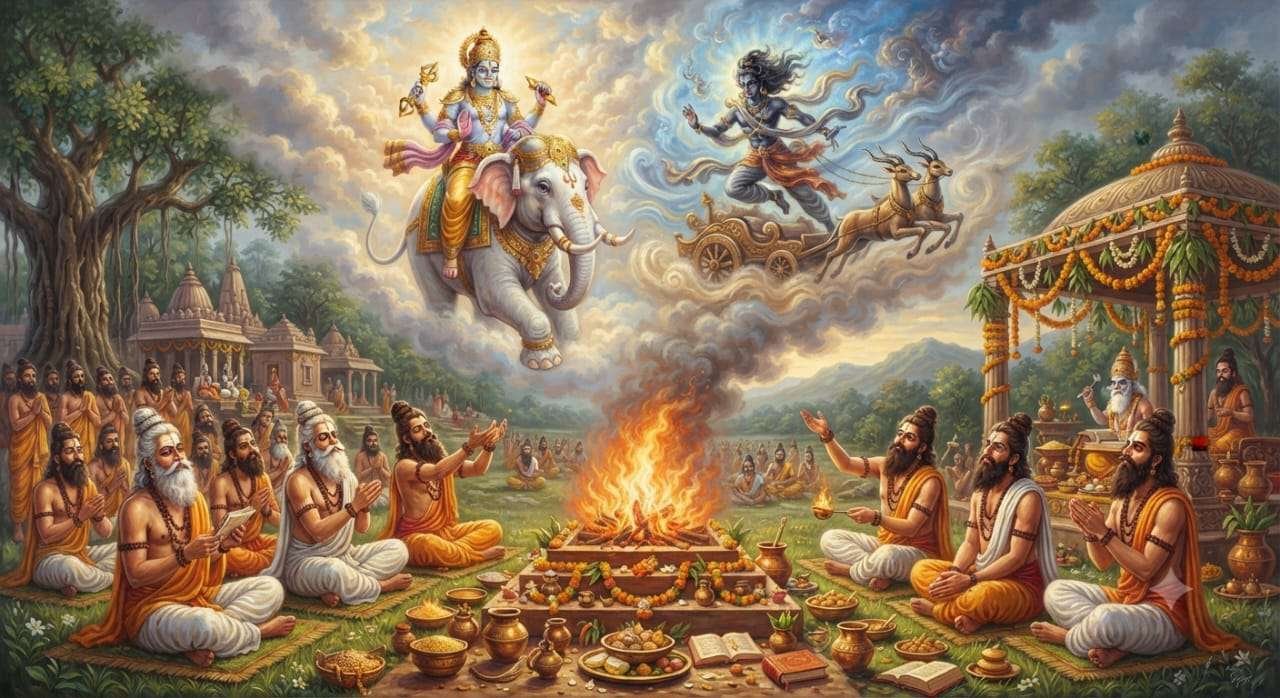
The sacred halls of the ritual become a meeting place between the visible and invisible dimensions of existence. The patron of the yajna prepares the sacred environment, offers Soma, and invites the divine powers to participate. The imagery can be understood as a symbolic representation of the human aspiration to establish harmony between individual life and the larger order of nature. The ritual space becomes a carefully constructed centre of concentration where speech, sound, breath, fire, offering, movement, and intention are brought together.
The final invocation to Indra and Vayu asks both powers to come to the yajna and allows their horses to be released because they have arrived for the sacred drinking of Soma. The releasing of the horses is particularly evocative. The forces that carried the divine powers towards the ritual destination are no longer required to remain in motion. Movement reaches its purpose in arrival; effort culminates in fulfilment; energy finds rest when it has reached its rightful destination. At the spiritual level, this can represent the transition from restless activity to centred awareness.
Seen as a whole, Vamadeva’s hymn presents the yajna as a sophisticated symbolic framework in which nature, human consciousness, disciplined action, energy, speech, breath, intelligence, and cosmic order interact. Indra and Vayu are not merely distant supernatural figures in this interpretation. They embody complementary principles: power and movement, intelligence and vitality, direction and energy. Varuna adds the dimension of order, moral restraint, and cosmic law. Soma represents purification and the transformation of experience into higher awareness. The chariot represents an integrated system through which forces are directed towards a meaningful destination.
The scientific temperament of the hymn should not be confused with modern experimental science. The Rigvedic seers did not formulate these ideas using contemporary scientific equations or laboratory methodology. Yet the hymns demonstrate characteristics that are compatible with a disciplined intellectual outlook: close observation of nature, recognition of interconnected forces, attention to processes, appreciation of order and causality, symbolic modelling of complex systems, and an insistence that human action must be performed according to an intelligible sequence. The chariot, horses, breath, fire, Soma, speech, and cosmic movement become conceptual instruments through which the seer attempts to understand an interconnected universe.
Ultimately, Vamadeva’s prayer is an invitation to transform human aspiration into disciplined participation in the cosmic order. The purified Soma signifies refinement; Vayu signifies life and movement; Indra signifies empowered intelligence; Varuna signifies order and moral law; the chariot signifies an integrated system; and the yajna signifies conscious participation and reciprocal responsibility. The hymn therefore moves beyond the boundaries of ritual and becomes a meditation on how energy should be purified, directed, harmonised, and offered for a higher purpose. Its enduring message is that true progress arises when vitality is guided by wisdom, power is restrained by compassion, knowledge is joined with discipline, and human endeavour remains consciously aligned with the larger order of existence.