



Situated amidst the rocky hills of Mehrangarh in Jodhpur, the ancient Panchmukhi Hanuman Temple, popularly known as Panchmukhi Balaji Mandir, is a sacred shrine renowned for its magnificent Swayambhu idol of Lord Hanuman.
The temple is believed to be over 560 years old, predating the foundation of Jodhpur city by Rao Jodha in 1459 CE.
Lord Hanuman is worshipped here in his majestic Panchmukhi (five-faced) form with ten arms. The five faces represent Hanuman, Narasimha, Garuda, Varaha and Hayagriva. A distinctive feature of this south-facing idol is the presence of Patala Devi beneath the left foot of Lord Hanuman. The temple is revered as a Siddha Peetha.
The temple is situated amidst the natural rocky formations below the famous Mehrangarh Fort. The shrine blends with the surrounding rocky landscape, and the magnificent idol of Panchmukhi Hanuman is its principal attraction.
According to local tradition, the sacred idol of Lord Hanuman existed even before the establishment of Mehrangarh Fort. Over the centuries, the temple has remained an important centre of Hanuman worship in the Marwar region.
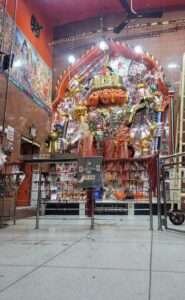
According to the temple priests, the magnificent idol of Panchmukhi Hanuman manifested naturally from the rocky hill and was not sculpted by human hands. The distinctive presence of Patala Devi beneath the left foot of Hanuman is associated with his divine manifestation during the rescue of Sri Rama and Lakshmana from Patala Loka.
According to popular Ramayana traditions, during the battle between Sri Rama and Ravana, Ahiravana abducted Sri Rama and Lakshmana and took them to Patala Loka. To defeat Ahiravana, five lamps burning in different directions had to be extinguished simultaneously. Lord Hanuman assumed his five-faced form, extinguished all five lamps, defeated Ahiravana and rescued Sri Rama and Lakshmana. Hence, he is worshipped in this form as Panchmukhi Hanuman. Devotees believe that worshipping Panchmukhi Balaji here protects them from negative forces and helps them overcome difficulties.
Hanuman Jayanti is celebrated with great devotion and grandeur. A remarkable tradition of this temple is that the elaborate Shringar (decoration) of the deity for Hanuman Jayanti takes nearly a month. Tuesdays and Saturdays attract a large number of devotees.


