



‘Heard melodies are sweet, but those unheard are sweeter,’ wrote John Keats. I sometimes wonder if the same could be said of songs that are heard but not seen.
For years, I had a rather beautiful picture of Lata Mangeshkar singing Pankh hote tho ud aati re… from Sehra. I had heard it on the radio, later on FM, and occasionally on the Indian Idol show.
The song seemed to float into the imagination exactly as a great melody should. Then came YouTube. I watched the song. And wished I hadn’t. Not because the song had changed. It was still the same exquisite melody.
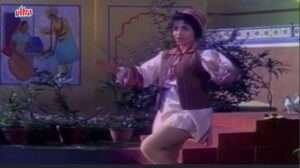
But suddenly the picture I had carried in my head for decades was replaced by Sandhya in an elaborate costume, surrounded by a busy, theatrical setting and performing choreography that seemed to belong to another song altogether.
That was my first lesson in the danger of seeing a song you have loved only with your ears.
When imagination does a better job
The words Pankh hote to ud aati re – ‘If only I had wings, I would fly to you’ – are almost visual in themselves. The heroine is yearning for an absent lover. She imagines herself reaching him like a bird, carrying the ache in her heart.
The song is about longing, not gymnastics. But V. Shantaram, the director of Sehra, appears to have approached the situation differently. Shantaram was a pioneering filmmaker with an unmistakable taste for spectacle, dance and visual flamboyance.
What he created on screen is technically energetic but, to my eyes, strangely at odds with what I hear.
Sandhya spins, stretches and moves with considerable physical dexterity. Yet the movements are so pronounced that they compete with the melody rather than surrendering to it.
The song asks for an expression of inner longing; the choreography keeps reminding us that someone is performing a dance. Even the costumes and sets seem determined to announce themselves. The result is visual overload where the music calls for emotional understatement.
When the dancer overwhelms the song
This isn’t a criticism of Sandhya’s ability as a dancer. Quite the opposite. The physical demands of the sequence are obvious, and she performs them with remarkable energy.
The problem, to me, is that the director seems to have used her ability because he could, rather than because the song required it.
Sometimes a dancer’s greatest contribution to a song is knowing when not to dance. A simple movement, a turn of the head, a distant gaze, a flowing dupatta, a breeze, an empty landscape – and Lata’s voice could have done the rest.
Instead, the screen keeps saying: Look at the dance. The ears are saying: Listen to the longing. I find myself wanting to shut my eyes again.
And then there was Navrang
Interestingly, I had experienced almost the same disconnect with another Shantaram film – Navrang, released in 1959, about four years before I was even born.
The song was ‘Aadha hai Chandrama, raat aadhi…’, sung by Asha Bhosle and Mahendra Kapoor, with music by C. Ramchandra and lyrics by Bharat Vyas.
What a beautiful idea the song contains. Aadha hai chandarma, raat aadhi… ‘The half moon, the half night, the half-spoken conversation, the half-completed meeting.’
Even the lovers’ emotions are expressed through incompleteness. The poetry is sensual without being explicit, romantic without being noisy.
Yet once again, Shantaram seems unable to resist turning a delicate romantic mood into a visual spectacle.
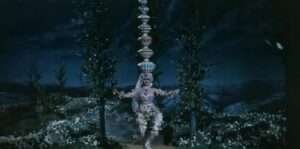
Sandhya’s dance, costume, makeup and elaborate movements become the dominant attraction. The eye is constantly occupied with what she is doing, how she is doing it with nine clay pots stacked on her head and whether she will successfully execute the next movement.
I should be thinking about the lovers. Instead, I am watching the dancer. And that, for me, is the problem.
When spectacle becomes the star
There is something almost paradoxical about Shantaram’s treatment of songs. Here was a filmmaker of enormous imagination and technical ambition.
Navrang itself is remembered for its elaborate dance sequences, with Sandhya at the centre of many of them. But perhaps that was precisely the problem.
When you are capable of creating spectacle, there is a temptation to create spectacle even when the material is asking for simplicity. A director can ruin a song not by doing too little, but by doing too much.
The greatest songs often contain their own cinema. Their lyrics create landscapes, their melodies create movement and the singer’s voice creates the characters’ emotions. The director’s job is sometimes merely to stay out of the way. Shantaram did not believe in staying out of the way.
The radio was kinder
There was a time when songs belonged to the radio. We heard Lata singing Pankh hote tho ud aati re… and each of us created our own heroine in our imagination.
The bird really flew. The lover really waited. The clouds really moved. The longing really hurt. Nothing got in the way.
Then technology gave us YouTube, and suddenly the director’s imagination replaced ours.
I discovered that the heroine wasn’t gliding through the sky at all. She was performing a carefully choreographed routine on a set. And the spell was broken.
Perhaps this is why some songs are better heard than watched. A great melody leaves room for the listener to become the cinematographer.
Give me Lata’s voice, Hasrat Jaipuri’s words and Ramlal’s music. I’ll supply the wings myself.

