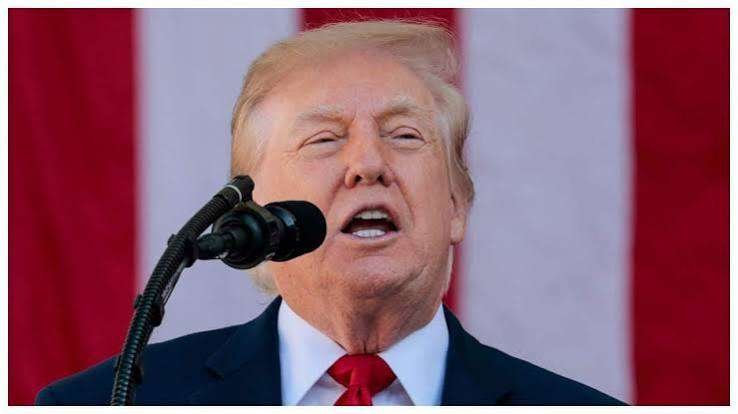
Washington: US President Donald Trump on Friday cited India’s 7% GDP growth and low interest rates to argue that the US economy could grow by as much as 20% if the Federal Reserve cut borrowing costs, while accusing the central bank of holding back economic expansion.
Speaking to reporters at the White House, Trump accused the Federal Reserve of raising interest rates when the US economy produces strong numbers, arguing that policymakers should instead ease monetary conditions to encourage further expansion.
“If you look at India, they have low interest rates, and they have a 7 percent GDP. We’d have a 14%, 15%, maybe even a 20% GDP,” Trump said.
He maintained that stronger economic performance should translate into lower borrowing costs, as robust financial indicators would make the US a more creditworthy borrower. Instead, he alleged, the Federal Reserve’s approach was restricting the country’s growth potential.
“We do just the opposite. We do it to destroy the country. When we have these great numbers, you shouldn’t keep raising the rates. You should lower rates because we’re a better credit. We would have a GDP of 15 or 20 percent, not 4 percent. We’d pay off the debt very rapidly,” he said.
Trump also questioned why the US should not have the lowest interest rates globally, given its economic influence and role in supporting other countries.
“We’re the country that makes other countries successful. Some of them are considered financial elite, but they are not. They are only elite because of us. So we should have the lowest,” he said.
The US President alleged that the Federal Reserve responds to positive economic data by raising interest rates rather than allowing favourable conditions to support further growth.
“Interest rates are too high because we have a very political Fed. I’m not blaming the chairman, but the fact that we have a very political Fed. Whenever we announce good numbers, they raise the interest rates. They do that for a reason. It should be the opposite,” Trump said.
His remarks reflect his continuing differences with the central bank over the pace of monetary easing. Trump has repeatedly pressed for lower borrowing costs, arguing that cheaper credit would support investment, business activity and economic expansion.
He has also defended his administration’s tariff policies, claiming they are encouraging domestic manufacturing and prompting companies to expand production in the US despite elevated borrowing costs.
Trump’s push for lower interest rates comes as US inflation remains above the Federal Reserve’s long-term target of 2%.
The annual personal consumption expenditures (PCE) inflation rate stood at 3.6% in September, while core PCE inflation, which excludes food and energy prices, was 3.1%, according to figures cited in the ANI report.
The Federal Reserve operates independently of the US government and considers price stability and maximum employment when determining monetary policy. Raising interest rates is one of its principal tools to contain inflation by making loans more expensive and moderating consumer and business demand.
Trump’s comparison with India, therefore, brings the debate over borrowing costs into sharper focus, particularly as his administration seeks faster economic growth while the central bank continues to weigh inflationary pressures.