N Nagarajan
When Bat enters inside homes, everyone goes tizzy. The other day my spouse met a middle-aged woman in a Puja store, where she was selecting a sari and other Puja items. She suddenly asked my spouse whether sari is okay and my spouse asked what’s the occasion, she then said a bat entered their house, and the pandit has recommended Puja where sari one of offering. My spouse said it’s okay as long as she likes it. Not going into the subject of why it’s practiced.
And what about gentle pigeons, which have love and hate connections. A lot people, particularly both Hindus and Muslims, often seen feed them for various reasons. Hindu religion and god also has some connection and our scriptures have mention. Pigeon of course has companion connection and rarely people want to eliminate the pigeons. However, pigeons indeed create a huge mess all over the globe, including health concerns and allergies, particularly for people with breathing issues. There are even demands to ban pigeon feeding in some parts, which attract large crowds, etc. Of course, in residential colonies, there are people who only want to fulfill their sentiments and are least bothered about neighbors. Of course, kite season pigeons are the main victims. We had great difficulty when one pigeon got entangled in manja and was hanging outside our bedroom on the top floor. A neighbor rang us to rescue the pigeon. We faced great difficulty in rescuing it, as we also had to save it. It almost took 45 minutes before it flew away.
Both Government and private building owners have to spend a fortune to keep them at bay, including the house of the President of India, the Old Parliament and power corridors in the capital. However, the Pigeons are here to stay and we humans have to live with it. However, innocent and troublesome Pigeons also created huge opportunity for net makers who have created both direct and indirect employment. Pigeons can be counted in GDP.
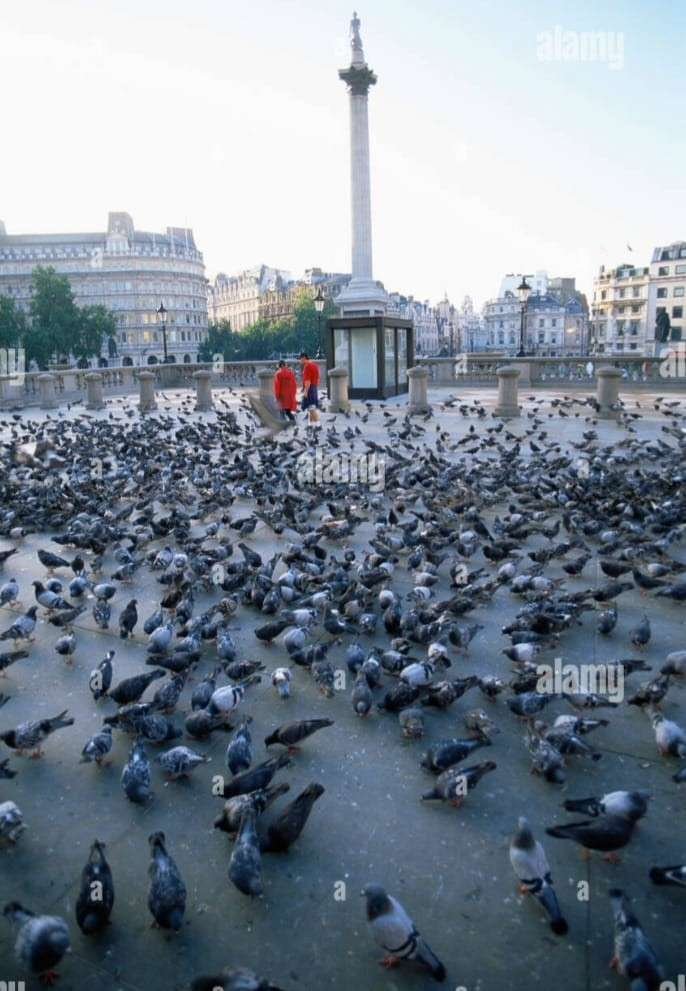
Remember the iconic DDLJ opening scene? Amrish Puri, feeding pigeons in London’s Trafalgar Square, lost in thoughts of Punjab’s mustard fields. It’s etched in Bollywood history. Of course, many Bollywood songs have a connection with Kabuthar. How can one forget Kabuthar Ja Ja Ja, Tamil song Oru Vellai Pura etc.
To conclude with the following, which I read a few months ago
But have you ever wondered why so many pigeons are always present in city squares? A Thread.
Trafalgar Square is one of London’s most vibrant and iconic spots, featured in DDLJ, where Amrish Puri’s character, in a nostalgic monologue, compares himself to urban pigeons searching for food in a foreign land. Throughout the film, pigeons serve as a metaphor.
But in reality, the presence of pigeons in a modern city isn’t an accident. It’s a global phenomenon, especially in coastal cities, rooted in a fascinating journey through natural history. But how do these birds thrive in the concrete jungle? Let’s unravel this.
Pigeons seem ordinary, right? But their presence in cities is anything but accidental. In fact, these birds have a long, surprising history with us humans—a story that goes back thousands of years. And, by the end of this thread, you’ll never look at them the same way again.
Today, there are more than 400 million pigeons worldwide, and most of them live in cities. But this wasn’t always the case.
The pigeons we see today are descendants of the rock dove (Columba livia), native to the rocky coastal cliffs of the Mediterranean, from North Africa to Southern Europe.
So, how did these cliff-dwellers end up ruling city skylines across the world? 10,000 years ago, in ancient Mesopotamia (modern-day Iraq) and Egypt, humans began luring these birds with food, coaxing them to roost near their homes.
These birds had a secret weapon: navigation. Pigeons have an uncanny homing instinct, a skill ancient sailors and armies soon discovered. Need to find land while lost at sea? Use a pigeon. Need to send messages across long distances? Send a pigeon!
But here’s where things get interesting. Pigeons became a status symbol. In Medieval Europe, nobles built elaborate pigeon houses, called dovecotes or pigeonnier, to breed them. You can still see a few of the remaining ones, mostly in France.
Each dovecote was a miniature palace for pigeons. During this time, the privilege to have a dovecote was highly coveted. Only the wealthy elite had the privilege to construct and maintain these elaborate homes for their pigeons.
However, everything changed during the French Revolution. As the revolution dismantled the old feudal structures, the privileges of the nobility were stripped away. Suddenly, farmers and commoners found the right to build dovecotes.
But how exactly did they even survive in an urban landscape after humans brought them here? This isn’t their natural habitat. And this is where the fascinating evolution of natural history comes into play.
As cities began to grow and develop, the structures that emerged mirrored the cliff faces pigeons were used to. Cities, with their towering buildings and endless crevices, became a pigeon’s dream habitat. They are quite natural on hard surfaces.
The concrete jungle mimics the rocky cliffs their ancestors loved. Tall buildings, window ledges, and balconies became perfect nesting spots. Cities became their new cliffs.
Pigeons thrived in this urban environment because they’re incredibly adaptable. Where other birds struggle, pigeons see opportunity. Think of every ornate building as a makeshift cliff, every air conditioning unit as a cozy nest spot. Evolution at its finest.
Window sills, ledges, and even the nooks of architectural designs serve as perfect perches for these birds who historically thrived in the wild, nesting on coastal cliffs and in rocky terrains. It became the most obvious choice.
This is why pigeons are everywhere. From New York to Mumbai, London to Melbourne—if there’s a city, there are pigeons. They are our feathery urban companions, having evolved alongside us for thousands of years. We built cities, and pigeons followed
And remember the DDLJ scene in Trafalgar Square? That’s no coincidence. Trafalgar Square once had so many pigeons that it became a local attraction! People fed them daily. But eventually, the city had to ban it—they were considered a health hazard.
Who would have thought a simple pigeon could have such a compelling story, right? Next time you’re in a city square, take a moment. You’re not just seeing pigeons—you’re witnessing, umm… evolution of natural history.