
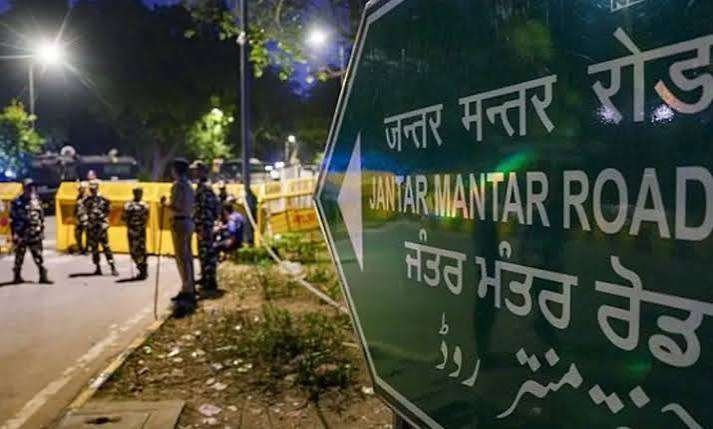
New Delhi: The Supreme Court on Friday gave one week to a woman to file a rejoinder in her plea challenging Delhi Police’s decision to de-notify Jantar Mantar as a designated protest site and shift demonstrations to three alternative locations in the national capital.
On October 15, a bench comprising Chief Justice Surya Kant and justices Joymalya Bagchi and V Mohana had sought responses of the Centre and Delhi Police on the petition filed by Swaty Singh challenging the October 11 order de-notifying Jantar Mantar as designated protest site.
On Friday, the bench adjourned the hearing for a week after Solicitor General Tushar Mehta questioned certain factual assertions contained in the written submissions circulated on behalf of the petitioner.
The bench, however, said factual assertions must be supported by an affidavit, with someone taking responsibility for their accuracy. Mehta also submitted that the petitioner should file a rejoinder on affidavit.
The Solicitor General informed the court that a request seeking an adjournment had initially been circulated on behalf of Additional Solicitor General S V Raju, who was unavailable, but was subsequently withdrawn.
The petition challenges a Delhi Police standing order issued by Commissioner Anurag Kumar on October 11, which withdrew Jantar Mantar’s designation as a protest site and identified Ramlila Ground, Burari Ground and CBD Ground in east Delhi as alternative venues for demonstrations.
During the earlier hearing, the bench had said it would examine whether the authorities had applied their minds to the use and effectiveness of Jantar Mantar as a designated protest site.
Senior advocate Gopal Sankaranarayanan, appearing for another litigant, had sought restoration of the notification recognising Jantar Mantar as a protest venue. He pointed out that the decision to de-notify the site was stated to have been taken in accordance with an earlier Supreme Court order.
Mehta, however, clarified that the earlier judgment was not the basis for the latest decision. He said a committee constituted to examine the issue had submitted a report outlining the reasons for the change.
In her petition, Singh argued that shifting protests to distant locations could undermine the fundamental rights to peaceful assembly and freedom of expression.
The plea contended that the right to protest was not merely about assembling at a designated location but also about being able to communicate grievances, express dissent and draw the attention of authorities and the public to issues requiring redressal.
It further argued that the location of a protest was crucial to its effectiveness, as proximity to relevant institutions, public accessibility and visibility determined whether demonstrators could reach their intended audience.
The petitioner also termed the police order arbitrary and procedurally deficient, arguing that merely identifying alternative venues did not ensure the preservation of the right to protest, particularly when arrangements governing access to those locations were left to a subsequent standard operating procedure.