



King Dhritarashtra, overwhelmed by grief and anxiety, asked Sanjaya, “After Duryodhana fell with his thighs shattered, what did the Pandavas and the Panchalas do?” Sanjaya replied with deep emotion, “O King, words scarcely suffice to describe the scene. The Pandavas, the Panchala princes, and their allies, accompanied by Sri Krishna, were filled with overwhelming joy. Some cast their garments into the air in jubilation, some twanged the strings of their mighty bows, others sounded their conches with thunderous force, while many shouted in triumph until the battlefield echoed with their cries. Gathering around Bhimasena, they praised him with admiration.”
They said, “Duryodhana was unmatched in the science of mace combat. Yet when he fought with reckless arrogance, you struck him down before he could escape. With a single irresistible blow you shattered his thighs and laid him low. Even now we remain astonished by your achievement. Just as Indra slew the invincible Vritra and earned the praise of the three worlds, so too have you accomplished a feat worthy of immortal acclaim. You have slain the cruel Dussasana and the wicked men who dishonoured Draupadi beyond all measure. You fulfilled your terrible vow by placing your foot upon Dussasana’s head. Who upon this earth has displayed such terrible valour and unwavering resolve?” Thus the assembled kings extolled the might and steadfastness of Bhimasena.
Sri Krishna, however, perceiving that several kings were silently disturbed because Bhima had struck below the waist, violating the accepted code of mace combat, looked around and addressed them with calm authority. “Let none declare that this wicked king has been slain unrighteously. Though Duryodhana committed unspeakable crimes against a virtuous queen, Dharmaraja sought peace until the very end and asked only for his rightful inheritance. Yet Duryodhana rejected every path of righteousness. Vidura and many wise elders repeatedly advised him, but blinded by pride and madness, he refused even a needlepoint of land to the Pandavas. Such a deceitful ruler invited the very end that has now overtaken him. This sinner has fallen like an uprooted tree. Why, then, should anyone invoke the language of righteousness on his behalf? Let us depart.”
Even as Krishna spoke, Duryodhana still clung to life. Writhing upon the earth like a serpent crushed beneath a mountain, hissing with the remnants of his strength, he fixed his blazing eyes upon Krishna and spoke bitterly. “Krishna, you never acknowledge your own faults. Without compassion or fairness, you speak as though you alone uphold righteousness. By your signal, Arjuna allowed Bhima to strike my thighs. Had it been an honourable contest, I alone would have sent all of you to the abode of death. You placed Sikhandi before Bhishma to bring down the grandsire. You persuaded Yudhishthira to utter a deceptive half-truth that destroyed Drona. When Karna’s chariot sank into the earth, you ordered Arjuna to kill him. Bhurisravas was deprived of his victory through your intervention. Jayadratha was delivered into Arjuna’s hands through your cunning before sunset. You, who achieved victory through stratagem at every step, possess no right to lecture others on righteousness. Your sins are beyond measure. Could Bhishma, Drona, Karna, Bhurisravas, Jayadratha, or even I have been defeated in a fair and honourable battle?”
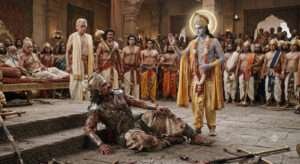
Sri Krishna answered with serene firmness. “Duryodhana, from Bhima’s childhood you sought his destruction. You poisoned his food, exposed him to venomous serpents, and cast him into deep waters. You conspired to burn the sons of Kunti alive in the house of lac while they slept. Through deceitful dice you robbed the righteous Yudhishthira of his kingdom and wealth. Draupadi, the noblest of women, was humiliated before the royal assembly in an outrage that words cannot adequately describe. Even then the Pandavas restrained their anger and faithfully observed their exile and year of concealment. As the envoy of Dharmaraja, I came seeking only their rightful share, yet you rejected every appeal.”
“Your arrogance, greed, and sinful obstinacy became the cause of Bhishma’s and Drona’s deaths. Sikhandi and Dhrishtadyumna were born through the austerities and sacrificial rites of Drupada for the very purpose of ending the lives of Bhishma and Drona. Destiny itself ordained their roles. Bhurisravas sought to slay the exhausted Satyaki without honour. Could such conduct remain unpunished? When young Abhimanyu was surrounded and mercilessly slain by seasoned warriors acting together, did you imagine his kinsmen would abandon their sacred duty of vengeance? Jayadratha had earlier humiliated Draupadi in the forest. Was Arjuna to forsake his solemn vow and sacrifice his own life?”
Krishna continued, “Do you also forget the Ghosha Yatra, when the Gandharvas captured you and your companions fled in fear? It was Arjuna who rescued you from humiliation. Later, during the cattle raid upon Virata’s kingdom, when Bhishma, Drona, Kripa, Ashwatthama, and all your warriors stood helpless before Arjuna’s celestial prowess, did you not witness his unmatched heroism? Karna, the fountainhead of many injustices, met his end when his chariot wheel sank because of the curse he had earned. Why should Arjuna spare such a man? Bhima had long ago vowed to shatter your thighs for the insult inflicted upon Draupadi. Every event that has unfolded is the inevitable fruit of your own deeds. The Pandavas have never knowingly abandoned the path of righteousness. It was your deceit in the game of dice that uprooted the Kuru race.”
Duryodhana, refusing to yield even in defeat, answered with regal pride. “I studied the Vedas, performed sacrifices according to sacred tradition, enjoyed immeasurable wealth, and ruled over countless kings who served beneath my banner. I conquered many proud monarchs in battle. Why should I not ascend to heaven along with my friends and warriors? Think of me as you please. Your opinion neither diminishes nor elevates me. The sorrow that awaits you shall exceed mine.”
No sooner had he spoken than a marvellous spectacle unfolded. Celestial beings showered fragrant flowers upon Duryodhana. Divine music resounded through the heavens. The quarters brightened with radiant splendour, and gentle, perfumed breezes swept across the battlefield. Witnessing these heavenly signs, even the sons of Kunti stood momentarily silent, their faces touched with wonder and subdued reflection.
Sri Krishna then consoled the Pandavas. “Do not grieve that Bhishma, Drona, Karna, and Duryodhana were not overcome by strength alone. They were masters of celestial weapons, unconquerable through ordinary valour. Therefore destiny employed extraordinary means to accomplish its purpose through me. Even the gods have often subdued mighty demons through strategy rather than force. Above all, the decree of destiny cannot be altered. Their appointed hour had arrived, and none could turn aside the will of Providence.”
Sanjaya concluded his narration with quiet solemnity. Dhritarashtra listened in dreadful silence, knowing that his son still breathed, yet only to await the loneliness of an inevitable death. The mighty Kuru dynasty, once the glory of Bharata, had reached its tragic end, leaving behind an enduring lesson that pride, injustice, and unrestrained ambition inevitably consume even the greatest of kings.

