



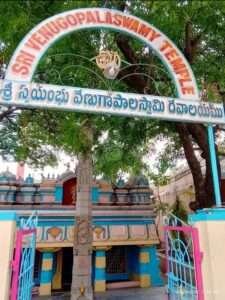
Sri Venugopala Swamy Temple, also known as Gopalaswami Temple, is an ancient shrine situated in Puttaparthi, Sri Sathya Sai District, Andhra Pradesh. Dedicated to Lord Krishna in his divine form as Gopala, the protector of cows, this temple holds a special place in the traditional history of Puttaparthi. Its fascinating legend involving a cow, a serpent and a curse makes it particularly meaningful to remember on the auspicious occasion of *Gopashtami*, celebrated on 17 November 2026.
The temple is believed to be several centuries old, although its exact age and year of construction have not been historically established. It is associated with the early settlement of Puttaparthi, which was once known as Gollapalli.
The presiding deity is *Lord Sri Gopalaswami (Venugopala Swamy)*, a form of Lord Krishna worshipped as the divine protector of cows.
Unlike the familiar flute-playing representations of Venugopala, the local temple tradition is associated with a sacred stone connected to the village’s ancient legend. This stone continues to be worshipped as Gopalaswami.
Lord Krishna’s identity as Gopala symbolises his affection for cows, cowherds, and all living beings.
The temple follows the simple architectural tradition of an old South Indian village shrine. Unlike the magnificent temples with towering gopurams and extensive mandapams, this shrine is modest in appearance.
Its sacred importance comes from the traditional worship of Gopalaswami and its connection with the origins of Puttaparthi.
📜History
According to local tradition, Puttaparthi was originally called Gollapalli, meaning the village of cowherds. The settlement was known for its large population of healthy cattle and the prosperity of its pastoral community.
The village later became associated with a curse involving a serpent, after which its cattle population declined and anthills began appearing throughout the area.
To overcome the curse and restore prosperity, a temple dedicated to Gopalaswami was established and endowed by the Raju family. The shrine remains an important reminder of Puttaparthi’s early religious traditions.
Sthalapurana – The Cow, the Serpent and the Curse of Gollapalli
According to the ancient local legend, Gollapalli was once a prosperous village inhabited by cowherds who owned numerous healthy cows. Among them was a cow that mysteriously stopped yielding milk. Its owner became suspicious and decided to follow it secretly. To his astonishment, he discovered that the cow regularly visited an anthill, where a cobra emerged and drank milk directly from her. The cow stood peacefully, allowing the serpent to feed. Unable to understand this extraordinary sight, the cowherd became furious and struck the cobra with a stone, killing it.
As the serpent lay dying, it is believed to have pronounced a terrible curse upon the village, declaring that the prosperous settlement would become filled with anthills and that its cattle would decline. Soon, according to the legend, the once-flourishing village began experiencing misfortune. The cattle lost their health, their numbers diminished, and anthills appeared throughout the region. The settlement consequently came to be called Valmikipura, derived from the Sanskrit word Valmika, meaning anthill, and later Puttaparthi, with Putta referring to an anthill in Telugu.
Distressed by these events, the villagers sought to overcome the curse and restore their former prosperity. The Raju family established and endowed a shrine where the sacred stone associated with the serpent’s death came to be worshipped as Lord Gopalaswami. According to tradition, this worship was intended to remove the curse and bring prosperity back to the cattle and the village. The sacred stone continues to be revered, preserving the remarkable story of how Gollapalli became Puttaparthi.
Krishna Janmashtami and other important Vaishnava festivals are spiritually significant occasions for devotees of Lord Gopalaswami.
Gopashtami, observed on the eighth day of the bright fortnight of Kartika, commemorates the day when Lord Krishna and Balarama were entrusted with the responsibility of tending fully grown cows instead of calves.
On this auspicious day, devotees traditionally bathe and decorate cows, offer them food, perform Gau Puja and seek the blessings of Lord Krishna as Gopala and Govinda.


