


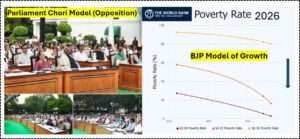
True to their contrasting characters, both the Leader of the Opposition and the Prime Minister of Bharat delivered what was expected of them. While Rahul Gandhi was busy with “Parliament Chori” in the lawns of octogenarian leader Mallikarjun Kharge and his antics on the streets of New Delhi and Ramlila Maidan, Prime Minister Narendra Modi quietly pulled out 49.6 crore people from multidimensional poverty. Multidimensional poverty is a way to measure poverty by looking at multiple overlapping deprivations a person experiences in daily life, rather than relying solely on income or money.
According to a World Bank report entitled “Poverty & Equity Brief – October 2026”, Bharat made remarkable progress in reducing poverty after PM Modi took the reins of the country in 2014. The share of the population living below the Lower Middle-Income that is $4.20/day in 2011 (2021 PPP) fell from 57.7 percent to 16.1 percent, lifting an estimated 496 million people out of poverty, while extreme poverty that is people living on $3.00/day declined from 27.1 percent to 2.6 percent. This is one of the fastest poverty declines in the world over the past decade (http://documents.worldbank.org/curated/en/099722104222534584).
The report concluded that this progress was mainly driven by strong consumption growth, rising employment, especially among women, and expanded social transfers, including food subsidies. As poverty declined, it became increasingly concentrated among households with lower education, fewer assets, limited access to stable employment, and higher dependency ratios.
Unfortunately, this remarkable achievement did not receive the media attention it deserved, apart from a few brief and low-profile reports aired during non-prime-time slots. Social media, too, made only a limited effort to highlight this historic comeback story of our country after more than seven decades of independence because they were more interested in street protests of cockroaches and opposition parties.
I watched Rajdeep Sardesai, who had a wry smile and a sarcastic expression, while conducting a discussion on the World Bank report on the India Today TV programme. It was typical Rajdeep’s style of discussing any issue that is critical of Prime Minister Narendra Modi or his government. Questioning methodology, examining data, and pointing out challenges are legitimate journalistic tasks. But doing so selectively is not journalism. Unfortunately, this selective approach appears common across much of the national media, with few exceptions.
A senior journalist once told me, “We have bills to pay, and negative news sells.” This reflects as much on society as it does on the media and may partly explain the formula behind the high TRPs of prime-time debates. Since 2014, negative coverage of the Modi government’s achievements has gradually turned into ridicule of the country itself during news-hour debates.
When poverty declines, or employment improves under this government, the response is often not celebration but scrutiny. The World Bank’s methodology and credibility are questioned, and “disgruntled” experts are invited to debate and cross-examine the report and search for loopholes. At times, prominent critics of the government like “Sens” and “Rajans” are brought in to amplify the scepticism. By contrast, when unemployment rises, poverty increases, inflation climbs, or the rupee weakens, the same issues are immediately portrayed as a national crisis
While journalists are not expected to become government cheerleaders, intellectual honesty surely requires them to acknowledge positive developments as well, irrespective of who receives the credit. Negative news may sell, but should credibility not be the true currency of journalism? I am aware that India still faces enormous challenges and has a long way to go. Yet recognising progress is not political propaganda. Scepticism is a journalist’s right; selective scepticism, however, is what makes viewers and readers question journalistic credibility
As a neutral observer, I feel the government deserves credit for a historic reduction in poverty, but celebration must not become complacency. Statistics can record progress, yet the real test of development lies in what we see on the ground. Today, it is common to see a daily-wage labourer earning around ₹800 a day, owning a two-wheeler and a smartphone, and the same is true for house helps in urban and semi-urban cities. So, the World Bank’s finding that extreme poverty has fallen sharply reflects ground reality, as evidence is visible in everyday life, in the ability of ordinary working people to own assets, stay connected, access services, and aspire for a better life. This is not merely statistics; it is the ground reality of a changing Bharat that would have seemed unimaginable to many households a generation ago. Hunger deaths in the late nineties and early and mid-2000s are history now.
The role of government in implementing the welfare measures has strengthened the economic security of the lower strata of society. Free and subsidised education, access to government health insurance and affordable healthcare, free or subsidised foodgrain through the public distribution system, and direct benefit transfers into bank accounts have reduced many of the immediate vulnerabilities faced by poor households. Gone are the days of Congress when only 15 paisa out of every rupee of the government used to reach the beneficiary, as acknowledged by late former Prime Minister Rajiv Gandhi. These measures do not merely provide relief; they help families protect their limited incomes, avoid distress borrowing during illness or crop failure, keep children in school, and plan for a better future.
Farmers, too, have benefited from improved rural connectivity, subsidised fertilisers, crop insurance, minimum support prices for key crops, irrigation projects, and direct income support schemes such as PM-KISAN. Better roads, electricity, mobile networks, and market access have enabled many cultivators to sell produce more efficiently, access information, and diversify into dairy, poultry, fisheries, and allied activities. While agrarian distress, fragmented landholdings, climate risks, and price volatility remain serious concerns, the gradual modernisation of rural Bharat has expanded opportunities for many farming households. The conditions of the farmers would have improved much had the revolutionary farm laws brought by the Modi government not been withdrawn by their agitation.
Final Word: Challenges certainly remain. Incomes can be irregular, social security is still limited, and many workers lack access to quality housing, healthcare, and education. Yet the central truth is clear: development in Bharat is no longer confined to statistics or elite lifestyles. It is increasingly visible in the improved living standards, financial inclusion, social protection, and growing aspirations of the lower-income population.
It is time to discard the attitude of the perpetual “Naraz Fufa”, the perennially disgruntled critic who searches for shortcomings even in a well-functioning system. Such critics seem unable to acknowledge progress in any field. If Bharat lands on the Moon, they ask why resources were not spent on food; if infrastructure improves, they point out that many people still do not own vehicles; and if the country strengthens its defence capabilities, they invoke the emotional argument that taxpayers’ money should not be spent on war preparedness. The list is endless.
I conclude with a humble request to our elitist section of society to come down to the ground level and witness how the lives of the poorest is changing. I am aware that one’s view depends on the floor one occupies. Today’s reality stands in sharp contrast to the pessimistic “dead economy” and “zero-growth” narratives, often amplified by foreign forces and echoed by their domestic sympathisers to belittle the government’s efforts towards an inclusive growth involving 140 crore population of our country. Remember, the road to success is always under construction.


Great reading early in the morning on a Sunday.
We CAN DO IT, is the mantra which pushes the Modi government. Identify problems, solve them in real time, at the ground level ,is being implemented in several smaller units, states/ UTs and that is what is adding up to our National Power.
Let us celebrate while the critics keep whining.
Jai Bharat
very good analysis of today’s journalists and journalism. Practical way of understanding the truth and better way of living.
My compliments to Dr.Chaddah for his remarkable narrations.
TRK Chetty
Very well articulated message. My comments are as below:
The elite society is already aware of these facts. But, they don’t want to acknowledge. The poor people unfortunately can’t understand easily these numbers. The middle class are confused. There are some vested interests, who don’t want to understand and always want to criticise (oppose). Under these circumstances, the solution according to me lies in : creating proper awareness, a strong RULE BOOK and GOVERNANCE and finally using a strong WHIP for non-DOERS. Gone are those days, people on their own understand the complexity of the situation and lead a disciplined life in the SOCIETY.
You have rightly observed and stated the questionable attitude of some journalists/media houses reg. Indian success story. We as a nation (as recorded by the WB too), have come a long way in alienating the poor and thereby reducing poverty. A serious point of concern however is about the progress/attention given to the infrastructure development. Many parts of the capital city, Delhi are still neglected. At many places, situation is so bad that even a physically fit/able bodied person may have difficulty in traversing those pavements. (Wonder where is the public money meant for improving them is vanishing!). Same is the state of clean air (AQI) and supply of pure drinking water in the taps. I understand a country’s infrastructure is a strong indicator of its overall development level and economic prosperity, though it is not the only metric.
If I’m right some of the journalists, if not all, r used to freebies like free food, star hotel accommodation and some pocket money to meet daily expenses, to cover the tours of Prime Ministers visiting foreign countries. These so called self declared experts will give positive report on PM’s tours and the visits likely impact. The current PM had withdrawn all these privilege’s/perks,these so calledexperts under such circumstances how they r expected to give positive/favourable reports. Long live their tribe and such people and their reportage.
If I’m right some of the journalists, if not all, r used to freebies like free food, star hotel accommodation and some pocket money to meet daily expenses, to cover the tours of Prime Ministers visiting foreign countries. These so called self declared experts will give positive report on PM’s tours and the visits likely impact. The current PM had withdrawn all these privilege’s/perks,these so calledexperts under such circumstances how they r expected to give positive/favourable reports. Long live their tribe and such people and their reportage.
A good article with positive outlook for future brought out. Justifies World Bank assessment with unbiased expression
Very good read on a Sunday morning. It is rightly pointed out that some journalists are very critical of government achievements. Some are like, their behavior is like that. Whatever achievements government makes they criticize for the remaining people. In a country like India with 150 crore population there is always a section of people left behind of various reasons. Overall very good progress and kudos to prime minister and thanks to you for sharing the news.