
M Bala Bhaskar
Sri Lanka and Thailand are steadily expanding their bilateral relationship beyond traditional diplomatic, cultural and economic engagements, with education emerging as an important new area of cooperation. A recent agreement between higher education institutions from the two countries marks another step towards strengthening academic partnerships, promoting international learning opportunities and developing skills relevant to an increasingly technology-driven world.
The Embassy of Sri Lanka in Thailand recently welcomed the signing of a Memorandum of Understanding (MoU) between Oxford Chester Uni of Higher Education (OCU), Sri Lanka, and the Institute of Science Innovation and Culture (ISIC), functioning under Rajamangala University of Technology Krungthep (RMUTK), Thailand.
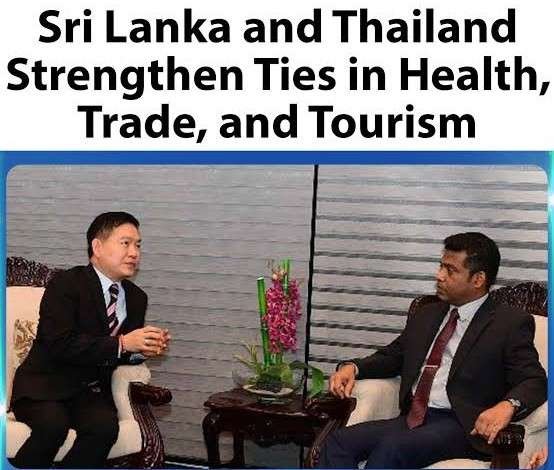
The agreement was signed at the ISIC premises in Bangkok on November 6, in the presence of Sri Lanka’s Ambassador to Thailand and Permanent Representative to UNESCAP, Wijayanthi Edirisinghe, who delivered the keynote address.
The Sri Lankan delegation included OCU Director Dr. Dulan Hettiarachchi and Minister Counsellor (Commercial) of the Sri Lankan Embassy, Shiwanthi Abeyratne. The Thai delegation was led by Associate Professor Dr. Yaoping Liu, Director and Founder of RMUTK-ISIC.
Opening International Academic Pathways
One of the significant features of this partnership is its potential to expand access to international higher education for Sri Lankan students. Operating through the Gangaramaya Educational Centre, OCU seeks to make quality higher education accessible and affordable. Under the partnership, Sri Lankan students will have opportunities to pursue international university programmes ranging from bachelor’s degrees to doctoral qualifications.
Such institutional collaborations can provide students with exposure to international academic environments, new teaching methodologies and qualifications that could broaden their professional and career prospects.
For Sri Lanka, which is seeking to modernise its education system and improve the employability of its younger population, international academic partnerships offer an opportunity to complement domestic capabilities with global expertise.
Beyond Classrooms: Skills and Rural Empowerment
Importantly, the latest MoU is part of a wider engagement between Sri Lanka and Thailand on education, vocational training and community development.
In April 2026, Sri Lanka’s Minister of Rural Development, Social Security and Community Empowerment, Dr. Upali Pannilage, led a delegation to Thailand’s Chitralada Technology Institute to study its approach to education and practical skills development.
The discussions focused on Thailand’s Sufficiency Economy Philosophy and its application in innovative agriculture, industrial technology, business administration, digital technology and vocational education.
The visit provided Sri Lankan representatives an opportunity to examine how technical education, practical training and community-based initiatives could contribute to rural development and economic self-reliance.
Thailand’s Chitralada Technology Institute follows an educational approach that combines theoretical learning with vocational training, encouraging students to acquire practical competencies alongside academic knowledge. This model offers relevant lessons for countries seeking to bridge the gap between classroom education and workplace requirements.
Building Wider Academic Networks
The engagement is not confined to technical education alone. Sri Lanka has also been exploring academic cooperation with other prominent Thai institutions.
In September 2025, Ambassador Wijayanthi Edirisinghe held discussions with the Faculty of Economics at Thammasat University on undergraduate and postgraduate student exchanges, scholarship opportunities and collaboration in economic policy formulation.
Earlier, discussions with the Chitralada Technology Institute had explored possibilities for student and faculty exchanges, curriculum development, knowledge-sharing initiatives and scholarships for Sri Lankan students.
These engagements indicate a broader effort to establish institutional networks that can facilitate academic mobility, research cooperation and the exchange of expertise.
Aligning Education with Future Needs
The developments assume significance against the backdrop of Sri Lanka’s efforts to transform its education system. Its National Education Policy Framework recognises the need to respond to emerging technologies, particularly Artificial Intelligence, climate change and changing socio-economic realities.
The country’s education reform agenda also seeks to strengthen vocational learning, modernise curricula and make education more responsive to the requirements of a changing employment market.
Thailand’s experience in vocational and technical education, lifelong learning and industry-oriented training could offer useful reference points in this transition.
Ultimately, the success of such international partnerships will depend not merely on signing agreements but on translating them into tangible outcomes through student exchanges, accessible scholarships, recognised academic programmes, faculty collaboration and practical training opportunities.
For both countries, education offers an avenue to strengthen people-to-people relations while investing in the most valuable resource of any nation — its human capital.
The Sri Lanka–Thailand partnership therefore carries significance beyond institutional cooperation. It reflects an emerging recognition that the future of education lies in international collaboration, practical knowledge, technological adaptability and skills that empower individuals to participate meaningfully in national development.