


Shri Khandoba Temple at Malegaon, situated approximately 57 kilometres from Nanded city, is an ancient and highly revered temple dedicated to Lord Khandoba, an incarnation of Lord Shiva. The temple is considered one of the important centres of Khandoba worship in Maharashtra and is especially famous for its annual Malegaon Yatra, which attracts thousands of devotees from Maharashtra and neighbouring Karnataka.
The temple is traditionally believed to be around 850–900 years old, with its origins traced to the medieval period. The ancient shrine has undergone renovations and additions over the centuries while retaining its religious importance. The exact date of its original construction has not been firmly established.
The presiding deity is Lord Khandoba, also known as Malhari Martand and Mhalasakant, worshipped along with his consort Goddess Mhalsa. The sacred stone representations of the divine couple are worshipped in the sanctum. Lord Khandoba is regarded as a powerful guardian deity and Kuladevata (family deity) by many communities in Maharashtra and Karnataka. Devotees worship him for protection, prosperity, and the removal of difficulties.
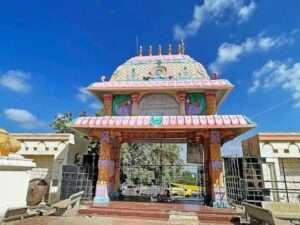
The temple is associated with traditional stone architecture and features a sanctum, assembly hall and courtyard. Its architectural features reflect the regional temple-building traditions of medieval Maharashtra. The temple premises become particularly vibrant during festivals, when devotees gather in large numbers to offer turmeric powder, known as Bhandara, as a sacred offering to Lord Khandoba.
Malegaon has been an important centre of Khandoba worship for several centuries. The temple’s religious traditions have been preserved through generations of devotees. Its annual pilgrimage fair has become an important part of the cultural heritage of the Nanded region, bringing together religious celebrations, traditional trade, and rural customs. The temple also reflects the longstanding cultural and devotional connections between Maharashtra and Karnataka.
According to the local Sthalapurana, many centuries ago, a merchant was travelling from Karnataka with bullock carts carrying sacks of grain. During his journey, he stopped at Malegaon for the night and unloaded the sacks to allow his bullocks to rest.
The following morning, when the merchant prepared to continue his journey, he noticed that one particular sack had become unusually heavy. Despite repeated attempts, neither he nor his helpers could lift it. Surprised by this mysterious incident, the merchant decided to open the sack.
To his astonishment, he discovered two sacred stone idols representing Lord Khandoba and Goddess Mhalsa hidden among the grain. The merchant immediately realised that this was no ordinary occurrence and believed that the divine couple had chosen Malegaon as their permanent abode.
Accepting the incident as a divine indication, he installed the sacred idols at the very place where they were discovered and established a shrine for their worship. According to local tradition, this miraculous discovery took place on Margashirsha Vadya Chaturdashi, an occasion remembered during the annual temple celebrations.
Another interesting legend associated with the temple concerns Goddess Banai, the second consort of Lord Khandoba. According to local belief, Banai once became upset with Lord Khandoba and came to stay near Malegaon.
Lord Khandoba followed her and requested her to return, but she refused. It is believed that Lord Khandoba then remained nearby in the form of a Shiva Linga, waiting for her. A separate shrine associated with this tradition is found near the main temple.
The most important festival celebrated here is the annual Malegaon Khandoba Yatra, held during the Hindu month of Margashirsha (November–December). The celebrations include a grand palanquin procession, devotional singing, traditional drums and the offering of turmeric powder or Bhandara.
The fair continues for several days and is particularly famous for its traditional livestock market, including horses, cattle and donkeys. Folk performances, wrestling competitions and other cultural activities form an important part of the celebrations. Champa Shashthi, Amavasya, Purnima and Sundays are also considered auspicious occasions for worship.


