


King Janamejaya said, “O venerable Sage Vaiśampāyana, on the seventeenth day of the great war, Karṇa, the supreme commander of the Kaurava army, fell in battle. With their greatest warrior gone and their forces shattered, how did Duryodhana continue the struggle against the unconquerable Pāṇḍavas? Whatever I have heard thus far concerning the history of the descendants of Pāṇḍu has filled my heart with satisfaction, yet my longing to know the events that followed has only deepened. Therefore, O sacred sage, narrate to me the remaining course of that unparalleled conflict.”
The illustrious Vaiśampāyana replied, “O King, after the death of Karṇa, the surviving monarchs and warriors assembled around the grief-stricken Duryodhana in his camp. Though overwhelmed by despair, they consoled their king with words of courage, reminding him that true Kṣatriyas never abandoned the battlefield while life remained. Rekindling their martial spirit, they anointed Śalya, the mighty king of Madra, as the new commander of the Kaurava host. The remaining soldiers gathered their courage, arrayed themselves in battle formation, and marched once more to Kurukṣetra. The Pāṇḍavas, perceiving their preparations, likewise arranged their forces with unfailing wisdom. As the two armies met again, the earth trembled beneath the tread of warriors, and the clash resembled the celestial war once fought between the gods and the mighty demons.”
As the battle raged beneath the blazing sun, torrents of arrows darkened the heavens, and the cries of elephants, horses, and heroes echoed across the plain. Around midday, the valiant Śalya, despite displaying extraordinary prowess, was struck down by King Yudhiṣṭhira, the righteous son of Dharma. With the fall of their commander, the remaining allies, relatives, and loyal companions of Duryodhana rushed forward in desperate fury. One after another they met heroic deaths beneath the irresistible might of Bhīma, Arjuna, Nakula, Sahadeva, Sātyaki, and the other champions of the Pāṇḍava cause. At last, seeing his immeasurable army reduced to nothing and all hope extinguished, Duryodhana abandoned the battlefield and fled, his heart filled with fear and desolation. Seeking concealment, he entered the depths of a lonely lake, hoping to preserve his life.
The victorious Pāṇḍavas soon discovered his hiding place. Standing around the still waters, they called upon him with stern words, declaring that a warrior born in the Kuru race must not seek refuge beneath the waters when honour demanded combat. Their voices stirred his wounded pride. Rising from the lake like a serpent emerging from its hidden abode, Duryodhana took up his mace and challenged Bhīmasena to single combat. A fierce duel followed, worthy of immortal remembrance. The earth shook beneath the blows of their mighty maces until, as the sun descended toward the western horizon, Bhīma fulfilled the solemn vow he had sworn in the royal assembly. Striking Duryodhana upon his thighs with irresistible force, he shattered them, and the proud monarch fell helpless upon the dust of Kurukṣetra, his earthly glory extinguished.
When darkness enveloped the battlefield, the tragedy of war had not yet reached its conclusion. During the silence of the night, Aśvatthāmā, consumed by wrath and vengeance, entered the sleeping camp of the Pāṇḍavas accompanied by Kṛtavarmā and Kṛpācārya. Mistaking vengeance for righteousness, he massacred the unsuspecting Pāñcāla and Prabhadraka warriors, together with the sons of Draupadī and many other heroes who lay asleep, thus staining the final hours of the war with an act remembered forever for its sorrow and cruelty.
At dawn, Sañjaya departed from Kurukṣetra and journeyed to Hastināpura. His eyes overflowed with tears, his body trembled beneath the unbearable burden of grief, and his voice was choked with sorrow. Raising his hands in anguish, he lamented before all who met him, “The son of Dhṛtarāṣṭra shall never reign as sovereign over Hastināpura. Duryodhana, who delighted the citizens as the cooling moon gladdens the thirsty earth, has perished in a manner unforeseen.”
Entering the private chambers of the aged King Dhṛtarāṣṭra, Sañjaya found the blind monarch seated amidst Gandhārī, the widowed daughters-in-law, Vidura, and other members of the royal household. The king was already mourning the death of Karṇa, his heart crushed beneath the weight of successive calamities. Approaching with reverence, Sañjaya bowed low, touched the king’s feet, and, unable to restrain his tears, spoke with a voice broken by sorrow.
“O King Dhṛtarāṣṭra,” he said, “Śalya has fallen. Śakuni, together with his son Ulūka, has been slain. The united hosts of the Kambojas, Śakas, Yavanas, mountain tribes, Mlecchas, and countless warriors who came from every direction have all perished. The sons of Karṇa and the princes who fought beneath your banner lie lifeless upon the field. As Bhīmasena had vowed before the assembled kings, Duryodhana, lord of monarchs, has fallen with both thighs shattered by the force of the mace. Bereft of his splendour, he now rests upon the dust of Kurukṣetra.”
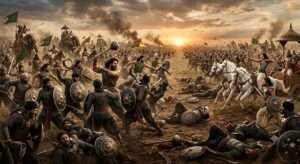
Sañjaya continued, “On the opposing side, Śikhaṇḍī, Uttamaujā, Yudhamanyu, the mighty Pāñcāla warriors, the Cedis, the Matsyas, the Prabhadrakas, and the noble sons of Draupadī—Prativindhya and his brothers—have likewise perished, together with innumerable horses, elephants, chariots, and foot soldiers. In both camps, only the women survive to mourn the fallen. Among the Kauravas, only Kṛpa, Aśvatthāmā, and Kṛtavarmā remain alive. Among the victors survive the five Pāṇḍavas, Lord Kṛṣṇa, Sātyaki, and your righteous son Yuyutsu. For the single ambition that Duryodhana should become sovereign over all the earth, destiny has consumed eighteen Akṣauhiṇīs of warriors—eleven on your side and seven on the side of the Pāṇḍavas. They fought with incomparable courage, and now they have vanished like footprints washed away by the flowing river of time.”
Hearing this dreadful account, King Dhṛtarāṣṭra collapsed unconscious. Gandhārī and the bereaved daughters-in-law also fell senseless upon the ground, overwhelmed by grief too great for human endurance. For a time they remained motionless, as though life itself had departed from their bodies. With gentle care, Vidura and Sañjaya revived them. Recovering consciousness, the aged king cried to Vidura, “Brother, you alone are now my refuge. I am stripped of sons, brothers, friends, and all who gave meaning to my life.” After a long silence, he breathed deeply like a serpent confined within a narrow vessel, unable to master the storm raging within his heart.
The palace echoed with the cries of the women, while Sañjaya himself wept openly beside his sovereign. At length Dhṛtarāṣṭra, gathering what little composure remained, spoke in a trembling voice. “My mind no longer obeys me. Vidura, lead Gandhārī and my daughters-in-law to their chambers. Let them not witness the depth of my anguish.” Vidura, with words of compassion and wisdom, gently persuaded the grieving women to withdraw. Sobbing and scarcely able to walk, they slowly departed, leaving the king alone with Vidura and Sañjaya within the silent chamber.
After a long pause, Dhṛtarāṣṭra stretched forth his trembling hands toward the direction of Sañjaya and spoke with indescribable sorrow. “What path remains for me now? Why did the five Pāṇḍavas survive while my sons have all been consumed by death? Your words scorch my heart like blazing fire. When you declared that all my sons had fallen, my heart did not break. Surely it must be fashioned from diamond, for no mortal heart could endure such grief. Blind from birth, I was denied the joy of beholding their playful childhood, their radiant youth, and their noble growth into manhood. Now even the comforting words of my relatives torment me more cruelly than flames.”
Unable to restrain himself, the aged monarch cried aloud, “O my beloved son Duryodhana, come once more and embrace your father. Relieve your mother Gandhārī from the unbearable weight of sorrow. Was it fitting that you should abandon your aged and helpless parents? Tell me, O king of the Kurus, by what path shall we continue to live without you? Forgetting that we are blind and dependent upon your care, why have you departed? Where has your affection gone? Where is the kindness with which you once served us?”
His lament grew ever more heartrending. “You, who were worthy to be attended by royal servants and honoured by mighty kings, now lie forsaken upon the lonely earth near the lake where you fell. Your strength was unconquerable before the greatest of warriors, yet destiny decreed that you should perish at the hands of the sons of Pāṇḍu. Who will now stand before me with filial devotion? Who will daily comfort these aged eyes that have never beheld the face of a beloved son? Bereft of kingdom, family, and hope, I remain only to bear the burden of memory, while the glory of the Kuru race has disappeared into the inexorable silence of time.”

