


Rahul Ghandy failed to garner the support of “We the People” through the “Hook” of minority-appeasement politics and the I.N.D.I.A. alliance in the 2024 Parliamentary elections, followed by defeats in Haryana (October 2024), Maharashtra (November 2024), Delhi (February 2025), Bihar (November 2025), and Assam, West Bengal and Puducherry in 2026.
Only Kerala favoured the I.N.D.I.A. alliance. In Puducherry (UT), an AINRC-led administration emerged, while Tamil Nadu recorded an outcome favouring TVK.
No wonder Rahul Ghandy is hell-bent on grabbing power by “Crook”. Surely, a layman on the streets would be politically naïve not to recognise the anarchic developments, particularly in Delhi.
Quite apparently, Rahul Ghandy has adopted the strategy and end objective of “Regime Change by Revolution”, taking cues from political developments in Sri Lanka, Bangladesh and Nepal.
Rahul Ghandy’s Congress party general secretary, K.C. Venugopal, has described the ongoing agitation and protests as the “Second Freedom Struggle”.
Viewed from the perspective of “Economic Security”, “Regime Change by Revolution” can have extremely adverse consequences. Nor is there any guarantee of political stability or societal unity.
For example, the Sri Lankan Revolution in March 2022 fundamentally reshaped the country’s entire political hierarchy. However, from the economic security perspective, GDP growth still remains around 4.2%.
Following the July 2024 uprising, the economy of Bangladesh experienced a period of deceleration followed by stabilisation. Structural disruptions caused by political turmoil brought real GDP growth down significantly compared with the pre-revolution historical average of 6–7%. In FY 2025–26, it is still at 3.68%.
Following the September 2025 revolution, Nepal’s domestic economy suffered an unprecedented downslide in private-sector confidence and industrial growth. Real GDP growth reportedly nose-dived from an estimated 4.3% to 2.1%–2.3% for the fiscal year following the unrest.
To sum up, “Regime Changes” have undoubtedly occurred in Sri Lanka, Bangladesh and Nepal, but they have also raised concerns about economic security, from which these countries are yet to recover. Political stability and national unity remain moot points. What is more, all three are small nations compared with India, with its 30 States, six UTs and a population of 1.45 billion.
Already, foreign investors have withdrawn Rs 44,166 crore from Indian equities so far in October amid elevated crude prices, rising US bond yields and a shift towards North Asian markets. If political uncertainty compounds these pressures, the rapidly growing Indian economy could suffer an unprecedented setback.
Who will be affected? Let there be no doubt that if the so-called “Second Revolution” ever succeeds in destabilising the existing order, it is “We the People” who will bear the economic consequences, which will affect them directly. Instead of FII inflows, even domestic capital outflows could follow.
Note that the current crop of political leaders instigating protests and riots to advance the so-called “Second Revolution” will continue to live in “Delhi’s Palaces” at taxpayers’ expense.
Rahul Ghandy’s Strategy
Let me review the strategy adopted by Rahul Ghandy and the Congress party to remove the democratically elected Modi-led NDA Government.
Rahul Ghandy and the Congress party have apparently taken their cue from Union Education Minister Dharmendra Pradhan’s resignation following the CJP protests over the “NEET paper leak”.
The immediate objective now appears to be to secure CEC Gyanesh Kumar’s resignation, thereby stalling the CJP’s momentum.
Should they succeed, the next “heads on the chopping block” could be the Modi–Amit Shah duo. Perhaps even the Chief Justice of India, should the judiciary fail to toe their line.
Rahul Ghandy’s Behavioural Transformation!
Following the political developments of 2024, Rahul Ghandy’s parliamentary presence appears to have shifted from a historically low-profile attendee to an aggressive focal point of Opposition strategy. He has increasingly used aggressive messaging to challenge the Treasury benches on core issues such as student protests, national security and economic policies. His sharp rhetoric targets the top leadership and demands structural accountability from the Government.
Outside Parliament, Ghandy’s persona has shifted significantly towards grassroots activism, reinforced by public initiatives such as the Bharat Jodo Yatra and Chhatron Ki Goonj (translated as “Voice of Students”). He has also adopted a lighter, more strategic communication style on social media platforms such as Instagram, using AMAs (Ask Me Anything) and casual dining vlogs to soften his image and connect with younger audiences.
Currently, Rahul Ghandy is actively leading high-voltage street protests, some of which have resulted in physical confrontations with law enforcement and brief detentions. Supporters view this as a necessary struggle against State power, while opponents describe it as an incitement to lawlessness. He has also shown a greater willingness to enforce political decisions internally, including restructuring State leadership units, while prioritising practical electoral victories over rigid ideological positions.
The ruling party criticises him for crossing parliamentary lines, creating a ruckus and contributing to repeated adjournments of the Lok Sabha. Ruling ministers have also accused him of violating Lok Sabha rules, defying the Speaker and resorting to “childish antics” on the floor of the House. He has further faced criticism for making unsubstantiated claims, relying on sensitive memoirs and using derogatory language in Parliament.
In retrospect, Rahul Ghandy’s behavioural traits have undergone a highly visible transition over the past few years. Opinions on his conduct remain deeply polarised: his supporters view him as a revitalised, empathetic street-fighter, while his critics describe his actions as disruptive and combative.
Is Rahul Ghandy a “Perpetual Protestor”?
Can Rahul Ghandy be conferred the title of a “perpetual protestor”, hitting the streets on a daily basis?
Who is a “perpetual protestor”? He is a dissident who actively challenges an established political or social doctrine as a core part of his identity. A perpetual protestor can also be categorised as a serial objector who consistently files complaints, legal challenges or public protests against institutional decisions. Alternatively, a perpetual protestor can be viewed as a crusader who campaigns vigorously and untiringly for a major political reform — “Save Democracy”.
Rahul Ghandy is more of an agitator, one who stirs up public feeling or unrest and is often viewed by authorities as doing so merely to cause trouble. He appears to take an opposing view on almost every issue, seemingly for the sake of argument rather than out of genuine conviction. He can also be described as someone who persistently annoys or challenges people in positions of authority — a term derived from the insect that bites livestock. He is a rabble-rouser who systematically inflames crowd emotions to create chaos.
Foreign Hand
Ipso facto, the author believes that a foreign hand is actively aiding and abetting street protests under Rahul Ghandy’s leadership. Billionaire philanthropist George Soros, his son Alex Soros, and the Open Society Foundations (OSF) have been accused by critics of orchestrating and funding civil unrest. US President Donald Trump has reportedly called for federal racketeering charges under the RICO Act, alleging criminal conspiracies involving the orchestration and funding of civil unrest, and even domestic terrorism.
The relationship between billionaire investor George Soros and India is highly contentious, defined by decades of socioeconomic investments alongside allegations of political interference. The ruling BJP has characterised Soros as an “enemy of India” who seeks to destabilise the country, while Soros’s philanthropic organisations maintain that they support democratic values and social welfare.
The political conflict intensified following comments made by Soros at the Munich Security Conference, where he asserted that the Adani Group controversy would weaken Modi and spark a “democratic revival” in India. India’s External Affairs Minister, S. Jaishankar, publicly countered by describing Soros as “old, rich, opinionated, and dangerous”.
Examples cited by critics in support of allegations concerning Soros’s activities include Sonia Gandhi’s co-chairmanship of the Forum of Democratic Leaders in Asia-Pacific (FDL-AP); investigations into Pegasus spyware and the Adani Group by the Organized Crime and Corruption Reporting Project (OCCRP), which critics allege is linked to Soros-funded networks; and the participation of a vice-president of a Soros-linked foundation in Rahul Ghandy’s Bharat Jodo Yatra. These associations and allegations, however, do not by themselves establish a coordinated effort to destabilise India.
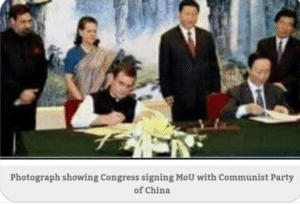
Add to these concerns the MoU that Rahul Ghandy, in his capacity as a general secretary of the Indian National Congress (INC), signed with the Communist Party of China (CPC) on August 7, 2008, in Beijing, at the Great Hall of the People, in the presence of Sonia Ghandy and Xi Jinping. The ruling BJP and various critics have scrutinised the 2008 party-to-party MoU, demanding that the Congress party make its contents public. Critics question why an Indian political party established a formal, direct consultation mechanism with the ruling party of a foreign state.
Separately, investigations revealed that the Rajiv Gandhi Foundation, a philanthropic entity chaired by Sonia Gandhi, received financial donations from the Chinese Embassy in New Delhi and the Government of China during the mid-2000s. In 2022, the Indian Government cancelled the RGF’s Foreign Contribution Regulation Act (FCRA) licence, citing violations of foreign-funding laws.
Add to these concerns adversaries such as Pakistan, among others, which may seek to stall the “Rise of India”. Surely, they would not want a united, modern India to take its rightful place among the world’s three leading powers by 2047 — China, the USA and India.
Plea
As an 88-year-old former Army veteran who has shed real blood to ensure “National Security”, I cannot help pointing out that “Peace is essential for Progress”; “Progress is for Prosperity”; and unity of the nation must be based on “Brotherhood”. Together, these constitute the P3B mantra.
Viewed from the “National Security” perspective, spreading “Anarchy” is contrary to national security. “Regime Change by Revolution” and the “Second Revolution to Save Democracy”, pursued in the name of regaining relevance in India’s democratic politics, are also contrary to national security.
From the economic security point of view, allowing Rahul Ghandy to stir anarchy and chaos could amount to a self-inflicted disaster for “We the People”.
My earnest plea to “We the People of India, particularly enlightened intellectuals, academicians and media experts”, is to raise their voices in unison, expose what the author regards as the anti-national tirade of the Rahul Ghandy-led I.N.D.I.A. alliance, and ensure that any political backlash boomerangs on those responsible for creating the unrest.

