



युधामन्युश्च विक्रान्त उत्तमौजाश्च वीर्यवान्।
सौभद्रो द्रौपदेयाश्च सर्व एव महारथाः॥
The opening movement of the Bhagavad Gita presents a remarkable psychological picture of the battlefield. Duryodhana, having surveyed the assembled armies at Kurukshetra, approaches his preceptor Drona and begins describing the strength of the forces standing against him. His words are not merely a military enumeration; they reveal the state of his mind at a moment when the enormous consequences of the impending war begin to confront him with undeniable reality.
Duryodhana first draws attention to the distinguished warriors among the Pandava forces. He mentions Yudhamanyu, renowned for his valour, Uttamaujas, celebrated for his strength, Abhimanyu, the heroic son of Subhadra, and the sons of Draupadi. He concludes this enumeration by describing them as Maharathas. The choice of these names is significant. Duryodhana is not simply counting soldiers; he is acknowledging the quality, courage, lineage and martial capacity concentrated within the opposing army.
In the military vocabulary of the ancient Indian tradition, a Maharatha represents an exceptionally accomplished warrior capable of confronting numerous opponents simultaneously. Traditional descriptions associate the term with extraordinary mastery of warfare and the capacity to command or withstand large formations. Thus, when Duryodhana repeatedly identifies Pandava warriors as Maharathas, his words convey more than admiration of individual skill. They indicate his recognition that the Pandava army possesses a formidable concentration of military leadership even though its numerical strength is smaller.
This distinction between numbers and effectiveness is central to understanding the scene. An army is not rendered powerful merely by the number of men standing upon the battlefield. Discipline, command, courage, strategic intelligence, weapon mastery, unity of purpose and the ability of commanders to inspire their forces can transform a smaller army into a formidable power. The Pandava army embodies precisely this principle. Its strength lies not merely in its size but in the extraordinary quality of the warriors who constitute its principal fighting force.
Duryodhana’s speech therefore has an important psychological dimension. Under ordinary circumstances, a commander confident in his own superiority would naturally begin by presenting the strengths of his own army, its commanders, its numerical advantage and its strategic resources. Yet Duryodhana turns his attention first toward the opposing side. This unusual emphasis suggests that the presence of the Pandava warriors has already entered his consciousness as a serious challenge. His words reveal an awareness that the impending conflict cannot be reduced to a simple calculation of numbers.
The setting itself intensifies this psychological tension. The two armies have assembled in vast formations on the sacred field of Kurukshetra. Behind every warrior stand generations of lineage, honour, vows, loyalties and accumulated grievances. This is not an ordinary military expedition in which an army marches into an unknown land. It is a confrontation among members of the same extended royal house, supported by some of the greatest warriors of the age. The battlefield consequently becomes both a physical and moral theatre in which personal relationships and political ambitions collide.
Duryodhana’s recognition of the Pandava Maharathas is particularly revealing because he cannot dismiss them as insignificant simply because their army is smaller. Abhimanyu represents youthful brilliance and inherited martial excellence; the sons of Draupadi represent the continuation of the Pandava lineage; Yudhamanyu and Uttamaujas represent determined and capable defenders of the Pandava formation. Each name carries a history, and together they demonstrate that the Pandava army possesses depth beyond its numerical strength.
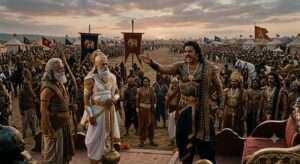
The reference to Abhimanyu is especially meaningful from an Itihasic perspective. He is the son of Arjuna and Subhadra and therefore belongs to two extraordinary lineages: the Pandava warrior tradition and the Yadava family associated with Krishna. His presence on the battlefield symbolizes the transmission of heroic qualities from one generation to another. The sons of Draupadi similarly represent the future of the Pandava house. Thus, Duryodhana is looking not merely at individual combatants but at the living continuation of the dynasty with which he is engaged in conflict.
The deeper logic of the passage lies in the difference between visible strength and actual strength. Numbers are visible and measurable; courage, discipline, conviction, and leadership are less easily measured. A large army may possess numerical superiority while lacking unity of purpose, whereas a smaller force may derive immense power from its commanders and its collective commitment. The Gita’s battlefield setting repeatedly invites the reader to look beyond external appearances and examine the forces operating beneath them.
Duryodhana’s anxiety, therefore, should not be interpreted simply as fear in a narrow personal sense. It is the psychological disturbance of a man standing before the consequences of a decision that has brought an enormous conflict into existence. For years, rivalry, resentment and political calculation have accumulated between the two branches of the Kuru family. At Kurukshetra, those accumulated tensions have become an irreversible physical reality. The sight of the opposing warriors gives concrete form to everything that had previously existed as political argument and personal hostility.
There is also an important contrast between Duryodhana’s perception and the deeper perspective of the Gita. Duryodhana sees the battlefield primarily through the categories of military power, warriors, formations and comparative strength. The Gita gradually leads the reader beyond these external calculations toward questions of duty, righteousness, attachment, self-knowledge and the nature of the Self. Thus, the military conversation at the beginning of the text becomes the threshold through which a much greater spiritual dialogue emerges.
The Pandava army may be smaller in number, but its effectiveness is presented as formidable because it contains warriors whose individual capabilities can alter the balance of battle. This reminds us of a broader principle applicable to human affairs: numerical superiority does not automatically produce decisive strength. A small group united by clarity, discipline and purpose can sometimes accomplish what a much larger group, divided by conflicting motivations, cannot. The ancient battlefield thus becomes a setting for a universal reflection on the difference between quantity and quality.
Duryodhana’s words also demonstrate the power of perception in moments of crisis. The same army may appear different to different observers. To one person, it may appear as a collection of opponents; to another, as a disciplined force; to another, as a gathering of relatives; and to yet another, as an instrument through which destiny is unfolding. The Gita deliberately begins with these differing perspectives because the ultimate teaching concerns the transformation of vision itself.
Consequently, the enumeration of the Maharathas is not an insignificant catalogue of warriors. It is the first indication of the profound psychological and philosophical drama that lies beneath the surface of Kurukshetra. Duryodhana sees the strength of the opposing army and speaks of it before his teacher. In doing so, he inadvertently reveals the very uncertainty that he seeks to conceal. His words acknowledge that the Pandavas, though fewer in number, possess a formidable concentration of courage, skill, lineage and leadership.
The eternal significance of the passage lies in this contrast between external measurement and inner strength. The battlefield asks a question that extends far beyond warfare: What truly makes a person, a group or a cause powerful? Numbers can create an appearance of dominance, but conviction, discipline, courage and righteousness determine the deeper character of strength. The Gita begins its journey toward eternal truth by teaching us to look beyond what the eyes immediately see and to understand the forces that govern action, thought and destiny.

