



China “Dream by 2049″ – Dominant Nation Status
China’s “Dream by 2049,” is achieving dominant nation status, which is officially defined by Beijing as leading the world in “composite national strength and international influence”: Economic, Technology, military, and Social Power. The CCP views the post-WWII, Western-dominated international system as a historical anomaly that must be rebalanced, with China reclaiming its historical position at the centre of global affairs. The year 2049 is highly symbolic as it marks the centenary of the founding of the PRC. The rise of China is inevitable considering the continuation of the monolithic rule by the CCP. The focus is on “Peaceful Rise”. Carefully, China is avoiding wars, but demonstrates military power. Unless the CCP rule is dethroned under unforeseen circumstances, none can prevent/pre-empt China’s rise.
Viewed in the background historical perspective covered in Part 2, it is imperative to review the emerging geopolitical events, particularly China’s foreign policy postures to achieve the long-term strategic end objective of “Dream by 2049 that is achieving dominant status.
China’s Dynamic Shifting Strategies – Rivals to Partners to Competitors or Collaborators
Historically, China has been shifting strategies from “Rivals to Partners to Competitors or Collaborators” depending on situational context and content.
For example, China has been a rival to Russia since the early 16th century, when the Russian Pioneers and Cossacks clashed with the forces of the Qing Dynasty to capture areas beyond the Stanovoy Mountains and to the Amur River basin. Russia is the only country that still controls the territory it acquired from the Qing Dynasty via the unequal treaties: the Treaty of Nerchinsk (1689) and the Treaty of Kyakhta (1727). Teachers in China continue to teach students about the annexation.
That the border disputes/clashes re-erupted in 1965 and continued till 1988. Even in the 21st century, many official CCP websites describe the 1969 Sino-Soviet border conflict as a Soviet aggression against China. Furthermore, Russia and China were rivals during the Second Opium War (1858), Manchu War (1868), and Boxer Rebellion (1899). Also, they were rivals post-split 1963 up to 1972 and during the Sino-Vietnamese war (1979). Only on 3 September 1994, a demarcation agreement was signed, fixing the boundary along a previously disputed 55-km stretch of the western Sino-Russian border. The 2004 Complementary Agreement between the PRC and the Russian Federation on the Eastern Section of the China–Russia Boundary stated that Russia agrees to transfer a part of Abagaitu Islet, all of Yinlong (Tarabarov) Island, about a half of Bolshoy Ussuriysky Island, along with some adjacent islets, to China.
Next, Russia and China collaborated in the First Sino-Japanese War (1894–1895) and were alliance partners to reach Li–Lobanov Treaty (1896). During the Second Sino-Japanese War (1931), Russia supported the CCP. During World War II starting in 1937, Russia partnered with the ROC and CCP. Also, post-World War II (1945-1956), Russia collaborated with the CCP in the Korean War and Vietnam War.
Rivals Post Stalin’s Death – Ideological Grounds
During the Cold War, the Sino-Soviet split was a major geopolitical turning point, transforming a seemingly monolithic communist bloc into a bitter, multi-polar rivalry: an ideological and strategic breakup. By the late 1960s, the former allies had become overt military adversaries. Russia’s aid to India in 1962 followed. By 1969, long-standing territorial disputes erupted into a brief, bloody border war along the Ussuri River, centered on Zhenbao Island. Terrified by the likelihood of Soviet invasion, Mao opened diplomatic channels with Washington, culminating in U.S. President Richard Nixon’s historic visit to China in 1972. Followed the Sino-Vietnam War in 1979 and the Soviet Invasion of Afghanistan (1979).
Sino-Russia Rapprochement – Shift to Comprehensive Strategic Partnership by 2011
The dissolution of the Soviet Union in 1991 fundamentally altered the dynamic, setting off a steady process of rapprochement with diplomatic relations established and the relationship strengthening significantly afterwards. Post 1992, Russia and China were declared as “friendly countries” and “good-neighborly and mutually beneficial”. During the Border Agreements (1994-1997), they claimed “equal and reliable partnership.” Their relations grew stronger during the 2014 Annexation of Crimea. In 2019, the two countries defined their relationship as a “comprehensive strategic partnership of coordination for a new era.”
In 2000, Vladimir Putin succeeded Yeltsin as the President of Russia. In 2001, the two countries joined the Shanghai Cooperation Organization (SCO). A month later, they formalized the strategic relationship with the Treaty of Good-Neighborliness and Friendly Cooperation, a twenty-year strategic, economic, and security treaty. The treaty was later renewed in June 2021 for five more years.
During the 2008 Russo-Georgian war, China opposed Russia’s infringement on Georgia’s sovereignty. Citing principles of sovereignty, territorial integrity, and global order, China used its influence in the SCO to prevent the organization from supporting Russia.
In 2011, during a visit to Russia by Hu Jintao, the two countries agreed to upgrade their relationship to a “comprehensive strategic partnership”. When China attempted to build closer relations with Russia in 2013, the Russian government initially had reservations. China neither denounced nor recognized the Russian annexation of Crimea. However, the United States’ sanctions against Russia for its 2014 annexation of Crimea helped push Russia to a warmer relationship with China.
China backed Russia in the Second Chechen War and regarding Russia’s concerns of NATO expansion, while Russia backed China regarding the issues of Taiwan, Tibet, and Xinjiang. The two countries also increasingly cooperated in the United Nations Security Council.
In May 2015, Xi Jinping visited Russia to attend the Moscow Victory Day Parade; the two countries signed agreements on joint assembly of a long-range passenger aircraft and the construction of a high-speed railway line from Moscow to Kazan. In 2019, during a visit to Russia by Xi, the two countries upgraded their relationship to a “comprehensive strategic partnership of coordination for a new era”.
By 2019, both nations had serious grievances with the United States. For China, the issues were control of the South China Sea, trade policies, and technology policy. For Russia, the main issue was severe economic penalties imposed by the U.S. and Europe to punish its seizure of Crimea from Ukraine.
In February 2022, shortly before Russia invaded Ukraine, the two leaders declared a “no-limits partnership”. Following the Russian invasion of Ukraine, China stated that it respects Ukraine’s sovereignty but Russia’s security concerns about the enlargement of NATO should also be addressed. It abstained from United Nations votes that condemned the invasion. China has also objected to international sanctions against Russia. Xi Jinping assured Vladimir Putin of China’s support on Russian “sovereignty and security” in June 2022. China did not recognize the Russian annexation of Donetsk, Kherson, Luhansk and Zaporizhzhia oblasts in September 2022.
In May 2025, Xi Jinping visited Russia to attend the Moscow Victory Day Parade. Wang Yi stated that China did not want to see Russia’s loss in Ukraine, fearing the United States could focus more on Asia once the conflict in Europe is over. On 16 May 2026, Vladimir Putin visited China to meet Xi Jinping. The visit highlighted the growing Russia-China partnership, with Russia increasingly dependent on Chinese technology and energy, giving Beijing leverage.
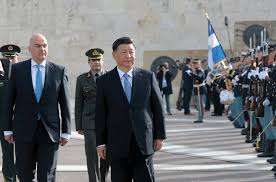
Russia is increasingly becoming dependent on China while it is under large-scale international sanctions. China and Russia have significant economic ties, and Russia is an important source of natural energy and oil for China, while China is a critical source of consumer and industrial goods for Russia. China is by far Russia’s largest trading partner: US$234 billion as of 2025.
Historically, Russia was the dominant partner supplying technology to an agrarian China. Today, the roles have reversed. Heavily sanctioned by Western nations, Russia has become highly dependent on China. By 2026, China has cemented its place as Russia’s largest trading partner, absorbing vast amounts of Russian fossil fuels in exchange for manufactured goods, vehicles, and electronics.
Sino-US Relations Post 1972 – – Confrontation to Conciliation to Cooperation to Collaboration
Richard Nixon made a historic visit to Beijing in 1972, thawing decades of icy silence. Deng Xiaoping established trade relations: “Strategic Engagement”. Between 1972 and 1982, the U.S. and the PRC signed three foundational documents to define their new relationship: 1972 Shanghai Communiqué; the 1979 Communiqué on the Establishment of Diplomatic Relations; and the 1982 Joint Communiqué signed by Ronald Reagan.
With U.S. backing, China joined the World Trade Organization (WTO). On December 11, 2001, China officially became the 143rd member of the WTO. This unleashed an era of hyper-globalization, turning China into the “factory of the world” and the second-largest global economy, tightly bound to U.S. consumers. By the late 2010s, the consensus shifted from economic cooperation to systemic strategic competition. Washington began viewing Beijing’s economic rise, intellectual property practices, and military expansion in the South China Sea as direct challenges to American primacy.
The official start date of the sweeping China-specific tariffs that triggered the modern trade war was July 6, 2018 during the first tenure of Donald Trump, which Beijing answered with retaliatory measures. This expanded into a critical “tech war,” during Trump’s second tenure with Washington placing strict export bans on advanced semiconductors and equipment to throttle China’s domestic cutting-edge tech manufacturing. Following a period of near-triple-digit retaliatory tariff threats, Donald Trump and Xi Jinping established an “eight-point consensus” during a high-stakes Washington state visit in September 2026.
Now, the two superpowers have entered a phase of “managed rivalry.” Recent breakthroughs include a $30 billion reciprocal tariff reduction and a trade truce extension until January 2027 to avoid an outright economic crash. Crucially, the relationship has evolved to address the next frontier of conflict: the U.S.-China Super Intelligence (SI) Dialogue, launched to set safety hotlines and protocols around advanced SI.
Historically, Sino-U.S. relations have been also alternated between “Confrontation, Conciliation and Cooperation or Collaboration” as per situational context and content. Understanding the complexities and fluidity of geopolitical developments due to Xi Jinping’s grandstanding is not easy to identify and define; Shift from the Middle Kingdom to China.
According to the Chinese statements from the recent summit, Xi emphasized: Peaceful Coexistence; “Two-Power” Reality; People-to-People Ties; consensus that Iran must fulfill its commitment not to develop nuclear weapons; and maintaining open international waterways without arbitrary transit tolls. Also, the two sides agreed to launch a formal bilateral dialogue on AI risks and benefits.
Xi Jinping has cautioned Donald Trump to avoid the “Thucydides trap”—the historical tendency toward war when a rising power challenges a dominant one. Xi Jinping explicitly told Donald Trump that “China doesn’t want to replace America,” proposing a framework of “constructive strategic stability” where two great global powers can coexist on equal terms. Donald Trump showed the 1951 Treaty of San Francisco signed between the Allied powers and Japan, which excluded the PRC. Beijing continues to hold that the treaty’s clauses concerning Chinese territorial sovereignty (including Taiwan) are completely invalid.
In retrospect, Xi Jinping policy prescriptions in all fields reflect his strategic leadership potential: “balancing-against-capabilities.” He has staked his claims to ‘global leadership role” through agile and smart diplomatic calisthenics with Chinese finesse: launched the “OROB” initiative, created AIIB and the BRICS New Development Bank, and negotiated the RCEP, as opposed to the USA-sponsored Trans-Pacific Partnership – TPP. Today, Russia depends on China to buy the energy and commodity exports. Even the USA is economically tied to China. In sum, the Asia-Pacific emerged as the center of gravity (CoG) of the global economy and politics.
To sum up, China and Russia share one of the world’s most important foreign relationships. Their relationships have alternated from “Rivalry to Collaboration to strategic partnerships” during various eras in the past. Today, they enjoy close relations militarily, economically, and politically, while supporting each other on various global issues. Russia recognizes Taiwan as an inalienable part of China and opposes Taiwan independence. Russia also supports China’s policies in Hong Kong, Tibet and Xinjiang. The two countries also voiced opposition to AUKUS, expressed concern about U.S. plans to develop missile defense and criticized attempts by “certain states” to “establish global hegemony”.
In turn, China has called for Russia’s security concerns to be accounted for and has opposed the enlargement of NATO, sanctions against Russia and demanded for security guarantees from the West. The two countries cooperate through multilateral organizations and project such as the Shanghai Cooperation Organization, BRICS and the Belt and Road Initiative. And, both nations share interest in energy cooperation, military ties, and geopolitical alignment in challenging the collective West at large, including the United States. Although they have no formal alliance, the two countries do have an informal agreement to coordinate diplomatic and economic moves, and build up an alliance against the United States. China and Russia officially declared their relations “Not allies, but better than allies”.
China and Russia do, however, differ on some policies. China does not recognize Russia’s annexation of Crimea. Russia has officially kept neutral regarding China’s claims in the South China Sea, but has criticized the involvement of “non-regional powers”, indirectly referencing the United States.
The two have released a joint statement which said the relationship between the two countries was “superior to the political and military alliances of the Cold War era” and that both nations shared “no limits” to their commitments.
It is in such a complex and dynamic strategic framework that other nations should do crystal gazing to review likely emerging scenarios that can be conjured, which should form the basis for forging strategic posturing of other key actors, particularly India, Taiwan, Japan and SE Asian nations with the TROIKA. (Part 4 – Conclusion – Future Strategies for India)

