



The Narendra Modi government appears to have finally decided that demographic change cannot remain a subject of political whispers, partisan accusations or selective outrage. The Union Home Ministry’s decision to seek detailed, district-wise and religion-wise information from States and Union Territories is therefore significant—not because it prejudges the outcome, but because a nation of Bharat’s size and complexity cannot afford to make policy in the absence of facts.
The High-Level Committee on Demographic Changes, headed by retired Justice Prakash Prabhakar Navlekar, has been tasked with scientifically examining demographic changes arising from illegal immigration and other abnormal causes. Its mandate includes studying religious and social population patterns, abnormal settlement patterns, cross-border activity and the administrative mechanisms required to identify illegal immigrants.
Its latest exercise reportedly seeks 15 years of time-series data on visible demographic changes in districts, industrial clusters and border areas, including religion-wise birth registrations, delayed registrations, suspected fraudulent registrations, Aadhaar, voter and ration-card enrolment, property transfers, vehicle registrations, religious institutions and educational establishments in tribal areas. States have also been asked to explain how their administrations identify illegal migrants already living in established settlements.
This is precisely the kind of evidence-based exercise that should have begun years ago.
There is nothing inherently communal about asking whether a border district’s population structure has changed sharply, why it has changed and whether the change is attributable to normal demographic processes, economic migration, internal migration, cross-border movement or illegal immigration. The answer must come from evidence—not political convenience.
West Bengal provides an obvious reason for such scrutiny. The 2011 Census recorded Muslims as 66.27% of Murshidabad’s population, 51.27% in Malda and 49.92% in Uttar Dinajpur. These are facts of enumeration, not allegations about illegal immigration. The question the committee now has an opportunity to answer is what has happened subsequently, particularly in sensitive border districts, and what part—if any—of the change can be explained by migration rather than natural demographic factors.
The same intellectual honesty must apply to Kerala. The 2011 Census recorded Muslims at 70.24% of Malappuram, 39.24% of Kozhikode, 37.24% of Kasaragod, 29.43% of Kannur and 28.65% of Wayanad. These figures by themselves do not establish illegal immigration or explain the reasons for demographic change. But they certainly justify examining long-term district-level trends rather than dismissing the subject as politically inconvenient.
And the Northeast cannot be an afterthought.
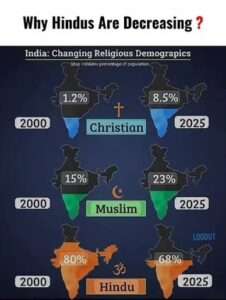
Assam’s 2011 Census recorded Muslim majorities in several districts, including Dhubri, Barpeta, Nagaon, Morigaon, Darrang, Hailakandi and Karimganj; South Salmara’s Muslim share was particularly high. The region’s demographic sensitivities extend beyond religion: tribal land, indigenous communities, border settlements and migration pressures make demographic stability a matter of governance and national security. Official Census datasets themselves provide district-level religious and tribal information for Assam, Tripura, Meghalaya, Arunachal Pradesh and other northeastern States.
The Opposition is perfectly entitled to question the Centre’s motives and methodology. But opposing the collection of facts—or treating every attempt to investigate demographic change as inherently communal—would be equally irresponsible. Equally, the government must ensure that the exercise does not become a licence to stigmatise any religious community or treat ordinary citizens as suspects.
The real test is therefore simple: facts first, politics later.
If the data establish abnormal patterns, the government must act within the Constitution and law. If the data show that particular changes are the consequence of fertility, internal migration, urbanisation or legitimate economic movement, that too must be acknowledged.
For years, demographic change has been discussed more loudly than it has been measured. The Navlekar Committee now has an opportunity to replace rhetoric with evidence.
Better late than never.
But after the evidence is collected, there must be no more excuses—neither from the government nor from those who have spent years denying that the question deserved to be asked.

