



There is a point beyond which journalism stops informing society and starts manufacturing confusion. When a supposedly responsible media organisation sensationalises a sensitive issue involving an independent Constitutional institution, and political parties then seize upon that report to manufacture a narrative against the institution, the consequences can be far more damaging than an ordinary journalistic error. The latest controversy surrounding the Election Commission of India (ECI) and the Special Intensive Revision (SIR) of electoral rolls is a textbook case of why the media needs serious introspection. The Indian Express’s reports on differences within the three-member Election Commission triggered a political storm. Its September 25 investigation reported that the two Election Commissioners had formally raised objections on several occasions concerning electoral-roll management and related systems. The report was followed by demands from Opposition leaders for Chief Election Commissioner Gyanesh Kumar’s resignation and a political campaign questioning the functioning of the Commission. But here is the uncomfortable question: did the newspaper adequately distinguish between internal deliberation, recorded objections and an institutional breakdown? The law itself provides the answer. Section 18 of the Chief Election Commissioner and Other Election Commissioners Act, 2023, says that the Commission’s business should, “as far as possible”, be transacted unanimously. Where the CEC and other Election Commissioners differ, however, the matter is to be decided according to the majority opinion. In other words, disagreement among constitutional functionaries is not, by itself, evidence of institutional illegality or collapse. The Constitution is equally clear. Article 324 vests the “superintendence, direction and control” of electoral rolls and elections in the Election Commission. The CEC is the Chairman when other Election Commissioners are appointed; the Constitution also provides special protection for the CEC’s tenure. That does not make the Election Commission infallible. Nor does it place it above scrutiny. The media has every right—even a duty—to investigate it. Courts too have the power to examine legality and constitutional compliance. But scrutiny is not the same thing as conviction, and disagreement is not synonymous with institutional failure. Indeed, the Supreme Court’s own May 2026 judgment on the Bihar SIR is instructive. The Court upheld the ECI’s power to conduct the revision under Article 324 read with Section 21(3) of the Representation of the People Act and held that the exercise was legally sustainable, while also recognising procedural safeguards and judicially directed corrective measures. There is another constitutional reminder that political street mobilisation cannot casually substitute for established institutions.
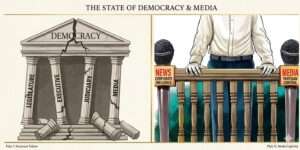
Article 329 places a specific bar on court interference in electoral matters except through constitutionally prescribed mechanisms. The constitutional scheme deliberately distributes responsibilities among the Election Commission, Parliament, courts and the electorate. Yet today, political rhetoric is increasingly suggesting that every institutional disagreement must be converted into a street battle. Yogendra Yadav has himself used the striking formulation that democracy will be decided “by the streets” rather than merely through Parliament and elections. Whatever the political intent behind that statement, it should concern every democrat who believes that constitutional institutions, legislatures and courts—not perpetual street confrontation—must remain the principal mechanisms for resolving disputes. And this is precisely where irresponsible journalism becomes dangerous. A headline, an investigative narrative or a selectively presented document can reach millions within hours. An Opposition politician can then convert it into a political weapon. Social media amplifies it. Public discourse gets polarised. And before the facts are properly examined, a Constitutional institution stands accused in the court of public opinion. The September 26 ECI clarification that all SIR orders had the unanimous approval of all three Commissioners was therefore significant. It did not magically erase every question raised by the Indian Express reports. But it certainly demonstrated why complex institutional processes should not be reduced to a simplistic narrative of one individual overriding the entire Commission. Rahul Gandhi and other Opposition leaders are perfectly entitled to question the ECI. They are equally entitled to seek judicial scrutiny. But demanding the resignation of the CEC on the strength of media reports before the underlying facts and legal position are conclusively established is another matter altogether. The greater lesson is for journalism. If the media gets it wrong, it does not merely get a story wrong. It can get society wrong. A free press has enormous power. That power demands greater verification, greater context and greater restraint—not less. Investigative journalism must expose wrongdoing where evidence establishes it. It must not manufacture wrongdoing by presenting institutional disagreement as institutional collapse. Bharat’s democracy is too large, its electorate too vast and its Constitutional architecture too consequential to become hostage to sensational headlines and politically convenient interpretations. The Indian Express and every other media organisation covering the Election Commission therefore owe the nation something more valuable than another dramatic headline: introspection. Because when journalism becomes the raw material for political misinformation, the damage is no longer confined to a newspaper page. It reaches the credibility of institutions, the confidence of citizens and, ultimately, democracy itself. Media must question power. Absolutely. But it must never manufacture facts to question power.

