



The Dhaneshwar Mahadev and Lokeshwar Mahadev Temple is a sacred Shiva temple located at Rampura (Mangrol) in Narmada district of Gujarat, on the southern bank of the Narmada River. Situated on the Narmada Parikrama route, the temple is unique for housing the Shiva Lingas of Dhaneshwar Mahadev and Lokeshwar Mahadev under the same roof. The sacred surroundings also contain other ancient Shiva shrines associated with the local Tirtha tradition.
According to the traditional account associated with this Tirtha, the Shiva Lingas here are believed to have been established in the Treta Yuga. The exact historical date of construction of the present temple is not documented, so its antiquity is based on the traditional religious history of the sacred site.
The principal deities are Dhaneshwar Mahadev and Lokeshwar Mahadev. The two Shiva Lingas face each other within the same temple. Lokeshwar Mahadev is traditionally considered the older of the two, while Dhaneshwar Mahadev is the larger Linga and is adorned with a mukhavata. Nandi idols are placed before the Shiva Lingas. The temple complex also has shrines of Kamandaleshwar Mahadev and Jateshwar Mahadev, along with deities including Ganesha and Hanuman.
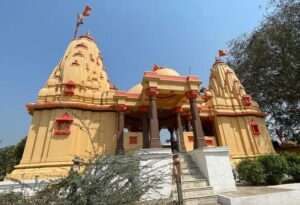
The temple is built of stone and has two main shikharas with smaller subsidiary spires. A common half-mandapa connects the two shrines. The walls are decorated with figures of various deities, while the mandapa has a domed ceiling. The stone construction and traditional design are characteristic of the religious architecture associated with the Narmada pilgrimage region.
The temple is located about 15 km from Nandod and forms an important halt for devotees undertaking the Narmada Parikrama. Its religious traditions are associated with the Narmada Purana and the sacred traditions of the Narmada region.
An ashram connected with Dhaneshwar Mahadev was established here around 1930. In 1943, Jayramdasji Maharaj, popularly known as Tapasvi Baba, came to this place after learning about the Narmada Parikrama tradition through the Narmada Purana. The ashram subsequently became associated with serving Narmada Parikrama pilgrims and with cow protection.
The traditional Sthalapurana of Lokeshwar Mahadev is connected with the story of Bhasmasur. After receiving a boon from Lord Shiva, Bhasmasur became arrogant and attempted to use the boon against Shiva himself. Lord Shiva fled and came to this region on the banks of the Narmada. The place where Shiva is believed to have taken refuge came to be revered as Lokeshwar Mahadev.
Lord Vishnu then appeared in the form of Mohini and made Bhasmasur imitate her dance. When Mohini placed her hand upon her own head, Bhasmasur followed her and placed his hand on his head, causing him to be destroyed by his own boon.
Dhaneshwar Mahadev is traditionally associated with Kubera. After Ravana took possession of his golden Lanka, Kubera is believed to have come to this sacred region and performed penance to Lord Shiva. During his penance, he established a Shiva Linga to the north of Lokeshwar Mahadev, which became known as Dhaneshwar Mahadev.
The nearby Kamandaleshwar and Jateshwar Mahadev shrines are also connected by local tradition with this episode. It is believed that Shiva’s kamandalu fell at one place and drops of his perspiration fell at another, giving rise to these sacred Shiva shrines.
Thus, the Dhaneshwar–Lokeshwar temple complex is revered as a sacred Shiva Tirtha on the banks of the Narmada and continues to be an important halt for pilgrims performing the Narmada Parikrama.
Mahashivaratri, the month of Shravan, and the Mondays of Shravan are important occasions for worship. Devotees perform abhishekam and offer prayers to Dhaneshwar and Lokeshwar Mahadev. Chaitra Shukla Trayodashi is also observed as an auspicious day at the Tirtha. Narmada Parikrama pilgrims visit the temple throughout the year to take darshan and seek the blessings of Lord Shiva.


