MS Shanker
The Congress and its political allies may not like it, but they can no longer conveniently dismiss the RSS as a communal organisation without confronting a rather uncomfortable question: what exactly does its chief, Mohan Bhagwat, mean when he unequivocally says that a Hindu who believes Muslims should not live in Bharat is not a Hindu?
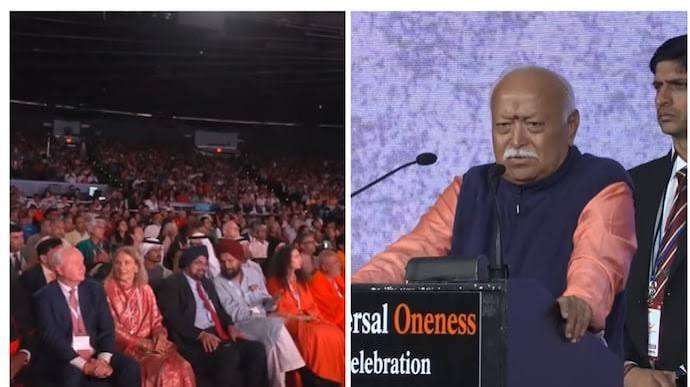
Bhagwat’s remarks at Madison Square in New York deserve to be examined in their entirety rather than selectively interpreted. His message was unmistakable: Muslims are an integral part of Bharat and any Hindu who advocates their exclusion cannot claim to represent the essence of Hinduism.
That is hardly the language of a man advocating the expulsion of a minority community.
For decades, the Congress and several parties in the Opposition ecosystem have portrayed the RSS as a Hindu majoritarian or even militant organisation, often making it the convenient villain in every debate concerning communal relations. But if the Congress genuinely believes in secularism and inter-faith harmony, it should have the intellectual honesty to acknowledge statements that do not fit its established political narrative.
The RSS may have an ideological worldview that the Congress disagrees with. It may advocate cultural nationalism rooted in the civilisational identity of Bharat. Its critics are perfectly entitled to challenge those ideas. But branding the entire organisation as inherently anti-Muslim, without distinguishing between ideology, political disagreement and criminal conduct, is neither serious political discourse nor a constructive approach to national integration.
In my view, Bhagwat’s latest message provides an opportunity to move the debate away from political labelling and towards a more fundamental question: what kind of relationship should the majority and minority communities have in a democratic Bharat?
The answer should be simple—equal citizenship, mutual respect and adherence to the Constitution.
The historical trauma of Partition cannot, of course, be wished away. Bharat was divided in 1947 based on the two-nation theory, resulting in one of the most tragic episodes in the subcontinent’s history. Millions were displaced and countless lives were lost. But those Muslims who chose to remain in Bharat made their decision to live in a democratic country as equal citizens. Their descendants cannot and should not be made to carry a collective burden for the politics of the past.
Equally, the Hindu majority cannot be expected to apologise endlessly for being the majority or to accept the proposition that raising legitimate questions concerning national integration, common laws or social reform is itself communalism.
This is where the debate over a Uniform Civil Code assumes significance. A modern constitutional democracy must eventually ask whether citizens should be governed by different personal laws solely because they belong to different religious communities. Supporting a common civil framework need not amount to hostility towards any faith. It can equally be argued as an attempt to establish equality before the law.
The same principle must apply to every community. Muslims, Hindus, Christians, Sikhs and every other citizen have the same constitutional rights—and the same constitutional responsibilities.
That is also why political parties must stop treating minority communities merely as electoral vote banks. The Congress ruled Bharat for decades and, whatever its welfare record, its politics often encouraged the perception that minority identity could be converted into a permanent electoral constituency. The BJP, too, must be judged on whether its governance actually delivers equal opportunity and dignity to citizens irrespective of religion.
The Narendra Modi government has repeatedly maintained that welfare schemes are meant for all beneficiaries without religious discrimination. The correct test is not political rhetoric from either side but measurable outcomes: who received housing, sanitation, electricity, bank accounts, healthcare, food security, loans and other benefits? If a poor Muslim family received the benefit, it should be counted as a success of inclusive governance—not dismissed merely because the government implementing it happens to be led by the BJP.

This is precisely why the Congress and its allies should reconsider their habitual demonisation of the RSS.
If Bhagwat says that a Hindu who wants Muslims excluded from Bharat is not a Hindu, political opponents should engage with that statement honestly. They may question the RSS on other ideological grounds, but repeatedly describing it as a monster while ignoring such explicit statements only weakens their own credibility.
At the same time, Muslims too must recognise that peaceful coexistence is a two-way street. No community should demand special political treatment merely because of its religious identity. Nor should any community be subjected to suspicion merely because it belongs to a particular faith.
Sanatan thought has long carried the philosophical idea of Vasudhaiva Kutumbakam—the world as one family. Whatever political interpretations may surround Hindu nationalism today, that civilisational principle provides a powerful basis for coexistence rather than confrontation.
Therefore, the Congress, Communists and regional parties that routinely invoke the RSS as a political bogeyman should ask themselves a simple question: are they genuinely fighting communalism, or merely preserving a political narrative that has served their electoral interests?
And the RSS, for its part, should continue to make its position on equal citizenship, constitutionalism and peaceful coexistence unmistakably clear.
The time has come to judge every organisation and every political party by its words, actions and commitment to constitutional democracy—not by inherited labels.
If Bhagwat’s message is indeed that every community belongs to Bharat and that Hinduism does not demand the exclusion of Muslims, then the Congress and its allies should have the courage to acknowledge it.
Political disagreement is legitimate. Demonisation is not.
And perhaps the most important message from Madison Square is this: Bharat cannot build lasting peace by constantly reopening the Hindu-Muslim divide. It can do so only when every citizen—majority or minority—accepts that the country belongs equally to all, while the Constitution remains supreme.