An Aggrieved Parent
The announcement of Hyderabad’s Ranji Trophy squad, with Mohammed Siraj taking over the captaincy, has inevitably brought one notable omission into focus — Shaunak Kulkarni.
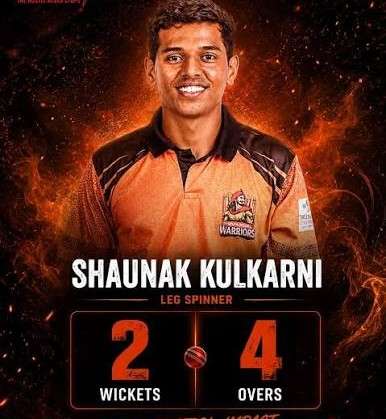
Shaunak is not a name that has suddenly appeared on the Hyderabad cricket radar. He has progressed through the local cricket structure, performed consistently in the leagues and Super League, and has gradually established himself as a genuine wicket-taking wrist-spinner.
His reported 18-wicket haul in the Super League, which made him the competition’s highest wicket-taker, is particularly significant. If the Super League is intended to provide a competitive platform for players to demonstrate their credentials and stake a claim for higher honours, such a performance would naturally merit serious consideration from the selection committee.
This is not to suggest that taking 18 wickets automatically guarantees a place in the Ranji Trophy squad, much less the playing XI. Selection at that level involves several considerations — team balance, conditions, opposition, experience, tactical requirements and, importantly, the selectors’ assessment of a player’s readiness for first-class cricket.
But that is precisely why Shaunak’s case deserves examination.
A young wrist-spinner who consistently takes wickets offers a different proposition from a bowler whose primary role is simply to contain runs. Wrist-spin, particularly in the longer format, can provide a captain with a genuine wicket-taking option when partnerships need to be broken and established batters dismissed.
Shaunak is also part of the Warangal Warriors squad in TG20, giving him exposure to another competitive platform and an opportunity to develop his skills in a different environment.

The larger issue, therefore, is not whether Shaunak was entitled to selection. It is whether Hyderabad’s selection pathway is adequately recognising performances produced within its own competitions.
The HCA has spoken about transparency, accountability and merit-based selection. Ambati Rayudu, after taking charge as Head of Cricket Operations, has also spoken about fair selection and professionalising the cricketing system.
That makes Shaunak’s case a legitimate cricketing question rather than merely a parental grievance.
If a player emerges as the leading wicket-taker in an HCA competition, what happens next? Is his performance systematically reviewed? Is he tracked over a period of time? Does he receive feedback from selectors? Is there a clearly defined pathway from league cricket to the Super League, from there to the senior squad and eventually to Ranji Trophy cricket?
These are important questions because the objective of a domestic cricket structure cannot merely be to conduct competitions. It must also be to identify, develop and reward talent.
One player’s omission may have perfectly valid cricketing reasons. The selectors may have a different assessment of his present readiness, or may have opted for a particular combination of bowlers. Those are legitimate considerations.
But when a young player produces numbers as striking as 18 wickets in the very competition through which talent is expected to emerge, the selection machinery should be able to explain where that player stands in the larger pathway.
Otherwise, a performance can become merely a statistic on a scorecard.
That is where the HCA needs to look beyond Shaunak Kulkarni himself.
Hyderabad has no shortage of talented young cricketers. The real challenge is to ensure that talent does not get lost between one level and another, and that performances are consistently converted into opportunities.
If performance matters, performance must matter in selection too.
Shaunak Kulkarni may or may not be ready for Ranji Trophy cricket today. That is for the selectors to determine.
But a young wrist-spinner who has emerged as the highest wicket-taker in the Super League certainly deserves to know where he stands in Hyderabad’s cricketing pathway.
And that leaves HCA with a larger question — one that goes beyond a single player:
Are we identifying tomorrow’s match-winners, or simply continuing with yesterday’s names?