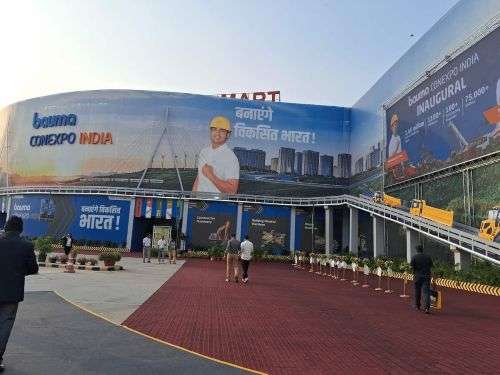
By the afternoon of 18 September, the fourth and final day of bauma CONEXPO INDIA 2026, the opening-day urgency at the India Expo Centre in Greater Noida had given way to something more revealing. Machines were still being photographed, demonstrated and inspected, executives were deep in conversation and buyers were making final rounds, but the exhibition-floor theatre was increasingly giving way to business conversations.
Across roughly 1.45 million sq ft, with more than 1,100 exhibitors participating in the eighth edition of the international trade fair for construction machinery, building material machines, mining machines and construction vehicles, the scale was substantial. Yet size was not the most interesting feature. The more important story was the range of questions being asked around the machines.
India is increasingly demanding equipment that works harder, is easier to support, incorporates technology sensibly and can, where possible, be manufactured or engineered here for markets beyond India. The old naivete that India would remain primarily a market for selling more machines is becoming increasingly difficult to sustain.
This is where market maturity becomes relevant, not as a slogan but as a change in behaviour. The Indian customer is asking more questions, comparing more alternatives and increasingly looking at the machine as part of a larger business proposition.
Bigger Machines
The traditional Indian CE narrative was relatively straightforward: infrastructure spending creates demand, mechanisation follows and manufacturers sell more machines. bauma CONEXPO INDIA 2026 suggested a more complicated next phase, with contractors and project owners looking for higher productivity, greater application relevance and increasingly specialised equipment.
There was plenty of oomph on the exhibition grounds, but horsepower alone was no longer the whole conversation.
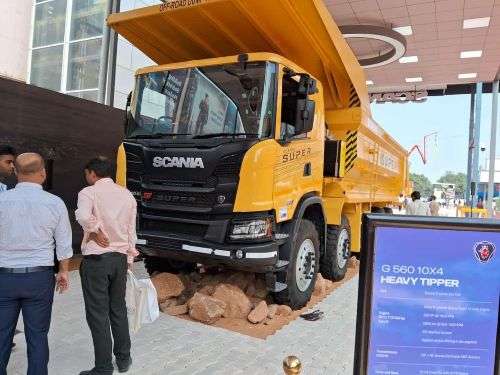
JCB’s large India-focused display and new India-made machines reinforced India’s evolution from a sales market into an engineering and manufacturing base. Volvo CE pushed into the higher-capacity segment with the 65-tonne EC650 excavator for mining and mass excavation, while Caterpillar displayed the Cat 355 excavator, D5 dozer and 120 GC motor grader.
The significance was not simply the size of the machines. It was the range of increasingly demanding applications that Indian contractors and fleet owners are now prepared to consider.
Indian Depth
Tata Hitachi and HD Hyundai Construction Equipment India illustrated another dimension of this transition. Tata Hitachi sits at the intersection of Indian manufacturing, global technology and local application knowledge, while HD Hyundai’s excavators and wheel loaders reflected the increasing emphasis on productivity, fuel efficiency, connectivity and application-specific solutions.
The distinction between “Indian” and “international” equipment companies is becoming less useful. Global companies are localising while Indian companies are globalising, with manufacturing, engineering, sourcing and exports increasingly overlapping.
A little chutzpah helps in such a market, but the harder currency remains engineering depth, product reliability and execution.
The Indian customer is increasingly exposed to global technology, while global manufacturers are increasingly exposed to Indian operating conditions. India is therefore becoming part of the process through which products are adapted, engineered, manufactured and exported.
Road Logic
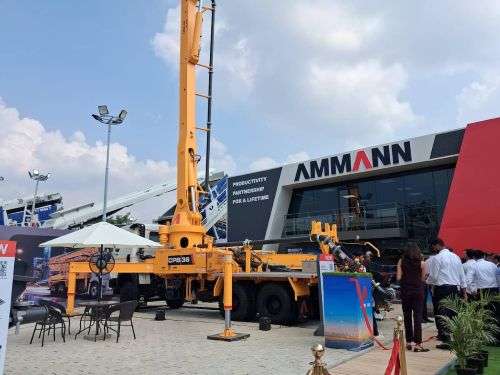
Wirtgen and Ammann India illustrated the movement from individual machines towards broader road-construction processes. Wirtgen’s technologies span milling, recycling, stabilisation, paving, compaction, crushing and screening, while Ammann covers asphalt production, paving and compaction.
India’s road-building challenge is no longer simply about adding kilometres. Pavement quality, recycling, material efficiency, plant utilisation and lifecycle performance are becoming increasingly important. The exhibition consequently offered considerably more substance than the occasional braggadocio of a giant machine beneath a giant corporate logo.
The direction of travel is towards technologies that address the complete construction process rather than a single machine within it.
Lifting Ambition
Action Construction Equipment represented the expanding Indian capability in cranes and material handling, segments that sit somewhat outside the traditional excavator-heavy definition of construction equipment.
Infrastructure requires lifting, access and specialised material-handling solutions, and Indian manufacturers in these areas are increasingly being tested against global competition. The question is moving beyond whether Indian companies can build equipment for India towards whether they can develop products capable of competing internationally on technology, reliability, price and support.
A domestic market provides scale. International markets provide a harder test of consistency, certification, engineering, service capability and brand credibility.
Concrete Chain
Putzmeister Equipment India and Schwing Stetter India represented another critical link in the infrastructure chain: concrete.
Their presence also provided a useful window into how international technology and Indian industrial development have interacted over several decades. Schwing Stetter, in particular, represents the evolution of German engineering adapted to Indian conditions through local manufacturing, application knowledge and customer relationships. Putzmeister provides another important reference point in the same ecosystem.
The significance goes beyond the machines displayed at Greater Noida. Roads, bridges, metros, tunnels, airports, industrial plants and high-rise structures all depend upon concrete being produced, transported, pumped and placed with increasing consistency and efficiency.
A technology demonstrator can attract attention on a stand. The serious buyer ultimately wants to know what happens when that technology reaches a construction site at 2 a.m.
Heavy Engineering
Liebherr India showcased German engineering across earthmoving, material handling, cranes and components, while Herrenknecht India brought specialised German tunnelling technology to an infrastructure market increasingly shaped by metros, rail, water and other underground projects. Schwing Stetter and Putzmeister, both with German engineering heritage and long-established Indian operations, added another dimension.
This is where “GermanIndianeering”, an expression I have coined, becomes relevant. It describes the meeting of German engineering heritage with Indian scale, operating conditions, manufacturing capability and market realities. Schwing Stetter, Putzmeister, Liebherr and Herrenknecht offer four distinct examples of that interaction.
The international dimension was equally evident. European, Nordic, Japanese, American, Chinese and Indian companies brought different technologies, manufacturing approaches and market strategies to the same exhibition floor.
Chinese Equation
The Chinese presence added another important dimension. SANY and SDLG presented broad equipment portfolios covering diverse applications, including electric solutions, reinforcing the widening Chinese participation in India’s construction-equipment market.
SANY’s display ranged across excavation, deep foundation, road construction, mining, ports, aerial work platforms, material handling and heavy transportation. SDLG’s independent presence marked another phase of its Indian operations.
For European, American, Japanese and Indian manufacturers, this represents a competitive reality. India is simultaneously a major growth market and an arena in which Chinese engineering will be tested against established global players.
Price is only one variable. Technology, localisation, productivity, finance, service and residual value increasingly form part of the equation.
Electric Reality
Electrification was visible throughout the exhibition, but diesel had certainly not been sent into retirement.
India remains practical about equipment deployment. Machines work long hours, often where charging infrastructure is uncertain, and availability remains critical to project execution. SANY’s electric machines demonstrated the direction of travel, while Terex Finlay’s Elektro hybrid crushing equipment offered a more flexible approach, operating from mains electricity where available or from an onboard diesel generator when necessary.
India’s transition is therefore likely to involve power solutions matched to actual jobsites rather than a simple contest between diesel and electric systems.
Different applications, locations and duty cycles will demand different answers.
Local Ecosystem
Perhaps the most consequential development was localisation.
JCB’s export manufacturing, Tata Hitachi’s Indian industrial base, HD Hyundai’s manufacturing and export network, Wirtgen and Ammann’s local operations, Caterpillar’s Indian footprint and the activities of Liebherr, Putzmeister and Herrenknecht all pointed towards different versions of the same industrial shift. ACE demonstrated the growing ambition of Indian equipment manufacturers within that landscape.
Beneath the OEMs lies an even larger ecosystem of component suppliers, tyre manufacturers, hydraulic specialists, bearing companies, attachment suppliers and technology providers.
A machine assembled in India does not by itself create an industrial ecosystem. That requires engineering, component, service and supplier depth capable of supporting the machine through its operating life and, increasingly, enabling exports.
This is where the broader India Growth Story becomes industrially meaningful: not as a slogan, but as capability developing beneath the headline numbers.
Buyer Logic
The buyer conversation is changing with it. Serious customers are increasingly looking beyond catalogue specifications towards service response, parts availability, financing, residual value and the practical consequences of deploying equipment across demanding Indian conditions.
The contractor is becoming a more sophisticated procurement professional. Brand recognition, horsepower and a long specification sheet remain relevant, but they are increasingly only part of the decision.
The exhibition floor is beginning to resemble a boardroom with machines parked outside it.
Customers want to understand how a machine fits into the economics of construction, mining, roads, tunnelling or materials handling. Manufacturers, in turn, are being pushed towards a more detailed understanding of the customer’s operation.
Exhibition Value
The physical trade fair continues to matter because industrial purchasing ultimately depends upon confidence in the machine, the people behind it and the support structure that remains after purchase.
Almost every specification can now be found online. What digital platforms cannot easily reproduce is the ability to stand beside competing machines, inspect components, question engineers, compare technologies and judge the seriousness of the people representing them.
That is why the exhibition remained commercially relevant even as the four-day programme moved from launches and announcements towards increasingly detailed buyer discussions.
By the final day, many conversations had moved beyond presentation towards whether a discussion could become a customer, partnership, order, localisation programme or technology opportunity.
Messe Difference
Another part of the exhibition deserved attention: the platform itself.
Messe München’s experience in building major international industrial exhibitions was evident in the organisation and scale of the event. The machinery displays, visitor movement, conference programme, media engagement and exhibitor services required extensive coordination.
Bhupinder Singh, President IMEA of Messe München and CEO of Messe Muenchen India, together with his team and wider network of associates, has helped give the Indian edition an increasingly international character while retaining a strong connection with the Indian market.
The contribution is not merely about halls and stand space. It is about creating an environment in which manufacturers, component suppliers, contractors, technology companies, associations, international delegations and media can meet with a degree of order and purpose.
For an exhibition of this scale, that operational discipline is itself part of the product.
Contrarian Test
So what did bauma CONEXPO INDIA 2026 actually reveal?
Not simply that India wants more construction equipment. That has been evident for years.
The more significant development is that the Indian CE industry is entering a phase in which productivity, localisation, engineering capability, technology, export potential and aftermarket support are becoming increasingly interconnected.
The questions around the machines were therefore more precise: How dependable is the equipment? Where are the parts? How quickly can it be repaired? Can it be financed? Can it be electrified? Can it be manufactured here? Can the Indian factory serve markets outside India?
Those are increasingly boardroom questions rather than exhibition-floor questions.
Manufacturers are no longer addressing an Indian market simply waiting to be supplied. They are dealing with customers who understand technology, compare alternatives, evaluate support structures and expect manufacturers to understand their businesses.
After The Show
The real test will come through what follows the exhibition.
Leads, launches and visibility are useful, but they do not themselves create machine utilisation, contractor cash flow or project execution. What matters now will be purchase orders, localisation agreements, technology partnerships, export programmes, financing deals, dealer appointments and machines actually working on Indian projects.
The exhibition’s longer-term value will therefore emerge through commercial and industrial outcomes rather than the temporary spectacle of the show floor.
Did the buyer find a machine that solves a problem? Did the manufacturer find a customer or technology partner? Did an Indian supplier secure a new opportunity? Did an international company see a reason to deepen its Indian presence?
These are the questions that will give the 2026 edition its longer-term significance.
Analyst’s View
Having followed India’s construction-equipment sector and its major exhibitions over many years, my reading of bauma CONEXPO INDIA 2026 is that this was a useful snapshot of an industry becoming broader in capability and more demanding in expectation.
The equipment universe stretched from mainstream excavators, backhoe loaders and wheel loaders to mining equipment, cranes, road-building systems, concrete technology, tunnelling equipment, components, digital systems and electric or hybrid solutions.
JCB, Volvo CE, Caterpillar, Wirtgen, Ammann, HD Hyundai, ACE, Schwing Stetter, Putzmeister, Tata Hitachi, Liebherr and Herrenknecht demonstrated different ways in which India is being treated as a market, manufacturing base, engineering location, export platform and testing ground for technologies adapted to demanding local conditions.
SANY, SDLG and Terex Finlay added another dimension to the competitive and technological landscape.
Taken together, these companies showed that the Indian CE industry can no longer be understood through one simple narrative. It is simultaneously an infrastructure story, a manufacturing story, an engineering story, an export story and increasingly a technology story.
For me, the real achievement was the concentration of competing ideas about productivity, localisation, technology and global competitiveness in one place, allowing buyers to examine those propositions against actual machines and actual people.
The oomph was obvious. The industrial depth underneath it was more significant.
Future Message
Future editions need not become bigger merely for the sake of becoming bigger. They need to become more demonstrably useful.
The next level could place greater emphasis on demonstrating what happens when technology meets the Indian jobsite: productivity, localisation, export capability, digital integration, energy transition, aftermarket support and the ability to solve increasingly complex infrastructure requirements.
There is also an opportunity for the platform itself to evolve with India.
The present identity, bauma CONEXPO INDIA, reflects the coming together of Messe München’s bauma platform and AEM’s CONEXPO-CON/AGG heritage. But as India’s construction-equipment industry develops a stronger manufacturing, engineering and global footprint, the question of whether the platform should eventually acquire an even more distinctive Indian identity becomes worth considering.
A future “bauma India” could represent something more ambitious than a larger exhibition. It could become a concentrated showcase of India’s industrial capability, combining Messe München’s international exhibition discipline with India’s OEMs, component ecosystem, engineering centres, manufacturing plants, technology companies and export ambitions.
That is where the India Growth Story becomes more than a convenient phrase.
India is no longer merely building more roads, bridges, metros, ports, tunnels, housing and industrial infrastructure. It is gradually building the industrial capability required to build them with greater technological depth and, increasingly, with equipment engineered, manufactured, supported and exported from India.
A country that merely buys equipment participates in the construction economy. A country that manufactures equipment participates in the industrial economy. A country that develops the engineering, component, software, service and manufacturing capabilities to design, build and export that equipment begins to influence the global equipment economy.
That is the larger story emerging around India’s construction-equipment industry.
And that may ultimately be the most interesting message from bauma CONEXPO INDIA 2026: India is not simply asking what machine it should buy next. It is increasingly asking what kind of industrial capability it wants to build around that machine.